Last Updated: October 26, 2026
Last Updated: October 26, 2026





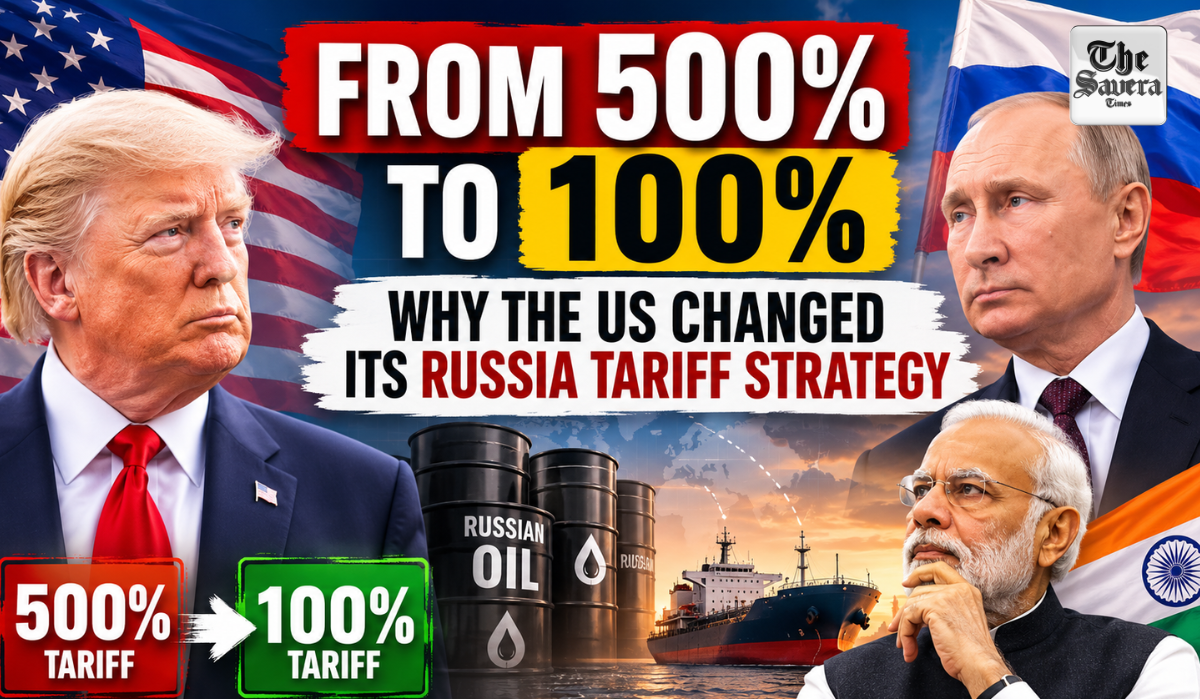
For months, one proposal in the US Senate had the potential to reshape global trade and energy markets. It threatened a massive 500% tariff on countries that continued buying Russian oil and gas. That proposal has now been revised. The maximum tariff has been reduced to 100%. While the bill is yet to become law, the change is significant, especially for countries like India and China that continue importing large volumes of Russian crude.
What Has Changed?
The revised bipartisan bill in the US Senate aims to increase economic pressure on Russia over the Ukraine war. Earlier, lawmakers proposed a blanket tariff of up to 500% on imports from countries buying Russian energy. The new version lowers that maximum to 100%.
The bill also proposes sanctions on Russian banks, officials, energy projects such as Yamal LNG and Arctic LNG, and Russia’s so-called shadow fleet of oil tankers. It also allows the US President to temporarily waive sanctions if doing so is considered in America’s national interest.
Why Is India Being Mentioned?
Since the Ukraine war began in February 2022, Western countries reduced purchases of Russian oil. Russia then started offering crude at discounted prices, and India sharply increased imports.
Before the war, Russia supplied only a small share of India’s crude oil. Today, it has become one of India’s biggest oil suppliers. India has consistently maintained that it buys oil based on affordability and national energy needs, not geopolitical pressure.
Because of these purchases, India is among the countries covered by the proposed legislation.
Why Did the US Reduce the Tariff?
A 500% tariff was considered extremely difficult to implement because it could severely disrupt global trade and strain relations with important partners, including India.
Reducing the proposed tariff to 100% still keeps pressure on countries buying Russian energy while giving the US administration greater flexibility. The revised bill also includes exemptions for some countries that are reducing their dependence on Russian gas.
How Does Iran Fit Into This Story?
This development comes at a time when the Middle East is witnessing renewed military tensions.
In recent weeks, the United States has carried out strikes on Iranian military targets after accusing Iran of attacks on commercial shipping in the region. Iran has denied targeting civilian shipping.
At the same time, Washington has resumed a naval blockade around Iranian ports and warned that it could launch further strikes if required. These developments have increased uncertainty across global energy markets.
Why Is the Strait of Hormuz So Important?
Much of the concern revolves around the Strait of Hormuz, one of the world’s most important maritime routes.
Located between Iran and Oman, the narrow waterway connects the Persian Gulf with the Arabian Sea. Around one-fifth of the world’s traded oil passes through this route every day.
Major oil producers including Saudi Arabia, Iraq, Kuwait, the UAE and Qatar depend on this passage to export energy. India, China, Japan and several European countries also receive a significant portion of their imported crude through this route.
Any disruption in the Strait of Hormuz can immediately push up global oil prices, increase shipping costs and affect inflation worldwide.
The Bigger Global Picture
The Russia-Ukraine war has already changed global energy flows. Now, tensions involving Iran and the Strait of Hormuz have added another layer of uncertainty.
If Russian oil becomes harder to buy because of new US sanctions, while Middle East supplies also face disruption, countries like India could face higher import costs. That would affect fuel prices, transportation costs and overall inflation.
For this reason, India continues to diversify its energy sources while maintaining that its oil purchases are guided by national interest and energy security.
What Happens Next?
The revised Russia sanctions bill still needs approval in the US Congress before becoming law. Even if passed, its implementation will depend on decisions by the US administration.
For now, the reduction of the proposed tariff from 500% to 100% signals a more calibrated American approach. But with the Ukraine war continuing, US-Iran tensions rising, and the Strait of Hormuz remaining strategically sensitive, global energy markets are likely to remain under pressure. For India, securing stable and affordable energy supplies will continue to be one of its biggest economic priorities.
It is quite intriguing that 'Free Kashmir' posters and slogans keep appearing on university campuses and at political...

Water storage in India's 178 major reservoirs fell by nearly 3.5 billion cubic metres in seven days, with...

For generations, India’s lighthouses were places people saw from a distance. Standing at the edge of the sea,...

Leader of the Opposition in the Lok Sabha, Rahul Gandhi, will visit Punjab's Sangrur district on November 4....

Good Evening Viewers! Stay updated with The Savera Times Evening Bulletin, bringing you the latest news and top...

The weather system forming in the Bay of Bengal is steadily strengthening. In view of this, Cyclone Warning...

Aries: The day will be auspicious...