Last Updated: October 12, 2026
Last Updated: October 12, 2026





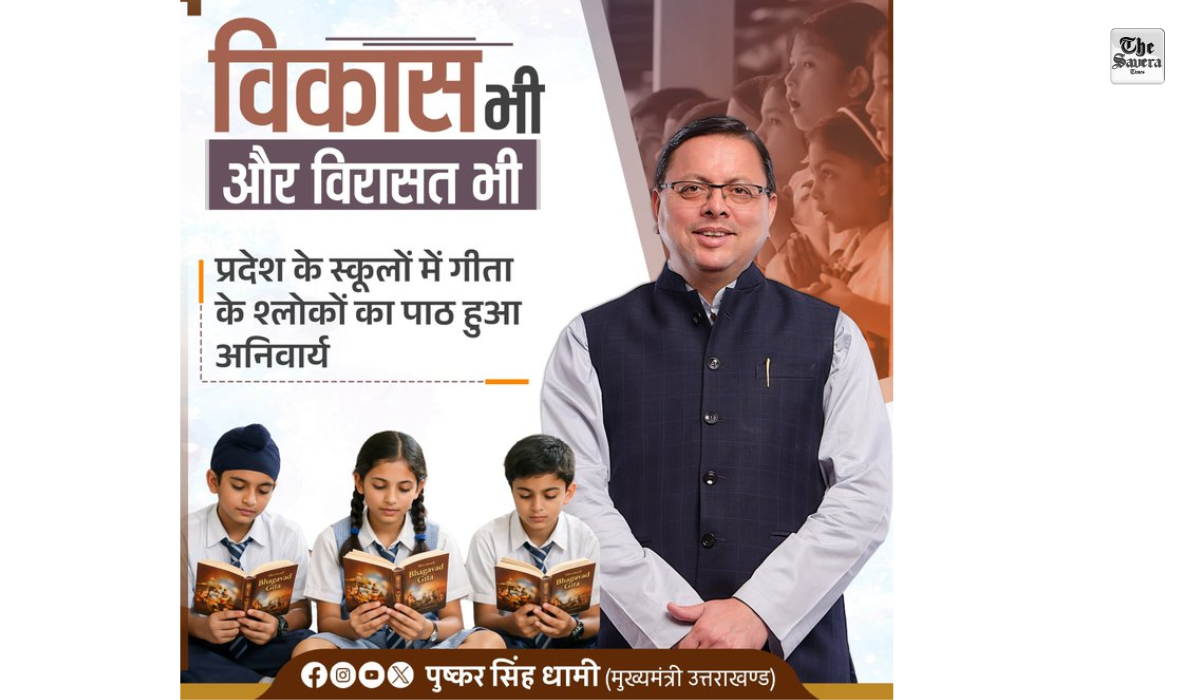
Uttarakhand: Chief Minister Pushkar Singh Dhami announced on Sunday that reciting verses from the Bhagavad Gita will now be mandatory in all schools in the state.
Under this directive, students will be required to recite a verse, along with its meaning, during the morning prayer assembly to promote moral development and cultural engagement. Chief Minister Dhami stated that the initiative aims to connect the younger generation with Indian values and promote holistic education.
While the government is touting this as a step towards character building, the decision has also sparked debate about the secular nature of public education. The announcement was made during a cultural event, where the Chief Minister also highlighted the architectural grandeur of the Katarmal Sun Temple.
हमारी सरकार द्वारा प्रदेश के स्कूलों में गीता के श्लोकों के पाठ को अनिवार्य किया गया है। यह पहल विद्यार्थियों को भारतीय संस्कृति, नैतिक मूल्यों और जीवन-दर्शन से जोड़ते हुए उनके सर्वांगीण विकास का मार्ग प्रशस्त कर रही है। pic.twitter.com/RbL7UE3E5w
— Pushkar Singh Dhami (@pushkardhami) December 21, 2025
Shrimad Bhagavad Gita Reciting Initiative
This decision to incorporate verses from the Bhagavad Gita into students’ daily routines is part of the Uttarakhand government’s broader approach to align education with traditional Indian values.
Implementation Guidelines and Educational Objectives
The Education Department has been instructed to develop a well-organized recitation program that does not disrupt regular academic activities. Each week, a verse will be selected and its philosophical meaning will be explained to students so that they can understand the life values inherent in it.
Officials stated that special attention will be paid to the psychological benefits of the Gita—such as stress management, a sense of duty, and mental strength. A senior education official said, “This is not just religious education, but an effort to provide moral direction to students.”
This order will be implemented in all government and government-aided schools in Uttarakhand from the next academic session.
Different Reactions and Social Perspectives
The announcement has elicited mixed reactions from the political and social spheres of Uttarakhand. Supporters argue that the Gita is a universal moral guide and that its inclusion will improve discipline among students and reduce behavioral problems.
Meanwhile, some critics and education activists have questioned whether such orders respect the country’s religious diversity. They believe that moral education should include various philosophies so that every student feels represented.
Despite these debates, the state administration remains firm on its decision and clarifies that the initiative is solely aimed at character building and promoting cultural literacy.
The Logical Indian’s Perspective and Cultural Context
At The Logical Indian, we believe that inculcating moral values in children is a commendable goal, but this process must be inclusive and sensitive to India’s pluralistic identity. Ancient texts like the Bhagavad Gita contain profound wisdom on duty and morality, from which everyone can benefit.
However, in a democratic education system, it is important to ensure that such initiatives do not alienate students from diverse backgrounds. We advocate a curriculum that draws inspiration from India’s diverse cultural heritage and promotes universal compassion, empathy, and harmony.
Chief Minister Dhami believes that educational institutions should not be limited to academic excellence but should also strengthen children’s spiritual and moral foundation. By incorporating these ancient teachings, the state aims to develop a curriculum that balances modern science and traditional knowledge.
This initiative is in line with the guidelines of the National Education Policy (NEP) 2020, which emphasizes developing a strong national identity by incorporating local and national heritage into the learning process.
Katarmal Sun Temple, Uttarakhand
During his address, Chief Minister Dhami made special mention of the Katarmal Sun Temple in Almora. This ninth-century architectural marvel was built by the Katyuri kings and is considered the second most important Sun Temple in India after Konark.
The Chief Minister said that while the state may be moving towards modernity, it should never forget its roots and historical heritage.
By mentioning the temple and ordering Gita recitation in schools, the Chief Minister hinted at a broader initiative to promote Uttarakhand’s cultural heritage and tourism, so that the younger generation can feel proud of their state’s unique development journey.
The Delhi Police has registered an FIR regarding the alleged disturbance at the Bangla Sahib Gurdwara in...

The Delhi Police on Monday removed Jantar Mantar from the list of officially designated protest sites. The police...

The Supreme Court on Monday clarified that it has not passed any judgment on the Election Commission's (ECI)...

The Kerala Assembly passed a resolution demanding the removal of Chief Election Commissioner (CEC) Gyanesh Kumar from his...
Amidst heavy security and barricades by the Delhi Police, INDIA Bloc leaders began a protest march towards the...

The Reserve Bank of India (RBI)'s new measures to curb speculation in the rupee and maintain stability in...