Last Updated: October 21, 2026
Last Updated: October 21, 2026





Abhishek Vij
Bangladesh’s stance towards India underwent a complete transformation when New Delhi granted asylum to then-Prime Minister Sheikh Hasina after she fled Bangladesh to save her life. Amidst the riots and rebellion, a caretaker government was formed in Bangladesh, headed by Nobel laureate Muhammad Yunus. Yunus’s policies were more lenient towards Pakistan, while the entire country turned against India. A Bangladeshi court reportedly sentenced Sheikh Hasina to death, and when India refused to hand her over, Bangladesh’s anger towards India intensified. Bilateral relations plummeted to an all-time low.
The fact that Bangladesh’s foreign trade with India was a major pillar of its economy was completely disregarded. But the issue here was not economic values, but religious communalism. Sharif Usman Hadi, a student leader who emerged from the student movement that ousted Sheikh Hasina, recently displayed a map of “Greater Bangladesh” that included Indian territories as part of Bangladesh. Shortly afterward, on December 12, Hadi was shot by two assailants. He sustained a serious head injury and was taken to Singapore for treatment. As soon as news of Usman Hadi’s death spread on Friday, violent protests erupted in Bangladesh.
Following the assassination of Hadi, a prominent opponent of Sheikh Hasina, some mischievous and disruptive elements spared no effort in spreading the rumor that Hadi’s killer had fled to India. Although the killer has been identified as Faisal Karim, he remains at large. In violent protests, Hadi’s supporters vandalized the residence of Bangabandhu Sheikh Mujibur Rahman and the offices of Sheikh Hasina’s Awami League party.
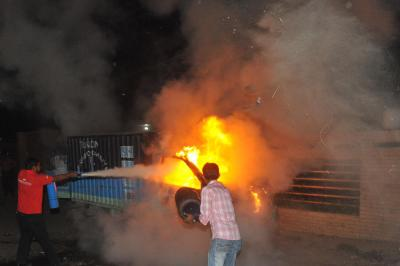
They also set fire to the offices of two major Bangladeshi newspapers, the Daily Star and Prothom Alo, disrupting their operations. Rioters renamed the Sheikh Mujibur Rahman Hall at Dhaka University to Shaheed Usman Hadi Hall and released posters to that effect. The mob beat a Hindu youth to death, then hanged and burned his naked body. A journalist was also shot during the violence. Several shops were burned down, and cultural buildings were attacked. Amidst widespread vandalism, Muhammad Yunus issued a perfunctory statement saying there was no place for violence in Bangladesh. He also condemned the killing of the Hindu youth. However, the violence escalated further on Friday evening when Usman Hadi’s body arrived in Bangladesh. Arson attacks broke out in various parts of Dhaka.
Those spreading rumors of Indian involvement in Hadi’s murder have fueled anti-India sentiment among the frenzied crowds. The situation has become so tense that the army has been put on high alert along the Indian border. It was hoped that the atmosphere would be positive in the run-up to the February elections in Bangladesh and that the establishment of a democratic government would put India-Bangladesh relations back on track, but the situation has turned out to be quite the opposite. Bangladeshi politics is currently in the hands of extremist elements. Hardliners are even claiming that India did not give democracy to Bangladeshis as a gift, but rather divided the country into two to settle its scores with Pakistan. The current situation in Bangladesh is not comfortable for India. A large number of Hindus live in Bangladesh, and the Indian government will have to be concerned about their safety. For now, the Bangladeshi government must first bring the violence under control.
Good Evening Viewers! Get the latest updates from India and around the world with The Savera Times Evening...

Bharatiya Janata Party (BJP) National General Secretary Smriti Zubin Irani launched a scathing attack on Congress MP and...
New Delhi: Cockroach Janata Party (CJP) leaders Saurav Das and Ashutosh Ranka will be released from judicial custody...
According to police, three suspicious young men are seen in CCTV footage. Efforts are underway to identify them....
A video has surfaced of an alleged attempted assault on Jan Suraj Party's Bihar president Manoj Bharti. The...
Two accused have been convicted and sentenced to 10 years of rigorous imprisonment in a 2017 drug trafficking...
Aries: The day will be auspicious...