Last Updated: October 15, 2026
Last Updated: October 15, 2026





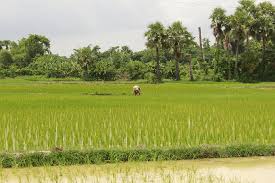
As on date, a farmer could gain Rs 17,540-47,160 per hectare by adopting different groups of climate-resilient rice varieties, yet their adoption remained sporadic and limited. This was what revealed in recent analysis by the Indian Council of Agricultural Research (ICAR). The returns were the highest for drought-tolerant varieties, followed by aerobic varieties, salinity-tolerant varieties, submergence-tolerant varieties, biotic stress-tolerant varieties and ones that are both drought- and submergence-tolerant. This benefit, the study estimated, was inclusive of mean yield effect and downside risk-reduction during the stress conditions which disproportionately affect smallholders.
The study published by ICAR-National Institute of Agricultural Economics and Policy Research, evaluated 21 climate resilient rice varieties (CRV) being cultivated on around 3.82-million-hectare area (7.9%). Overall, CRVs could generate an economic surplus of more than Rs 2.11 lakh crore by 2030. These gains — equivalent to nearly Rs 10,774 crore annually — stemmed largely from higher and more stable yields. However, despite the availability of nearly 100 climate-resilient rice varieties, only about 10 per cent of India’s rice area is currently under such cultivation, pointing to a persistent gap between research output and field-level uptake.
Rice is central to India’s food security and rural economy, covering nearly a quarter of the country’s cropped area and supporting millions of livelihoods. It accounts for a major share of public procurement and household food consumption, making production stability critical for market prices and inflation.
However, rice cultivation is increasingly exposed to climate stress. Rising temperatures and erratic rainfall are intensifying droughts, floods and heat stress across major growing regions. Under the National Innovations in Climate Resilient Agriculture programme, about 40 per cent of districts have been classified as highly vulnerable to climate change, with large parts of the net sown area prone to drought and flooding. In this context, CRVs, designed to withstand multiple stresses, have been seen as a key adaptation tool, offering higher average yields and greater protection against climate shocks. Drought-tolerant varieties, particularly in Jharkhand and Odisha, accounted for the largest share of projected benefits, with an estimated aggregate surplus of over Rs 1.08 lakh crore up to 2030.
These varieties generated substantial gains for both producers and consumers, while helping stabilise supply and contain price volatility in water-scarce regions. Similarly, submergence-tolerant varieties cultivated in flood-prone regions such as Assam and Odisha were found to generate a potential economic surplus of nearly Rs 79,837 crore up to 2030, equivalent to about Rs 3,842 crore annually. These varieties were capable of surviving up to 14 days under water, allowing crops to recover after flash floods that have become more frequent with changing monsoon patterns. Courtesy: DTE
Singapore: Two Singapore-registered container vessels were reportedly struck by unknown projectiles while transiting the Strait of Hormuz on...

Shimla: The Himachal Pradesh government has constituted a four-member commission to examine the reorganisation of administrative units in...

New Delhi: The Supreme Court on Wednesday listed for November 17 the appeal filed by self-styled godman Asaram...

Ranchi: Doctors in Jharkhand launched a protest on Wednesday over a slew of demands concerning their safety and...

Greater Noida: Police and Anti-Narcotics Team in Uttar Pradesh’s Greater Noida have seized ‘ganja’ worth Rs 1 crore...

New Delhi: The Enforcement Directorate (ED) has attached assets worth Rs 2,032.81 crore belonging to Reliance Power Ltd...
