


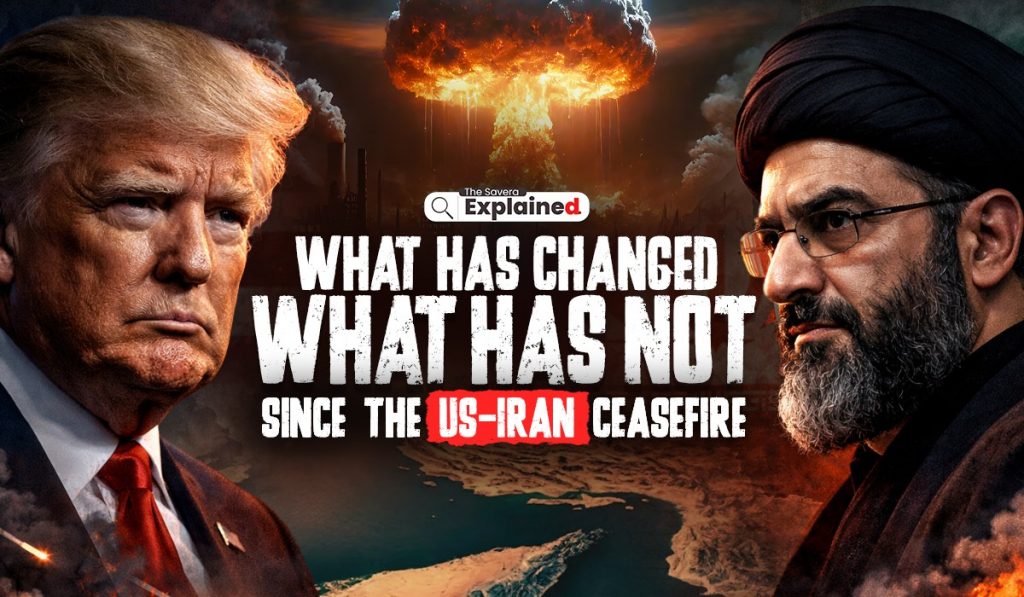
A war that almost crossed the point of no return… paused at the last possible moment.
Just 90 minutes before Donald Trump’s deadline to “wipe out” Iran, something unexpected happened — Washington and Tehran hit pause.
After more than five weeks of escalating conflict, missiles, threats, and global panic… a ceasefire was announced.
But here’s the real question:
Has the war actually stopped — or has it just changed shape?
How We Got Here?
This crisis didn’t explode overnight. It built up — fast and dangerously.
At the centre of it all: the Strait of Hormuz — one of the most critical waterways in the world. Nearly a fifth of global oil passes through this narrow stretch.
Then came the trigger:
Iran blocked the strait.
The response from the United States was immediate and aggressive. Donald Trump issued a stark warning — reopen the route or face devastating consequences.
What followed was a rapid spiral:
- Missile exchanges
- Military posturing
- Global markets shaken
- And rising fears of a full-scale war between the US and Iran
The world stood on edge.
Then, just as the deadline closed in — diplomacy stepped in.
A two-week ceasefire.
A pause in direct attacks.
And a surprising mediator: Pakistan.
What Has Changed
Let’s start with the positives — because yes, there are some.
- Direct US-Iran fighting has stopped — for now.
The biggest shift is simple but significant:
The United States and Iran are no longer firing directly at each other.
That alone has reduced the immediate risk of a global escalation.
- A two-week diplomatic window is now open.
This ceasefire isn’t permanent — it’s a pause.
But even a pause creates space:
- For negotiations
- For backchannel talks
- For global pressure to build toward peace
- Pakistan has emerged as a key mediator.
Pakistan hosted high-level talks in Islamabad.
For 21 hours, American and Iranian officials sat across the table — face to face.
That in itself is a major shift.
Because before this, there was no direct dialogue at all.
- Diplomacy is spreading beyond the US and Iran.
The ripple effects are already visible.
Benjamin Netanyahu has now agreed to direct talks with Lebanon — something that seemed unlikely just days ago.
Officials are expected to meet in Washington soon.
That signals one thing:
Even a fragile ceasefire can unlock wider diplomacy.
What Has Not Changed
Now, the reality check — because this is where things get complicated.
- The war has NOT stopped — it has just shifted.
The ceasefire applies only to the US and Iran.
It does not include:
- Israel
- Or Hezbollah
And that’s where the conflict is still very active.
- Fighting in Lebanon is intensifying.
On April 8, Israel carried out massive strikes across Lebanon.
That day became one of the deadliest in this phase of the conflict —
At least 300 people were killed.
So while one front paused… another escalated.
- The Strait of Hormuz is blocked again.
In response to ongoing tensions, Iran has once again shut down the Strait of Hormuz.
This move:
- Threatens global oil supply
- Raises economic fears worldwide
- And puts pressure back on the ceasefire
- Israeli strikes are continuing — openly.
Benjamin Netanyahu has made it clear:
Talks with Lebanon may happen —
but military operations will not stop.
That means diplomacy and war are happening at the same time.
- No actual agreement has been reached.
After 21 hours of talks in Islamabad —
There is still no deal.
JD Vance confirmed it publicly.
Iran, meanwhile, accused the US of making “excessive demands.”
So the ceasefire exists —
But the solution does not.
Side Stories Raising Eyebrows
While the war unfolded, the politics around it also grabbed attention — for unusual reasons.
- Messaging missteps from Pakistan
Shehbaz Sharif posted about peace efforts —
But the message turned out to be a draft from the White House.
It was quickly edited, but not before raising questions.
- Controversial remarks
Khawaja Asif called Israel “cancerous” in a post —
And later deleted it. - Trump’s aggressive rhetoric
Before the ceasefire, Donald Trump posted:
- One message filled with expletives
- Another warning about the “death of a civilisation”
These statements shocked many —
And even triggered calls from critics for action under the 25th Amendment.
So here’s the clearest way to understand this situation:
What HAS changed:
- Direct US–Iran fighting has paused
- A two-week diplomatic window is open
- Pakistan has stepped in as a mediator
- New talks — even beyond the main conflict — have begun
What has NOT changed:
- Fighting continues in Lebanon
- Israel’s strikes have not stopped
- Iran has blocked the Strait of Hormuz again
- And there is still NO final agreement
This ceasefire has bought time —
But not stability.
Right now, the situation is like a pressure cooker with the lid slightly lifted… not removed.
The next few days — especially the Israel-Lebanon talks in Washington —
Will decide whether this pause becomes peace…
Or just a short break before the next escalation.
And the world is watching.