Last Updated: October 21, 2026
Last Updated: October 21, 2026





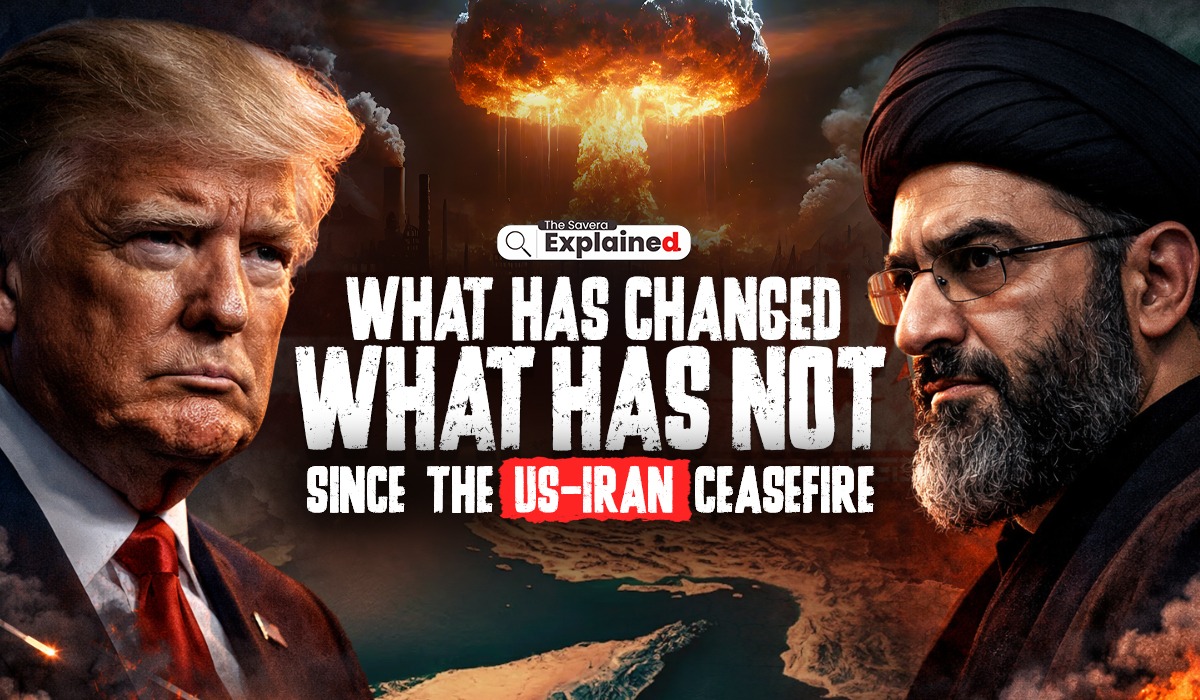
A war that almost crossed the point of no return… paused at the last possible moment.
Just 90 minutes before Donald Trump’s deadline to “wipe out” Iran, something unexpected happened — Washington and Tehran hit pause.
After more than five weeks of escalating conflict, missiles, threats, and global panic… a ceasefire was announced.
But here’s the real question:
Has the war actually stopped — or has it just changed shape?
How We Got Here?
This crisis didn’t explode overnight. It built up — fast and dangerously.
At the centre of it all: the Strait of Hormuz — one of the most critical waterways in the world. Nearly a fifth of global oil passes through this narrow stretch.
Then came the trigger:
Iran blocked the strait.
The response from the United States was immediate and aggressive. Donald Trump issued a stark warning — reopen the route or face devastating consequences.
What followed was a rapid spiral:
The world stood on edge.
Then, just as the deadline closed in — diplomacy stepped in.
A two-week ceasefire.
A pause in direct attacks.
And a surprising mediator: Pakistan.
What Has Changed
Let’s start with the positives — because yes, there are some.
That alone has reduced the immediate risk of a global escalation.
For 21 hours, American and Iranian officials sat across the table — face to face.
That in itself is a major shift.
Because before this, there was no direct dialogue at all.
Benjamin Netanyahu has now agreed to direct talks with Lebanon — something that seemed unlikely just days ago.
Officials are expected to meet in Washington soon.
That signals one thing:
Even a fragile ceasefire can unlock wider diplomacy.
What Has Not Changed
Now, the reality check — because this is where things get complicated.
It does not include:
And that’s where the conflict is still very active.
That day became one of the deadliest in this phase of the conflict —
At least 300 people were killed.
So while one front paused… another escalated.
This move:
Talks with Lebanon may happen —
but military operations will not stop.
That means diplomacy and war are happening at the same time.
JD Vance confirmed it publicly.
Iran, meanwhile, accused the US of making “excessive demands.”
So the ceasefire exists —
But the solution does not.
Side Stories Raising Eyebrows
While the war unfolded, the politics around it also grabbed attention — for unusual reasons.
It was quickly edited, but not before raising questions.
These statements shocked many —
And even triggered calls from critics for action under the 25th Amendment.
So here’s the clearest way to understand this situation:
What HAS changed:
What has NOT changed:
This ceasefire has bought time —
But not stability.
Right now, the situation is like a pressure cooker with the lid slightly lifted… not removed.
The next few days — especially the Israel-Lebanon talks in Washington —
Will decide whether this pause becomes peace…
Or just a short break before the next escalation.
And the world is watching.
Ladakh is seeing two changes at once: a new district has been announced, and the Centre has proposed...

What if a decision taken in Washington could influence India’s oil bills, export earnings and trade relations with...
What happens when the world’s richest business leaders clash over one of the world’s biggest internet markets? A...

Pakistan is heading into its wheat-growing season with a serious water problem. The country is facing a projected...
Imagine a foreign national standing among Indian citizens at a political protest, raising questions about the government or...

For thousands of Indian tech workers in the United States, a job offer is only the beginning of...

Aries: The day will be auspicious...