Last Updated: October 12, 2026
Last Updated: October 12, 2026





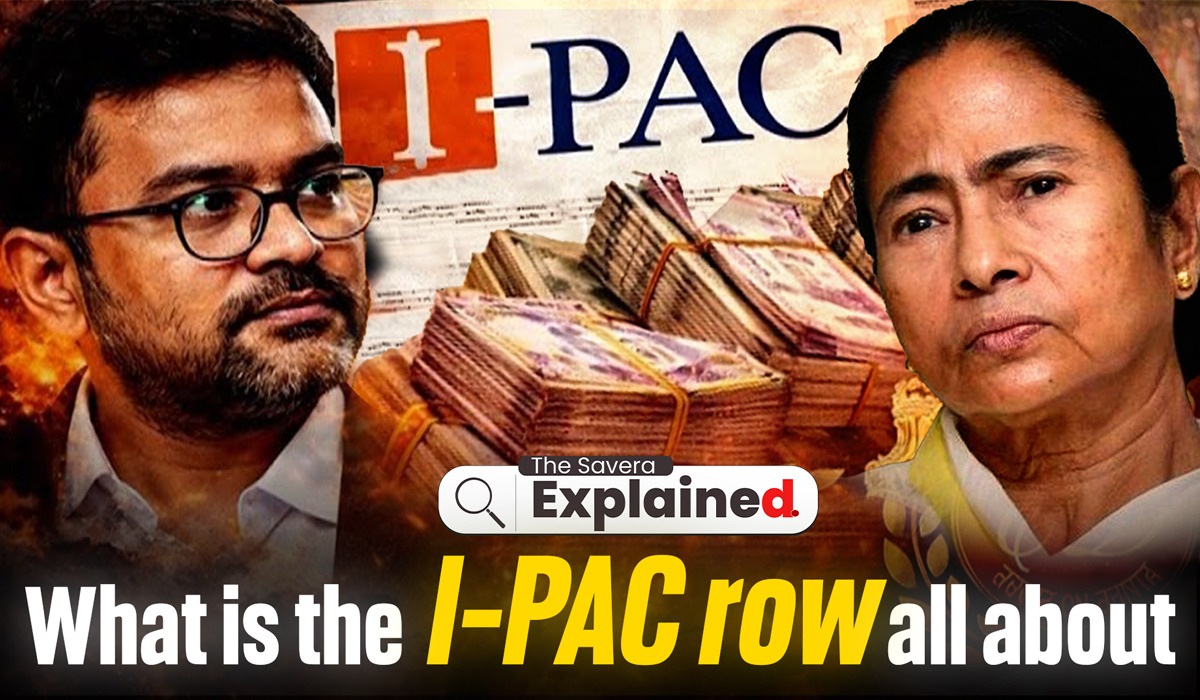
The political storm around the Indian Political Action Committee (I-PAC) intensified after the Enforcement Directorate (ED) conducted searches at its offices and the residence of its key functionary in Kolkata, triggering a sharp confrontation between the Trinamool Congress (TMC) government in West Bengal and the BJP-led Centre.
The episode has raised serious questions about the scope of central agency powers, alleged political interference, and the increasingly blurred lines between political consultancy firms and ruling parties.
What triggered the latest controversy?
On Thursday, the ED carried out raids at multiple locations linked to I-PAC, including its Salt Lake Sector V office in Kolkata and the residence of Pratik Jain, who heads I-PAC’s operations in the state and also serves as the IT head of the TMC. The searches were conducted as part of a money laundering probe connected to an alleged coal smuggling case in West Bengal.
The situation escalated dramatically when Chief Minister Mamata Banerjee personally arrived at Jain’s residence while the raid was underway. She accused the ED of attempting to seize the TMC’s internal documents, hard disks, and sensitive election-related data under the guise of a financial investigation. According to the ED, Banerjee and accompanying state officials removed documents and electronic evidence from the premises, prompting the agency to approach the Calcutta High Court.
What is I-PAC and why is it significant?
The Indian Political Action Committee, or I-PAC, is a political consultancy firm that provides election strategy, campaign management, data analytics, and communication support to political parties and leaders. Founded by political strategist Prashant Kishor, I-PAC has played a prominent role in several high-profile electoral victories across India.
In West Bengal, I-PAC worked closely with the TMC during the 2021 Assembly elections, helping the party secure a resounding victory over the BJP. While I-PAC is formally a private consultancy, its deep operational involvement with the TMC—particularly through Pratik Jain’s dual role—has made it a politically sensitive entity.
What is the ED’s case?
The ED maintains that the searches are strictly linked to a money laundering investigation arising from the alleged coal smuggling scam in West Bengal. The agency claims that financial transactions and possible proceeds of crime may have flowed through entities or individuals associated with I-PAC.
Officials have stressed that the probe is not about election strategy or political consultancy work, but about tracing illicit financial trails. However, the ED’s allegations gained further traction after it accused the Chief Minister and state officials of obstructing justice by removing potential evidence during an ongoing search operation.
Mamata Banerjee’s response
Mamata Banerjee has described the ED action as “political vendetta” and “unconstitutional,” directly targeting Union Home Minister Amit Shah and accusing the BJP of misusing central agencies to intimidate opposition parties. She has claimed that the real intent of the raids was to access TMC’s internal data and weaken the party politically.
Banerjee later led a protest march in Kolkata against what she termed the “misuse” of central agencies and filed two police complaints against the ED. She has also alleged that BJP leaders themselves benefitted from the coal scam, a charge the BJP has strongly denied.
Legal battle in the Calcutta High Court
The ED moved the Calcutta High Court seeking protection of evidence and action against alleged obstruction. Simultaneously, the West Bengal government challenged the legality of the raids and the ED’s conduct.
Both matters were heard on Friday, but proceedings were adjourned after chaos erupted in the courtroom. Justice Suvra Ghosh deferred the hearing, which is now scheduled to resume on January 14. The court’s eventual ruling is expected to have significant implications for the balance of power between state governments and central investigative agencies.
BJP vs TMC: Political fallout
The BJP has accused Mamata Banerjee of interfering with a lawful investigation and setting a dangerous precedent by entering a raid site. The party argues that no constitutional authority allows a Chief Minister to remove documents during a central agency search.
For the TMC, the I-PAC row has become part of a broader narrative of federal overreach and political targeting of opposition-ruled states. The episode has sharpened political rhetoric ahead of key elections and added another flashpoint to Centre–state relations.
Why the I-PAC row matters
Beyond the immediate political clash, the controversy raises larger questions about transparency in political consulting, the overlap between party structures and private firms, and the limits of investigative authority. As the legal proceedings continue, the I-PAC row is set to remain a major test case in India’s evolving political and federal landscape.
Imagine a foreign national standing among Indian citizens at a political protest, raising questions about the government or...

For thousands of Indian tech workers in the United States, a job offer is only the beginning of...
Three years ago, on October 7, 2023, Israel woke up to one of the deadliest attacks in its...

Imagine being seriously injured inside a flying aircraft, with blood on your clothes, passengers in panic and the...

Imagine the world’s biggest diesel exporter turning off its export taps. That is the concern after US President...

For India’s pharmaceutical industry, the latest US tariff decision brings relief — but not across the entire medicines...

Aries: The day will be auspicious...