Last Updated: October 21, 2026
Last Updated: October 21, 2026





Sheena Sandhu
A retired civil servant
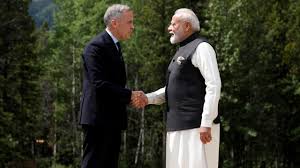
In diplomacy, presence and absence are both powerful conveyors of intent. When Canadian Prime Minister Mark Carney visited New Delhi in early March 2026 to reset relations with India, his decision to omit a stop in Punjab — the province long at the centre of emotive Indo-Canadian politics — was far from a benign scheduling choice. It was a calculated diplomatic signal about priorities: a shift away from diaspora-driven optics, and an implicit message that Canada may no longer indulge or tolerate secessionist
elements operating from within its borders.
This interpretation gains depth when viewed in the context of the broader set of bilateral agreements and joint statements made on security, terrorism and extremism during Carney’s visit a suite of commitments that together suggest a watershed in how Ottawa chooses to balance domestic pressures with strategic state-to-state interests.
Resetting the Relationship: Trade, Uranium, and Strategic Partnership
Carney’s India trip marked the first official visit by a Canadian prime minister in years, and it was not merely ceremonial. The two countries agreed to resume and accelerate negotiations toward a Comprehensive Economic Partnership Agreement (CEPA), with the ambitious goal of lifting two-way trade to $50 billion by 2030 nearly a fivefold increase on current levels. 
In parallel, Ottawa and New Delhi finalised a C$2.6 billion ($1.9 bn) uranium supply deal, underpinning India’s civil nuclear energy ambitions. 
At a time of global economic uncertainties especially given protectionist pressures in Western markets — these agreements signal a mutual recognition that trade and strategic cooperation matter more than lingering diplomatic discord. For Canada, diversifying trade beyond the United States is not a luxury but an economic imperative; for India, deepening ties with a G7 power strengthens its global commercial network.
Concrete Security Cooperation: From Words to Mechanisms
But the visit was more consequential still for what it said and what Carney’s itinerary avoided about security and terrorism. After years of strained relations following the 2023 diplomatic crisis triggered by then-Prime Minister Justin Trudeau’s allegations of Indian state involvement in the killing of Khalistani activist Hardeep Singh Nijjar on Canadian soil, Ottawa has quietly shifted its tone. A senior Canadian official publicly clarified ahead of the visit that Canada no longer believes India is linked to violent crimes on its territory. This recalibration was crucial in creating space for renewed cooperation. At the joint press conference in New Delhi, both Prime Ministers underscored that terrorism, extremism and radicalisation are shared, serious threats requiring close collaboration between democracies.
Moreover, India and Canada agreed on an expanded agenda of security cooperation that goes well beyond platitudes. The two sides committed to deepen collaboration on:
• Violent extremism and terrorism with specific reference to tackling activities that threaten national security.
• Organised crime, narcotics trafficking, cybercrime, and financial fraud acknowledging the transnational nature of today’s security challenges.
• Enhanced information-sharing and law enforcement cooperation, including bolstering existing mechanisms like the Joint Working Group on Counter-Terrorism, and institutionalising defence and security dialogues. 
Taken together, these initiatives signal a more structured, reciprocal approach to security issues that previously were mired in distrust and political controversy.
What Skipping Punjab Really Means
Punjab’s omission from Carney’s itinerary was not an oversight it was a statement. For years, the Indo-Canadian relationship was burdened by the shadow of diaspora politics: Sikh separatist movements such as Babbar Khalsa and the Khalistan Tiger Force have historical roots in Canada, and Ottawa’s handling of these issues was a persistent source of Indian concern.
By avoiding community engagements in Punjab where such issues are often foregrounded the Canadian prime minister signalled a deliberate pivot: economic and strategic cooperation over symbolic interactions that could reignite controversy. This fits with his broader messaging that Canada seeks a pragmatic reset with India, focused on shared interests rather than internal fault-lines of diasporic activism.
Ottawa is sending a message to all stakeholders both in India and among Sikh communities in Canada that it intends to prioritise state-level dialogue and security cooperation over public posturing on contentious issues.
From Tactical Reset to Strategic Message
This is a delicate balancing act. Domestically, Canadian politicians still face pressures from diverse constituencies, and there are still strong sentiments among some Sikh diaspora groups about autonomy and history. But Ottawa’s overt emphasis on confronting violent extremism aligning language with India’s long-standing position that movements aimed at separatism are threats, not legitimate political expressions suggests a shift toward a less accommodating posture on secessionist agitation.
This does not mean Canada has criminalised dissent far from it. Rather, Ottawa appears intent on drawing clearer lines between lawful expression and activities that facilitate violence, extortion or cross-border destabilisation. The joint focus on tackling not just terrorism but organised crime, cyber threats and narcotics shows a holistic approach to security that leaves little space for exploitative loopholes.
What Comes Next?
For India, this is an encouragement. The reset visit combined commercial diplomacy with genuine security dialogue, and it underscored Ottawa’s willingness to subordinate short-term electoral calculus to long-term strategic partnership. For Canada, the message is that it can have robust ties with India without being ensnared by divisive diaspora politics.
The silence over Punjab was thus part of a louder message: that secessionist activities and extremism will no longer be pampered, acquiesced to or allowed to undermine bilateral ties. Whether this will translate into concrete policies at home for example, tighter enforcement against groups that finance or promote violence abroad remains to be seen. But for the first time in years, the tenor of Indo-Canadian engagement suggests a mutual determination to move beyond grievance-laden rhetoric toward enduring cooperation.In this subtle recalibration, absence spoke louder than presence: the omission of Punjab was a diplomatic cue that the age of symbolic indulgence is giving way to a new era of strategic realism. If sustained, this shift could define Indo-Canadian relations for a generation.
Good Evening Viewers! Catch up on the day's biggest stories with The Savera Times Evening Bulletin. Get the...

Congress leaders continued their protest outside the Jaipur Police Commissionerate on Tuesday, demanding the registration of a zero...
On the auspicious occasion of Vijayadashami, Prime Minister Narendra Modi on Tuesday called on the countrymen to unite...
A historic milestone was achieved on Tuesday in the expansion of Chhattisgarh's rail networkA historic milestone was achieved...

Model Shraddha Dubey, one of the main accused in the death of Lucknow businessman Shiv Sharma, has been...

Rashtriya Swayamsevak Sangh (RSS) chief Mohan Bhagwat on Tuesday called for strengthening national unity, social harmony, indigenous practices...
Aries: The day will be auspicious...