Last Updated: October 13, 2026
Last Updated: October 13, 2026





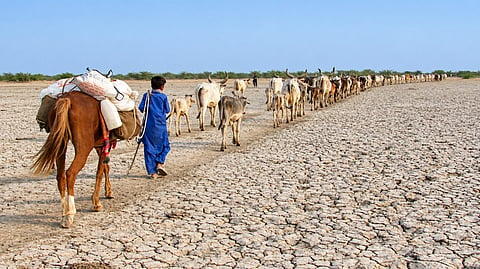
A drought does not begin with a government notification. It begins when a farmer watches his crop wilt, when a Maldhari walks farther in search of grass and water, when a family starts buying drinking water, and when livestock—built up over generations—has to be sold or transported elsewhere simply to survive. That is increasingly the reality in Gujarat’s largest district of Kutch.
The latest figures emerging from the district paint a deeply worrying picture. This year, around 0.482 million hectares (mha) have been brought under cultivation in Kutch, but only about 0.18 mha have access to irrigation. The remaining farmland is largely dependent on rainfall. Last year, around 0.65 mha were cultivated, indicating the sharp contraction in the agricultural area this year.
The crisis is not confined to farms. Around 2.1 million livestock—central to the economy and food security of Kutch’s pastoral communities—are now facing severe shortages of fodder and water. And migration has already begun. The crop has failed before the monsoon has officially ended.
By early September, Kutch had received only about 29.5 per cent of its normal seasonal rainfall, according to official data from the India Metrological Department (IMD). Subsequent assessments put the rainfall deficit at around 60 per cent. Some talukas (sub-districts) have received less than 10 per cent of their normal rainfall.
The latest reports show how this deficit is translating into ground-level distress. Of the 0.482 mha cultivated this year, only about 0.18 mha are irrigated. The remaining area is vulnerable to prolonged dry spells. Crops that survived the initial sowing phase are now reaching a critical stage without sufficient soil moisture.
This is particularly serious because Kutch’s agrarian economy has always been closely tied to the monsoon. A failed monsoon is not simply a failed crop; it means loss of household income, inability to repay agricultural loans, reduced employment and greater dependence on already stretched water and food systems.
The situation is made worse by shrinking water reserves. Kutch’s 19 medium irrigation reservoirs reportedly have only about 19 per cent of their storage available, while the district’s 170 small irrigation schemes have only around 13 per cent water availability, according to the latest local reporting.
The contrast is stark: there may be water in parts of Gujarat, but it is not necessarily available where Kutch’s farmers and livestock need it.
The Gujarat government’s own response has so far focused on ensuring drinking water and fodder in deficient districts, including Kutch. But for farmers whose standing crops are drying, drinking water alone cannot prevent agricultural losses.
The storm that the Jantar-G-G stirred with young people at Jantar Mantar, the designated protest site in India's...

For generations, India's lighthouses were places people saw from a distance. Standing at the edge of the sea,...

Cancer is believed to be the most deadly disease in India, with its expensive treatment. A family affected...

Kashmir’s handicraft industry is on a path to revival after the turbulent years of militancy and the Covid-19...
While western countries continue to focus on India’s coal-fired power plants in the debate on climate change, what...

Good Evening Viewers! Stay updated with The Savera Times Evening Bulletin for the latest news from Punjab, India...

Aries: The day will be auspicious...