Last Updated: November 12, 2026
Last Updated: November 12, 2026





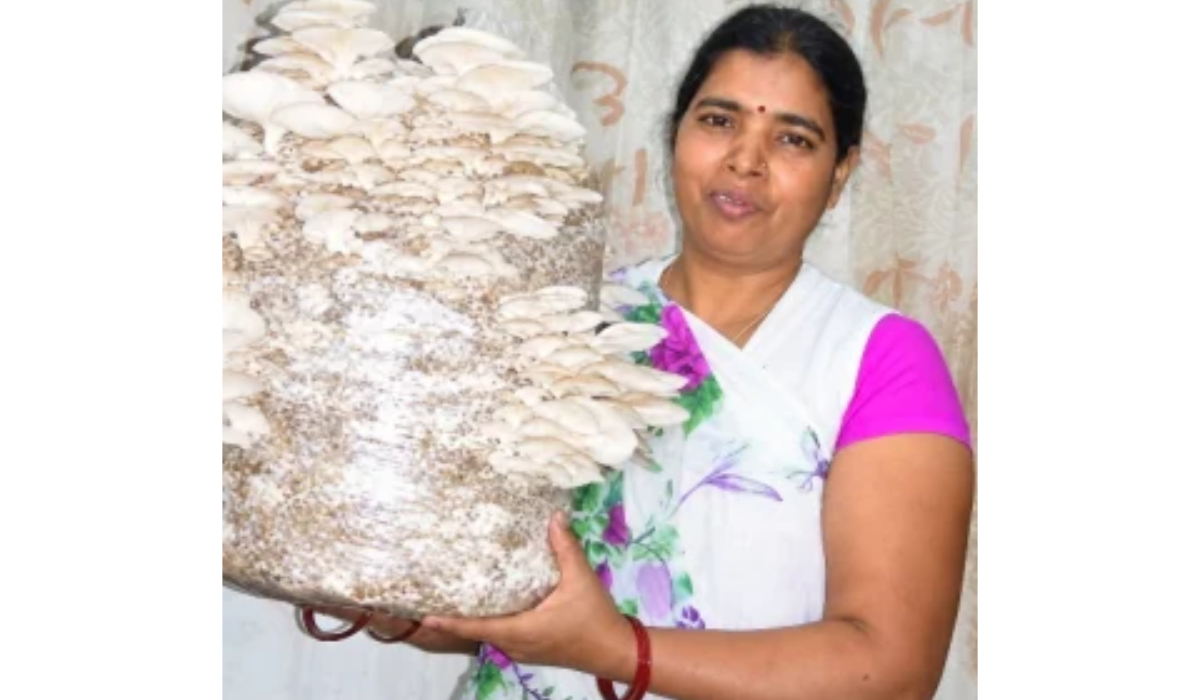
With growing interest in healthier diets, mushroom cultivation is gaining importance in India’s horticulture sector and offers scope for further growth. Mushrooms are valued for their nutritional profile, being generally low in calories, fat, and carbohydrates while providing protein, dietary fibre, vitamins, and minerals. They can be cultivated with limited land and in rural, urban, and peri-urban settings. A modest space, a few mushroom cultivation bags, and a new skill can create pathways to diversified livelihood opportunities. Across India, mushroom cultivation is emerging as a viable livelihood option for farmers, women, and rural youth. For Ruthu of Ippatam village in Guntur district, Andhra Pradesh, the journey began with a search for an alternative source of livelihood. At the age of 20, she was working as a waste picker and aspired to establish an independent livelihood. This opportunity emerged through a short-term training programme under the Skill Training for Rural Youth (STRY) initiative. Krishi Vigyan Kendra (KVK), Guntur, provided training in mushroom production, covering key stages such as composting, spawning, casing, pinning, cropping, and harvesting. The programme was conducted with support from the State Agricultural Management and Extension Training Institute (SAMETI), Andhra Pradesh, and the National Institute of Agricultural Extension Management (MANAGE), Hyderabad. Applying the skills acquired during the training, Ruthu began cultivating milky mushrooms and established a regular supply to the local market. Her production reached approximately 8 kg per day, generating a monthly income of around ₹35,000. She has also learnt the importance of using clean paddy straw free from disease and good-quality spawn, while maintaining the right temperature and moisture levels during cultivation. Her learnings and experiences encouraged three to four other community members to take up mushroom cultivation on a small scale, with guidance and support from her. Ruthu’s experience illustrates how targeted skill development, when translated into practical application, can support livelihood diversification and local knowledge-sharing. What began as a short training programme became a foundation for income generation and encouraged others in the community to explore mushroom cultivation as a livelihood option. A livelihood initiative can create far-reaching change when individual enterprise inspires collective action. In Anantpur village, Anita Devi’s journey from mushroom cultivation to community leadership illustrates how a locally rooted livelihood can create economic opportunities for rural women and strengthen community-based enterprise. For Anita, mushroom cultivation began with the aspiration to earn an independent income. Training at Dr. Rajendra Prasad Central Agricultural University and GB Pant University helped build her knowledge, while her engagement with Krishi Vigyan Kendra (KVK), Harnaut block, Nalanda district, Bihar, in 2010 provided direction for her entrepreneurial journey. Encouraged by KVK officials, she began cultivating oyster and milky white mushrooms, varieties suited to local conditions and suitable for cultivation using agricultural waste. Her initiative gradually inspired other women in Anantpur village to explore mushroom cultivation. The practice spread to neighbouring villages, and in 2012, the State Agriculture Department declared Anantpur a Mushroom Village. Anita came to be known as the “Mushroom Mahila” (The Mushroom Lady), reflecting her growing role in promoting this livelihood within the community. As cultivation expanded, access to quality mushroom spawn emerged as an important requirement. With support from the National Horticulture Mission, Anita established a spawn production laboratory with a subsidy of ₹15 lakh, helping address a critical input requirement. She further strengthened collective enterprise by establishing Madhopur Farmers Producers Company Limited, which works with mushroom producers and sellers and helps connect women with government schemes and markets. By 2023, more than 250 women from Jeevika Self-Help Groups are associated with mushroom-based livelihood activities in Nalanda. Anantpur’s recognition as the Mushroom Village of Bihar reflects the wider community adoption of an initiative that began with one woman’s pursuit of economic independence. Anita Devi’s journey demonstrates how skill development, institutional support, access to critical inputs, and collective enterprise can reinforce one another to expand livelihood opportunities. Mushroom cultivation is increasingly creating livelihood opportunities beyond traditional farming, including for professionals seeking to establish land-efficient enterprises. Anjanaben Gamit, a civil engineer from Tapi, Gujarat, explored this opportunity after reading an article on oyster mushroom cultivation published by KVK Tapi in the Agro-Sandesh. Recognising the potential of mushroom cultivation without requiring extensive landholdings, she visited Krishi Vigyan Kendra (KVK), Tapi, and participated in a four-day training programme on “Entrepreneurship Development through Mushroom Cultivation”. With technical guidance from KVK scientists, she began cultivating oyster mushrooms in 2017, making use of the resources available to her. Her initial cultivation unit was a modest 15 × 10 ft shed, constructed using bamboo and green shade net. KVK supported her with mushroom spawn, polythene bags, and other inputs, along with follow-up technical guidance. Within two and a half months, her first crop yielded approximately 140 kg of mushrooms, generating ₹28,000 against a production cost of ₹11,000. Encouraged by these results, she expanded her unit in 2019 by enlarging her mushroom house to 23 × 80 feet, investing an additional ₹1.72 lakh. Between April and December that year, she used 250 kg of spawn to produce 1,234 kg of mushrooms. The harvest generated a gross income of ₹3.09 lakh and a net profit of ₹2.20 lakh after production costs
As part of the strengthening bilateral energy ties, India’s imports from the UAE have risen sharply over the...

It is good news that the Indian government, heeding the Supreme Court’s advice, has initiated an effort to...

India is seen as a credible country that can help in the peace talks between Russia and Ukraine...
The Earth’s energy imbalance and the loss of India’s distinct seasons are becoming the same thing. 2024 was...

Ujjain (Madhya Pradesh): A fire broke out in a five-storey building at Bagadiya Tower near the old Central...

New Delhi [India]: Former Vice-President Jagdeep Dhankhar was admitted to the All India Institute of Medical Sciences (AIIMS)...
Aries: The day will be auspicious...