Last Updated: October 15, 2026
Last Updated: October 15, 2026





Akshay Bansal
BJPYM – NEC
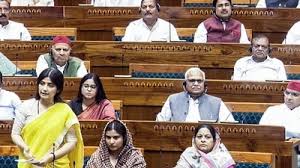
Recently, the Constitution Amendment Bill to tweak the women’s quota law along with the Delimitation Bill, and the Union Territories Laws (Amendment) Bill has been defeated in the Lok Sabha. Delimitation exercises haven’t been held since 1976 and, for the years, successive governments have ignored to touch this issue as it would open a Pandora’s box and left it to time.
It requires both courage and sensitivity to bring diverse regional interests and political groups onto a common platform for the nation’s long-term stability. For years, the women’s reservation bill faced opposition from various factions like the Congress, SP and RJD the parties which frequently talk about women’s empowerment, but when it comes to taking action, their dual character is exposed.
The Prime Minister’s sensitivity towards women’s issues has been evident since he assumed office in 2014. This is reflected in policies and schemes such as the construction of toilets for women under the Swash Bharat Abhiyan, the Ujjwala Yojana, and women-centric housing initiatives. The enactment of the Nari Shakti Vandan Adhiniyam, 2023, is another expression of this commitment to advancing women’s empowerment. This move, which will increase representation of women in Lok Sabha and state assemblies to 33%, could be one of the most fundamental changes in democracy since independence.
Our gram sabras are evident in this grassroots revolution. The Modi government decided to break the ice by de-linking Delimitation exercise with the last preceding census. As George Bernard Shaw said, “Progress is impossible without change, and those who cannot change their minds cannot change anything.” In 2023, when the government passed the Nari Shakti Vandan Bill, the opposition was demanding immediate enactment. Now, when it’s implementing they want It should be based on the 2027 census that means women’s reservations will apply by 2034.
Already we’ve missed the boat. To execute it immediately, the government proposed to expand Lok Sasha seats from 543 to 850 and increase state representation equally on the 50% increase formula. Instead of cutting down on one state for another, using 2011 census data along with interstate balance is protected for different states while increasing the total number of seats to accommodate growth of the population in the next 50 years. Article 82 of the Indian constitution provides for the re-adjustment of constituencies of Lok Sabha and state assembly after each census.
The idea behind that is that the value of each vote cast across the country has a similar value. It should not be like Bellary & Begusarai’s voting values differ. There are 120 Lok Sabha seats where the population is more than 20 lakhs. How one parliamentarian can represent such large number of people. It is practically impossible. Seats haven’t increased since 1976, but the population has increased from 50 crore to 140 crore.
This move will make the Indian democratic system more representative, inclusive and equitable, as the current average size of the constituencies is 22 lakhs per constituency, but after delimitation it will be 14 lakhs. The Opposition and several southern states have registered their protest, arguing that they may lose their share in Parliament. Here the government debunked the propaganda which divides the northern south, creating fear for the central government that South India or Punjab will lose their political representation. It would increase the existing allocation by a fixed percentage of 50% so that the overall proportion between the states will remain unchanged. As the opposition can accuse the government of undermining the Constitution, there seems to be no logic, even as presented by the Home Minister in parliament presented
In five south Indian states, there will be an increase of seats from 129 to 195, where their representation will increase from 23.76% to 23.87%. Hence, the increasing number of 50% of seats is directly related to the Nari Shakti Vandan Adhiniyam. Within the purview of the new formula Bihar and Tamil Nadu will get the same 20–20 seats at the same time.
In Gujarat, Rajasthan, and Andhra Pradesh, there will be an increment of 13–13 seats, while North and south divided politics have no answer to this. Let us assume for a minute if delimitation happens on the 2011 population census, then the southern states will be at a disadvantage, or even if it happens in the 2027 census, there will be no gain. In any case, it’s a golden chance for the Southern States. Unfortunately, political calculations have once again overridden the larger public good. It is not a matter of celebration that the government’s agenda has been defeated it is a matter of shame that we have not moved beyond mediocrity and have failed to meet the aspirations of women and representative democracy.
Singapore: Two Singapore-registered container vessels were reportedly struck by unknown projectiles while transiting the Strait of Hormuz on...

Shimla: The Himachal Pradesh government has constituted a four-member commission to examine the reorganisation of administrative units in...

New Delhi: The Supreme Court on Wednesday listed for November 17 the appeal filed by self-styled godman Asaram...

Ranchi: Doctors in Jharkhand launched a protest on Wednesday over a slew of demands concerning their safety and...

Greater Noida: Police and Anti-Narcotics Team in Uttar Pradesh’s Greater Noida have seized ‘ganja’ worth Rs 1 crore...

New Delhi: The Enforcement Directorate (ED) has attached assets worth Rs 2,032.81 crore belonging to Reliance Power Ltd...
