Last Updated: October 15, 2026
Last Updated: October 15, 2026





Parneet Sachdev
Chairman of Real Estate Regulatory Authority and a leading author
Cross stitching brings back memories of our grandmothers. How their exquisite pillows and hangings adorned the family home decades ago. Recent research describes how the hobby of cross-stitching became a lifeline for someone undergoing emotional upheaval—its rhythmic, meticulous character offering “a zone of predictability” and regulating the nervous system(The Washington Post). Cross stitching’s earliest fragments date to 6th century BCE in Egypt. However, it isn’t just an art form. It heals stress, the mind and the body.
Scientific studies and spiritual traditions have long suggested: when we give our hands something genuine to do, our minds free themselves from the rumination cycle of anxiety.
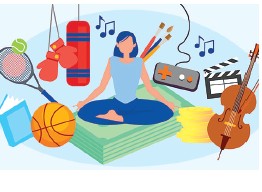
In a world of fractured attention, hobbies are emerging not as leisure, but as medicine
THE SCIENCE: WHAT’S GOING ON IN THE BRAIN
On a neurological level, hobbies exert beneficial effects in several interlocking ways.Engaging in an enjoyable hobby triggers activity in the brain’s reward system: by completing a stitch, a stroke of paint, a planted seed, we feel progress and purpose(research.reading.ac.uk).By moving both the hands rhythmically, hobbies like cross-stitching stimulate the brain by reducing cortisol (stress hormones), increases dopamine (mood regulators).
Activities that require moderate attention, physical engagement and repetition—like needlework, knitting or gardening—reduce activation of the sympathetic (fight-or-flight) nervous system and favour activation of the parasympathetic (rest-and-digest) system. For example, crafts have been likened to meditation because of their rhythmic character(The Washington Post). Hence, the simple act of seeing something you create gradually emerge has measurable neurochemical effects.In broader leisure studies, participation in hobbies correlates with lower measured stress and anxiety. Researchers state that leisure acts as a buffer against stressful experiences by promoting positive emotions and self-fulfilment (PMC).
Hobbies can also engage what psychologists call “flow” (complete absorption in an activity). When we shift from ruminative thinking (worrying about yesterday or tomorrow) into focused doing, we tap a different state of brain function. Research shows that having a hobby is linked to lower levels of depression—and may even prevent depression for some.
The Washington post notes that when attention is used purposefully and repetitively (as in following a pattern), it may strengthen neural circuits supporting executive control and emotional regulation.A hobby like cross-stitch gives a structure: you follow a pattern, make stitches, see progress. For high-performing individuals under chronic stress, crafting offers “small zones of predictability, which regulate the nervous system and restore a felt sense of agency.”
The sense of agency, which says, “I am making something” rather than simply reacting to somethingis deeply therapeutic.
THE SPIRITUAL DIMENSION: HANDS, HEART AND HARMONY
Beyond the biology, hobbies have an older, spiritual dimension that has been expressed in the scriptures and contemplative traditions.In many spiritual paths, manual work, rhythm and focus have been used as means of inner transformation: the repetitive tasks of weaving, carpentry, gardening or embroidery were not merely economic—they were meditative. The hands moving, the mind still—this is a pattern seen across cultures. The traditional Gurkuls of India, the ancient monasteries, all teach the students such arts apart from other knowledge.
The biblical book of Ecclesiastes (2:24) says:
“There is nothing better for people than to be happy and to do good while they live. That each of them may eat and drink, and find enjoyment in all their toil—this is the gift of God.”
In the Bhagavad Gita, the notion of karma yoga—performing one’s work as an offering, without attachment to the fruit—can apply even to simple crafts: if the maker stamps each stitch or brush-stroke with awareness, the external action becomes an inner discipline, a means of stilling the ego and attuning to the sacred.
In Buddhist thought, repetitive manual tasks offer a form of mindful action: the body is engaged, the mind remains present, attention anchored. This mirrors the findings of contemplative neuroscience: that present-moment attention changes brain circuits over time.
Thus, a hobby isn’t simply idle relaxation; it becomes a portal to deeper rest, to what some contemplative researchers call “deep rest” — a physiological and psychological recovery state akin to meditation(psychiatry.ucsf.edu).
PUTTING IT ALL TOGETHER: HOW CAN WE TRULY STITCH AWAY OUR BLUES
A new Mom fell into deep depression. Postpartum depression is serious; characterized by feelings of extreme sadness, anxiety, and exhaustion,it affects about 1 in 7 new mothers worldwide. The therapist asked her about any hobbies she ever had. She was a good carpenter and often used materials beyond wood. She started with 20 minutes a day. A micro hobby! Within days the extreme symptoms disappeared.
Ayurveda emphasizes that imbalances in the three doshas (Vata, Pitta, Kapha) contribute to illness. Engaging in hobbies helps manage stress and emotional well-being, which in turn supports dosha balance. Ayurveda aims to cultivate Sattva, the quality of purity, balance, and harmony.
Activities such as reading uplifting literature, engaging in creative pursuits like painting or music, and spending time in nature are encouraged to promote a Sattvic lifestyle and enhance dopamine (pleasure) and endorphins levels that uplift us.
Hobbies help build self-confidence, provide a sense of achievement, and help individuals develop a personal identity outside of their professional or obligatory duties. They offer an opportunity to pursue passions and “live one’s passion” that might not be possible in the workplace, contributing to overall happiness and character development.
These activities are considered part of the recommended daily (Dinacharya) and seasonal routines (Ritucharya). Ayurveda suggests scheduling time for rest, rejuvenation, and enjoyable pursuits to prevent burnout and maintain a harmonious work-life balance (HIIMS).
When we combine the science and the spirituality we arrive at a fuller picture of why hobbies matter so much. They create a ritual of creation, where we see visible progress and are rewarded by the brain.They foster mind-body regulation, lowering cortisol, boosting parasympathetic tone, reducing anxiety.
They also carry a spiritual significance, reminding us that labour, rhythm and presence are part of human flourishing—not merely productivity or output.
PRACTICAL SUGGESTIONS FOR INTEGRATING HOBBIES
For readers wishing to harness this effect, here are some guiding principles, drawn from both research and contemplative wisdom:
Choose something hands-on, ideally with a pattern or structure (e.g., stitching, knitting, woodworking, gardening). The structure gives the brain a framework for attention and progress.
Set aside a regular time, even if only 15–30 minutes a day, to create consistency and invite the nervous system to shift into rest mode.
Keep the mood non-judgmental: the goal is not perfect output, but process. This aligns with contemplative traditions: it’s the awareness that matters, not the flawless product.
Combine with reflection or gratitude: as you engage, you might pause briefly to notice your breath, the movement of the hands, the emergence of the pattern. This subtle mindfulness enriches the practice.
Recognise signs of progress, however small. The reward system of the brain will respond to small wins: saw-a-stitch more, planted a seed, sanded a board(ResearchGate).
In our fast-paced world of screens, alerts and endless “doing,” it may seem counter-intuitive to pick up a slow, manual hobby. Yet therein lies the paradox: slowing down creates speed of peace. From the neuroscience of dopamine and parasympathetic shifts to the ancient spiritual wisdom of mindful manual labour, hobbies function as gateways to calmer minds, healthier brains and deeper selves.
Therefore, if you find your mind stressed or your spirit worn, perhaps the best prescription is not yet another digital app, but something very analogue: thread, fabric, hands at work—and the art of being present and in surrender to the inner flow.
(Views expressed are the author’s own).
Good Afternoon Viewers! Stay updated with The Savera Times Afternoon Bulletin, bringing you the latest news from Punjab,...

New Delhi: Heavy rain and thunderstorms swept parts of Delhi-NCR on Thursday as dark clouds covered the national...
A street vendor has approached the Delhi High Court seeking to stop the Cockroach Janata Party (CJP)'s protest...

Suva: India and Fiji on Thursday held discussions focused on deepening bilateral ties and reaffirmed their shared commitment...

Bokaro (Jharkhand): The protest by trained youth from displaced families affected by the Bokaro Steel Plant (BSL) intensified...
Varanasi: Uttar Pradesh Chief Minister Yogi Adityanath, on a two-day visit to Varanasi, honoured sanitation workers from the...
Aries: The day will be auspicious...