Last Updated: October 21, 2026
Last Updated: October 21, 2026





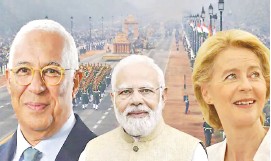
India is gearing up for a pretty historic Republic Day on January 26, 2026, and the usual fanfare of parades and national pride is getting an extra diplomatic shine this time. Instead of inviting the head of state or government of one country as the chief guest, New Delhi is inviting the top leadership of the European Union — Ursula von der Leyen, the President of the European Commission, and António Costa, the President of the European Council — to grace the 77th Republic Day celebrations as chief guests. This is a first for India, not just because two people from an international organisation are being invited together, but because an institution — the EU — rather than a single nation’s leader, is being put in that spotlight.
In India’s diplomatic playbook, choosing a Republic Day chief guest is never random. Beyond the ceremonial ceremony, it’s a strategic signal about where New Delhi wants to build or deepen partnerships. The President of India ceremonially hosts the guest at the parade on Kartavya Path in New Delhi, and that guest’s presence often reflects shared priorities — whether it’s defence cooperation, trade, geopolitics, or values alignment. So inviting Europe’s highest representatives is more than an invitation to celebrate the Constitution; it’s New Delhi telegraphing that its relationship with the EU matters on multiple fronts.
Ursula von der Leyen is a familiar figure in India-EU corridors. As the head of the European Commission — the EU’s executive arm — she has pushed for stronger ties with India across trade, technology, defence, and climate. She has visited India multiple times, including leading a large EU Commission delegation in early 2025, and both sides have underlined the importance of their strategic partnership. António Costa, on the other hand, chairs the European Council, which sets the political direction for the whole EU, making his involvement in this visit equally symbolic of Brussels’ political weight.
The invitation and the leaders’ expected acceptance mark a new high in India-EU relations. It’s not just about being chief guests at a marquee national event; it’s also timed to coincide with a major India-EU Leaders’ Summit planned in New Delhi on January 27, right after Republic Day. This summit is expected to put the finishing touches on a long-pending Free Trade Agreement (FTA) between India and the EU, potentially closing a chapter of stalled negotiations that have lingered for years. Both sides have been scrambling to bridge differences on issues ranging from market access to agriculture, wine and spirits, automobiles, insurance, and banking, and the summit offers a deadline to finally wrap things up.
Talks on the FTA took off again with real momentum after both sides concluded high-level engagements in Brussels in November 2025, and there’s a strong push to finalise much of the deal by year-end, with a formal agreement announcement expected around Republic Day. The hope is that this trade pact will unlock new levels of economic engagement, giving Indian businesses and European markets greater access to each other’s goods and services.
Economically, the EU is already one of India’s biggest partners. It’s a huge investor in the Indian economy and a major export destination, and there are thousands of European companies operating in India across sectors like manufacturing, services, and technology. Closer trade ties could also accelerate cooperation in areas like digital technologies, renewable energy, semiconductors, and standards for emerging industries. Given the EU’s emphasis on sustainability and green transitions, combined with India’s rapid economic growth, there’s a strong case for mutual benefit here. On the geopolitical side, the timing of this invitation is noteworthy too. As global power balances shift and tensions rise in various regions, India has been calibrating its foreign policy to maintain strategic autonomy while deepening partnerships that align with its interests. It has been engaging with major powers and blocs — from the United States and Quad partners to ASEAN countries and now the EU — in ways that don’t lock it into one alliance but rather give New Delhi the flexibility to work with multiple partners on trade, security, technology, and climate action. The EU, for its part, sees India as a key partner in balancing interests across Asia, Europe, and the Indo-Pacific, especially in the face of a more assertive China and unpredictable global economic dynamics.
Inviting the EU leadership also subtly highlights India’s growing role on the world stage. Republic Day chief guests have historically symbolised priorities — whether it was strengthening ties with neighbouring regions, showcasing strategic defence partners, or reaffirming shared values with democratic allies. This time, the focus is on a partnership with a bloc that represents 27 countries with deep economic and political clout. That says something about how India views its future engagement with the world.
Of course, the actual visit and summit outcomes will matter.
But even before the planes land in Delhi, the choice of Ursula von der Leyen and António Costa signals that India sees the EU not just as an economic partner, but as a strategic one too — someone with whom it can tackle global challenges, from climate change to technology governance to supply chain resilience. If the FTA gets over the line, and the summit delivers more concrete commitments on defence or connectivity cooperation, this Republic Day could end up being a turning point in how India and Europe shape their ties moving forward.
That’s the gist of it — a ceremonial invite, sure, but one loaded with economic promise and geopolitical weight, and likely the start of a deeper chapter in India-EU relations.
Reduced water levels at Har Ki Pauri and other Haridwar ghats have inconvenienced pilgrims during the Upper Ganga...
Six people returning from a Dussehra Mela were seriously injured when a car hit them on National Highway...

A bus travelling from Pachiound to Ramnagar fell into a gorge at Gulli Gula in Udhampur district. Nine...

Start your day with The Savera Morning Brief, bringing you the latest news from India and around the...

Union Home Minister Amit Shah will pay tribute to police martyrs at the National Police Memorial in New...
Four more people, including two women, have been arrested in the Tiger Shroff firing case. Delhi Police are...
Aries: The day will be auspicious...