Last Updated: October 13, 2026
Last Updated: October 13, 2026





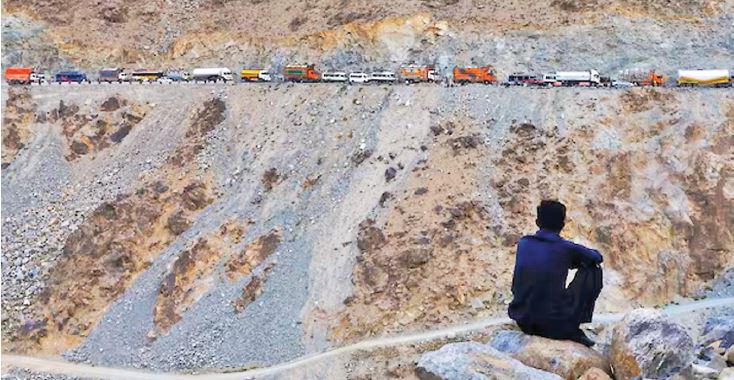
Protesters say the dispute revolves around delayed and inadequate compensation for land acquired for the Diamer-Bhasha Dam. Protest leader Niamat Khan said land was seized and payments were unjust and long delayed. Officials acknowledge PKR 3 billion is owed to landowners. Nearly PKR 2 billion has been transferred to the Kohistan deputy commissioner’s account, while the remainder is held up pending legal formalities.
For over a week a vital section of the Karakoram Highway has been blocked, severing the main road link between Gilgit-Baltistan and Khyber-Pakhtunkhwa. The stoppage began as a local protest in Harban, a village in Upper Kohistan, and has halted traffic at Harban Nallah. Hundreds of trucks and passenger vehicles remain stranded on both sides of the blockade.
Protesters say the dispute revolves around delayed and inadequate compensation for land acquired for the Diamer-Bhasha Dam. Protest leader Niamat Khan said land was seized and payments were unjust and long delayed. Officials acknowledge PKR 3 billion is owed to landowners. Nearly PKR 2 billion has been transferred to the Kohistan deputy commissioner’s account, while the remainder is held up pending legal formalities. Protesters reject these explanations and insist on immediate full payment and restitution for lost livelihoods.
The blockade has disrupted trade and supplies. Trucks carrying food, medicines and other essentials have been immobilised, pushing up prices of perishable goods including onions and tomatoes. Transporters have been forced to detour via the Babusar Pass, a route that is longer and more expensive. Increased transport costs have added to inflationary pressures in a region already facing economic fragility.
Civil society activists and local traders have criticised Khyber-Pakhtunkhwa and Gilgit-Baltistan administrations for their handling of the crisis. Traders in Gilgit said authorities appear indifferent while people suffer. The standoff has had particular impact in Diamer Valley districts such as Darel and Tangir. Residents there face difficulty reaching larger towns, including Chilas and Gilgit, for healthcare, education and trade. Stranded families warn that a prolonged deadlock could produce a humanitarian emergency.
Appeals from traders and commuters for talks have so far failed to end the protest. Demonstrators say they will continue the blockade until their demands are met. The disruption also poses an operational risk to the Diamer-Bhasha programme by delaying movement of materials and personnel and by increasing local tensions.
The Diamer-Bhasha Dam site lies on the River Indus near the boundary between Kohistan district in Khyber-Pakhtunkhwa and Diamer district in Gilgit-Baltistan. The site is 40 kilometres downstream of Chilas and 315 kilometres from the Tarbela Dam. When complete the dam will be 272 metres high and will create a reservoir covering 200 square kilometres with storage capacity of 8.1 million acre-feet.
The project is designed to deliver multiple benefits. Hydropower generation will be 4,500 megawatts, with an expected annual output of about 18 billion units of electricity for the national grid. Water storage will support irrigation of 1.23 million acres. The dam is intended to reduce flood risk by regulating Indus flows and to extend Tarbela Dam’s operational life by about 35 years through upstream sediment trapping. Plans include two underground powerhouses, one on each side of the main dam with six turbines each.
WAPDA reports it has spent PKR 78.5 billion on resettlement, infrastructure upgrades and social development projects. Among completed works is the Chilas Cadet College, built at a reported cost of PKR 2.1 billion.
Construction is a joint effort between China Power, a state-owned Chinese company, and Pakistan’s Frontier Works Organisation, a military engineering arm. In May 2020 a contract worth USD 5.85 billion, or PKR 442 billion, was signed. The project is part of the China-Pakistan Economic Corridor and has strategic implications given its proximity to the Chinese border. Pakistani officials say the dam is critical to addressing chronic energy shortages.
India has expressed strong opposition to the project, citing the location in Gilgit-Baltistan, which New Delhi regards as part of the former princely state of Jammu and Kashmir. New Delhi has said Pakistan’s construction violates India’s sovereignty.
What happens when the world’s richest technology entrepreneur puts his money, social media platform and political influence behind...

Chandigarh: Condemning the murder of anti-drug activist Parvinder Singh Jhota, BJP Rajya Sabha MP from Punjab Raghav Chadha...

Jammu: Joint security forces recovered a cache of arms and ammunition during a search operation in Jammu and...
New Delhi: The Centre on Tuesday cleared the appointment of two judicial officers as Additional Judges of the...
New Delhi: The Supreme Court on Tuesday issued notice to the Centre and the Election Commission of India...

Mumbai: Highlighting Maharashtra’s competitive edge, Chief Minister Devendra Fadnavis on Tuesday affirmed that the state stands at the...
Aries: The day will be auspicious...