Last Updated: October 15, 2026
Last Updated: October 15, 2026





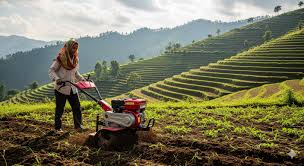
The Union Budget 2026-27 has placed a strategic bet on the agricultural sector by prioritising agri-tech — with significant funds mobilisation towards AI-driven advisory services, precision farming systems, and tech-enabled resource efficiency. While experts have welcomed the move as a step toward technology-led, outcome-driven agriculture growth aiming for enhancing productivity and farm incomes; yet, a crucial question remains: what will be its social implications, particularly for women farmers, and where do they stand in this unfolding transformation?
In recent years, digitalisation has moved to the centre of India’s agricultural policy imagination. Initiatives such as Digital Agricultural Mission or agri-based tech firms are being projected as a panacea to transform the sector through real-time crop monitoring, satellite-enabled weather alerts, targeted pest and nutrient management, or data-driven yields analytics. However, beneath this “techno-optimist” narrative lies a side that is often overlooked or does not attract adequate attention, creating a persistent blind spot: the structural “invisibilisation” of women farmers, whether smallholders, landless, Dalit, Adivasi or any other systemically marginalised agrarian labourers.
Despite constituting the backbone of India’s agrarian economy, women remain structurally marginalised within it. While nearly 85 per cent of rural women are engaged in agriculture, their labour continues to be undervalued and poorly recognised in official accounting systems. This produces a striking paradox: high participation but minimal visibility.
This marginalisation is rooted in a deeply gendered and male-centric agrarian terrain. Barely 13 per cent women have formal land-asset ownership, which directly restricts their access to institutional credit, subsidies, crop insurance and government support schemes. As a result a significant proportion of women remain heavily concentrated in “unpaid family labour” — a trend that has reportedly risen sharply over the past decade. This exclusion from asset ownership and formal farmer identity thus translates into limited bargaining power within households, weakens the role in decision-making, restricts their ability to access markets independently and their rightful place in programme policies which are often designed around the male member of a household as the default beneficiary. (Courtesy: DTE)
Singapore: Two Singapore-registered container vessels were reportedly struck by unknown projectiles while transiting the Strait of Hormuz on...

Shimla: The Himachal Pradesh government has constituted a four-member commission to examine the reorganisation of administrative units in...

New Delhi: The Supreme Court on Wednesday listed for November 17 the appeal filed by self-styled godman Asaram...

Ranchi: Doctors in Jharkhand launched a protest on Wednesday over a slew of demands concerning their safety and...

Greater Noida: Police and Anti-Narcotics Team in Uttar Pradesh’s Greater Noida have seized ‘ganja’ worth Rs 1 crore...

New Delhi: The Enforcement Directorate (ED) has attached assets worth Rs 2,032.81 crore belonging to Reliance Power Ltd...
