Last Updated: October 12, 2026
Last Updated: October 12, 2026





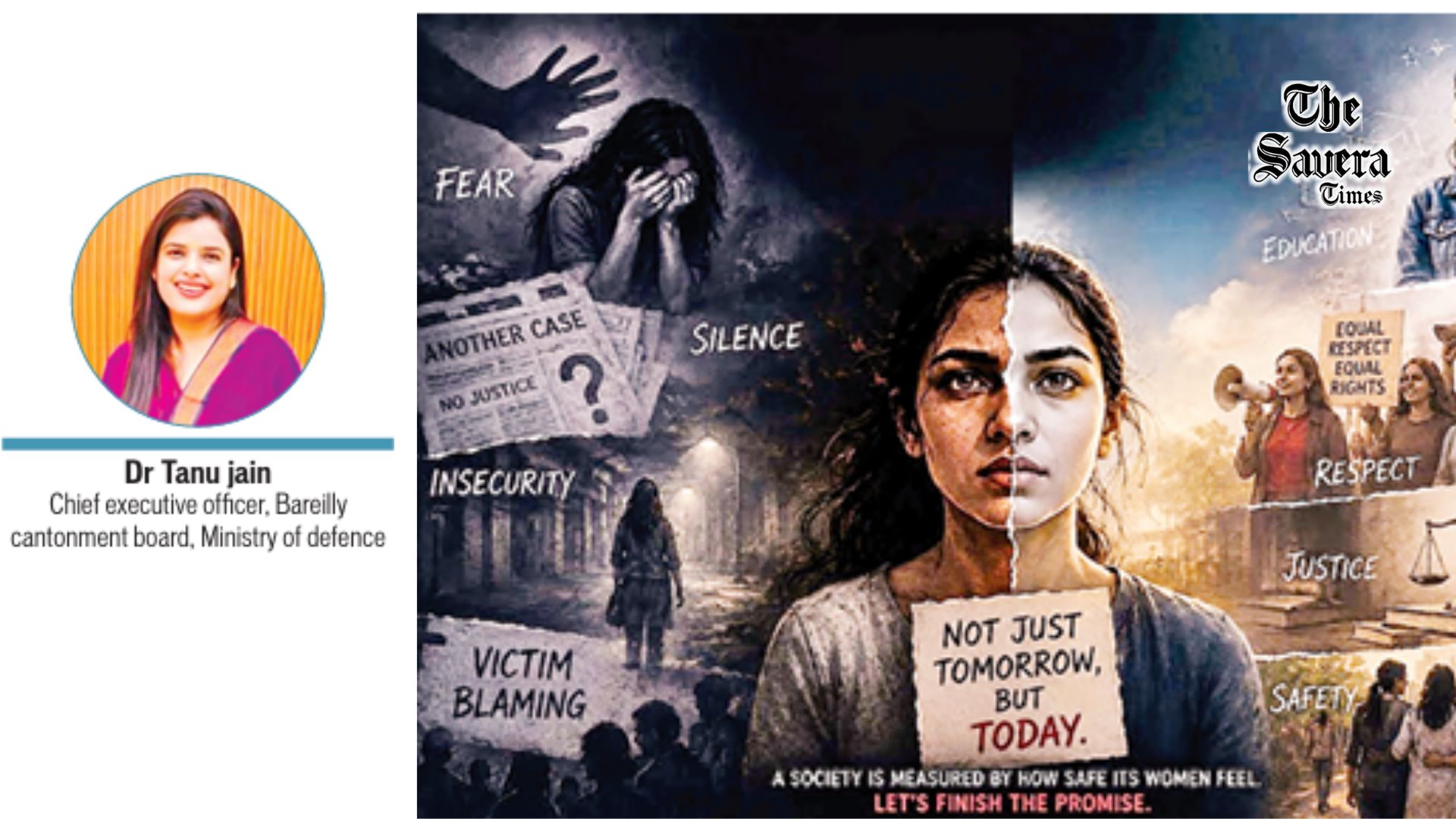
If a woman cannot live with dignity, freedom and safety, how civilised are we really? Last night, while scrolling through social media, I came across a reel that disturbed me deeply. I wish I could say it was unusual. But perhaps what troubled me most was the realisation that it was not. A woman being assaulted. A woman simply trying to live her life independently, as an ordinary human being, asking for protection—and still being subjected to violence, intimidation or humiliation. I kept thinking: Why is it still so difficult for a woman to simply live? We speak proudly of progress. We speak of technology, better healthcare, better education, artificial intelligence, space exploration and a world that is supposedly becoming more enlightened. We call ourselves a post-modern society. We have moved from ancient civilisations to industrial civilisation, from modernity to post-modernity. Thinkers have questioned power, identity, patriarchy and social structures. And yet, somewhere in this supposedly advanced world, a woman still has to think twice before saying no. Her safety is still negotiated. Her consent is still questioned. Her freedom is still sometimes treated as rebellion. And her independence can still become a reason for someone to punish her. This is not merely an Indian problem. It is a human problem. Sociologically, patriarchy explains much of this reality— the historical distribution of power in which men have disproportionately occupied positions of authority within families, institutions and society. Feminist theories have challenged these structures for decades. From liberal feminism’s emphasis on equal rights to radical feminism’s critique of deeply embedded structures of male power, the central question has remained: Who controls a woman’s choices? But perhaps we need to go one step further. Because laws alone cannot transform a society. A CCTV camera can record an assault. It cannot prevent the thinking that produces the assault. A police officer can register a complaint. But the deeper transformation must happen in the mind of the person who believes that another human being can be controlled, threatened or violated. Psychology tells us that behaviour is shaped by learning, reinforcement, social norms and observation. Albert Bandura’s social learning theory reminds us that people learn behaviours by watching others and observing what is rewarded or tolerated. If children repeatedly see aggression being normalised, women being blamed, consent being trivialised, or violence being dismissed as a “family matter”, those messages become part of the social environment in which they grow. That is why women’s safety cannot begin only at the police station. It must begin at home. It must begin when a little boy is taught that crying does not make him weak, but hurting someone does. It must begin when a girl is told that her boundaries matter. It must begin when parents teach children that no means no—not only in sexual relationships, but in every human relationship. It must begin in schools, where consent, empathy, emotional regulation, gender respect and responsible digital behaviour become part of education rather than occasional lectures. It must continue in colleges, workplaces and public institutions. And it must reach the digital world, where humiliation, stalking, threats and harassment can follow a woman even into the supposed safety of her home. So, are CCTV cameras relevant? Yes—but they are only one layer of the solution. Technology can deter, document and help investigate crime. Better street lighting, emergency response systems, safe public transport, well-designed public spaces, functioning helplines, rapid investigation and accountable policing all matter. But cameras cannot reform character. For that, we need something much harder: behavioural change. And behavioural change requires repetition, role models, consequences and culture. We need men to become active participants in creating safety— not merely observers of women’s suffering. We need bystanders to understand that remaining silent is not always neutrality. We need institutions to respond to complaints with seriousness rather than suspicion. We need society to stop asking a woman, “Why were you there?”, “Why did you trust him?”, “Why did you leave?”, “Why did you speak?” Perhaps the first question should simply be: “Why did someone believe they had the right to violate her?” This is also where psychology becomes important. Fear changes behaviour. A woman who repeatedly hears stories of assault begins to calculate routes, clothes, timings, transport, company and escape options. The burden of safety quietly shifts onto her. And that is profoundly unfair. Women should certainly be taught self-defence and safety awareness. But self-defence should be an additional shield, not society’s excuse for failing to become safer. I sometimes wonder what civilisation actually means. We have travelled from primitive tools to quantum computing. We can send machines beyond our planet, but can we create a street where a woman can walk without fear? We can build smart cities, but can we build empathetic societies? We can put cameras everywhere, but can we cultivate eyes that recognise injustice and hearts that refuse to tolerate it? Perhaps this is the real unfinished project of civilisation. Women’s safety is not a “women’s issue”. It is a measure of society itself. A country cannot truly call itself developed if half its population must constantly calculate the risks of simply existing. And perhaps the question we need to ask ourselves is not merely: “How do we protect women?” It is: “What kind of society are we creating in which women need protection in the first place?” That question is uncomfortable. It should be. Because sometimes discomfort is the beginning of change. And after watching that disturbing reel last night, I am left with only one thought—a thought I wish every home, every school, every police station, every institution and every government would ask: When will a woman be allowed to live—not cautiously, not fearfully, not conditionally—but simply and freely, as a human being? Until we can answer that, perhaps our civilisation still has a long way to go.
A Sudanese rights group says at least 72 gold miners were killed in an air strike near the...

An eyewitness has recounted the fatal Mini Cooper crash in Nedumbassery, Kochi, claiming the driver said his father...

Start your day with The Savera Morning Brief, bringing you the top India and world news, breaking developments,...

New Delhi: Chief Justice of India (CJI) Surya Kant has declined a request from the Congress-led INDIA bloc...

One of the most common questions people ask these days is how to lose belly fat. Belly fat...

Chennai: Prime Minister Narendra Modi on Sunday said India is moving forward with the dream of hosting the...