Last Updated: October 21, 2026
Last Updated: October 21, 2026





Parneet Sachdev
The Charaka Sutra Sthana, part of the larger Charaka Samhita, was likely composed over a period between the 4th century BCE and the 2nd century CE, with the core compilation attributed to Acharya Charaka, and the final sections completed by Dridhabala in the 6th century CE. The original text was written by Agnivesha, based on the teachings of Punarvasu Atreya. It says Balamarogyamayushchapranashchangnau
pratishthita, annapanendhanaishchagnirjwalativyetichanyatha
-Charaka Sutra Sthana, Chapter 28, verse 342
(Strength, health, longevity, and vital breath are dependent upon the power of digestion including metabolism. When supplied with fuel in the form of food and drinks, this power of digestion is sustained; it dwindles when deprived of it).
BEING A SUPERORGANISM
A recent review in Nature Reviews Gastroenterology & Hepatology has delivered what may be the most definitive statement yet in the field: our gut microbes are not passive fellow-travellers in digestion but active participants shaping metabolism, immunity and even mental health.
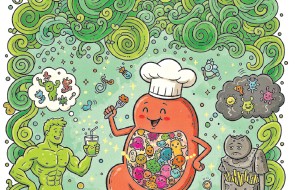
The trillions of microorganisms lining our intestines—collectively called the gut microbiome—feed along with us.
They transform what we eat into a cascade of biological signals that influence systems as far-flung as the brain, the liver and the immune cells patrolling our bloodstream (Nature Reviews Gastroenterology & Hepatology, 2025).
This idea is now reshaping medicine, nutrition and psychiatry. Today, a substantial body of scientific work has begun to map out how intimately the microbial world within us governs the physiological and psychological one we inhabit.
Technological change has allowed scientists to conduct large-scale studies. What has emerged is less a digestive system than an ecosystem, a densely networked colony of bacteria, fungi, archaea and viruses whose collective genome outnumbers ours by several orders of magnitude.
The implications are radical. Our bodies are not single organisms but composites—“superorganisms,” as some researchers call them—whose health depends on microbial harmony.
WILL YOU GET CANCER—YOUR FOOD MAY ANSWER
The gut, once imagined as little more than a muscular tube, turns out to be the control room of a biochemical economy linking food, immunity, metabolism and mood. The microorganisms within it digest complex carbohydrates we cannot, synthesize essential vitamins, and release metabolites that circulate far beyond the gut wall. These substances—short-chain fatty acids such as butyrate, acetate and propionate—affect the permeability of the intestinal barrier, regulate inflammatory pathways, and even alter gene expression in distant tissues(Cell Reports Medicine, 2025).
This is perhaps the most pathbreaking discovery. Imagine if you had a gene for a particular cancer. Whether it gets triggered or not will depend amongst other things on the foods you feed your microbiome.
MICROBIOME INFLUENCES THE MIND, IMMUNITY AND MUCH MORE
Perhaps most astonishing is the connection between the gut and the brain, a two-way conversation known as the microbiota–gut–brain axis. Through this system, microbes communicate via neural, hormonal and immune routes, influencing behaviour and cognition. The vagus nerve provides one direct link, ferrying chemical messages from gut to brain in milliseconds. Correlations have been found between specific microbial patterns and disorders such as depression, Alzheimer’s and Parkinson’s disease (PubMed 31460832; PMC10384867).
Roughly seventy percent of the body’s immune cells reside in the gut mucosa, constantly sampling microbial signals. When the microbiome is balanced, it trains the immune system to tolerate helpful species and react only to harmful ones. When it is disturbed—by poor diet, stress, antibiotics or infection—the immune system can misfire, producing chronic inflammation linked to obesity, diabetes, cardiovascular disease and even some cancers (PMC8291023).
FAT OR THIN
Obese individuals often exhibit a markedly different microbial composition than lean ones. Experimental transplants of “obese” gut bacteria into germ-free mice can induce weight gain without changes in diet, implying that microbes themselves affect energy harvesting and storage (PMC8291023). The same principle applies to glucose metabolism and insulin sensitivity: certain bacterial strains improve glucose regulation, while others impair it (PubMed 35105664). The microbiome thus becomes not only a by-product of what we eat but a determinant of how our bodies use what we eat.
BEING SCEPTIC IS NOT BAD
The global microbiome therapeutics and diagnostics market, valued at about $720 million in 2023, is projected to exceed $3.3 billion by 2030, according to Fortune Business Insights. Venture capital has poured into start-ups that promise to decode and engineer the microbiome—from Boston’s Finch Therapeutics to Paris-based Enterome—each seeking to turn microbial signatures into precision drugs and to design “functional foods” that feed beneficial bacteria.
Researchers caution that “gut-health” products marketed as panaceas often rest on correlations, not proven causality. The American Gastroenterological Association advises against routine probiotics for most digestive condition. Nonetheless, certain conclusions have grown difficult to ignore.
Microbial diversity—maintained by diets rich in plant fibre, legumes, and minimally processed foods—is consistently associated with better metabolic and cognitive outcomes
(PubMed 35468952).
Conversely, homogenised diets heavy in refined sugars, emulsifiers and artificial sweeteners appear to erode microbial variety, with measurable consequences for inflammation and insulin response.
Japan’s National Institute of Biomedical Innovation is testing dietary synbiotics—combinations of probiotics and prebiotics—as adjuncts to dementia care.
YOUR GUT BACTERIA KNOWS A LOT ABOUT YOU
Large studies called “PREDICT” in the UK, which tracked thousands of people eating consistent meals while wearing glucose monitors, show that
Genetics adds only modest predictive power, and in some cases microbiome data outperforms calorie and nutrient counts alone. Your microbes, it turns out, may know you more intimately than your DNA does.
It’s a virtuous cycle: what you eat today shapes the microbial community that will process tomorrow’s meals.
Why do people on identical diets experience wildly different health outcomes? Because each of us harbors a unique community of microbes. Some are especially skilled at making anti-inflammatory compounds, others are expert at wringing energy from starches, and a few are unfortunately proficient at manufacturing toxins.
The ratio of protein to fiber may matter more than total protein quantity.
Meal timing matters. Gut microbes keep their own biological clocks, synchronized with cycles of eating and fasting. Late dinners, practically a ritual in some Indian cities, can disrupt host and microbial circadian rhythms, with negative effects on metabolism and immune signaling.
Food companies are reformulating products around gut health principles, adding resistant starches and developing fermented product lines. Others simply sprinkle a bit of fiber onto ultraprocessed food and slap “gut-friendly” on the label.
What does this mean practically? Here is a useful rule of thumb: aim for different plant foods to support microbial diversity. Pair proteins with plants in combinations. Include fermented foods like dahi and idli, since trial data shows gains in microbiome diversity and reduced inflammatory markers.
Avoid processed foods in any form.
PHILOSOPHY OF EATING AND THE ENLIGHTENMENT IDEAL
Behind all this research lies a paradigm shift. The Enlightenment ideal imagined the human body as an autonomous machine, governed by a single consciousness. The microbiome reminds us that we are, in fact, collectives: microbial democracies negotiating daily compromises between health and disease. Feed the wrong constituents—through stress, processed food, or reckless antibiotic use—and the polity fractures; nourish it wisely, and it sustains your immunity, metabolism and mind.
Charaka says
Yet kinchitdoshmaasravyamnanirharatikayatah, aharjaatamtatsarvamhitayopapadhyate
Charaka Sutra Sthana, Chapter 26, verse 84
(All drugs and diets which dislodge the various Doshas from their proper place, but do not expel them out of the body are to be regarded as unwholesome).
Our age old knowledge is now being renewed with far greater vigour and with deep scientific rigour. Diet, long viewed through the lens of calories and macronutrients, is being reconceived as a means of ecosystem management. The old adage “you are what you eat” is being refined into a subtler truth: you are what your gut microbes eat.
(Views expressed are the author’s own).
Parneet Sachdev, IRS is the Chairman of Real Estate Regulatory Authority and a leading author.
Good Evening Viewers! Get the latest updates from India and around the world with The Savera Times Evening...

Bharatiya Janata Party (BJP) National General Secretary Smriti Zubin Irani launched a scathing attack on Congress MP and...

New Delhi: Cockroach Janata Party (CJP) leaders Saurav Das and Ashutosh Ranka will be released from judicial custody...

According to police, three suspicious young men are seen in CCTV footage. Efforts are underway to identify them....

A video has surfaced of an alleged attempted assault on Jan Suraj Party's Bihar president Manoj Bharti. The...

Two accused have been convicted and sentenced to 10 years of rigorous imprisonment in a 2017 drug trafficking...

Aries: The day will be auspicious...