Last Updated: October 24, 2026
Last Updated: October 24, 2026





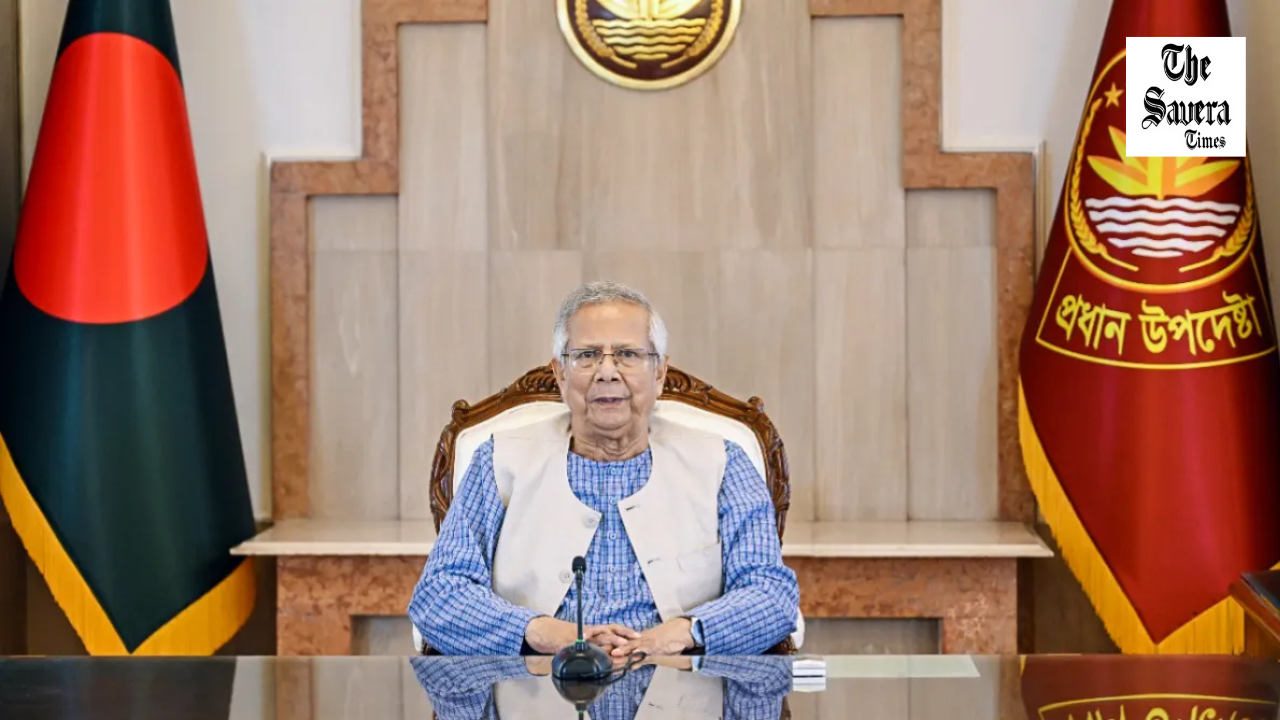
Dhaka — As Muhammad Yunus, outgoing chief adviser of Bangladesh’s interim government, delivered his farewell address on Monday, his remarks rekindled controversy both domestically and regionally. Facing mounting criticism over his 18-month tenure, Yunus used the televised speech to assert that Bangladesh had reclaimed its sovereignty, national interests and dignity in foreign policy. Analysts say his comments, particularly those touching on neighboring regions, were aimed not just at domestic audiences but also at signaling a recalibration in Dhaka’s external relations.
Yunus stressed that Bangladesh has moved away from what he described as “submissive foreign policy” a veiled critique of the previous government’s close ties with India. He declared the country “no longer guided by others’ directives” and positioned Dhaka as an assertive actor in South Asian geopolitics.
In a section of his speech that has drawn particular attention, Yunus highlighted the “immense economic potential” of deeper regional cooperation involving Nepal, Bhutan and the region commonly referred to as the “Seven Sisters” a term used for Northeast India’s eight northeastern states. Though he did not explicitly name India, his grouping of those states with sovereign countries in a regional economic vision has been seen as diplomatically insensitive and provocative.
“Our open seas are not just borders they are gateways to the global economy,” Yunus said, outlining a vision of economic zones, trade agreements and maritime access that would link Bangladesh with its neighbours’ hinterlands. This framing implicitly positions Dhaka as a key economic conduit for India’s landlocked northeastern region a narrative likely to raise eyebrows in New Delhi.
Observers note that Yunus’s emphasis on geopolitical autonomy comes at a politically sensitive moment, as Bangladesh transitions towards a new government following general elections that ended years of authoritarian rule by former prime minister Sheikh Hasina. Critics argue that his speech glossed over unresolved domestic issues, including concerns about democratic restoration and protection of minority communities.
In India, past remarks by Yunus about Bangladesh’s strategic role vis-à-vis India’s northeast have sparked criticism from officials and commentators. His comments during a previous visit to China suggesting Bangladesh’s access to the ocean was crucial for India’s northeastern states were described by some Indian political leaders as “offensive” and “strongly condemnable.”
Despite the controversy, diplomatic channels have remained muted, underscoring the calculated nature of Yunus’s messaging as Dhaka prepares for the incoming government led by Tarique Rahman of the Bangladesh Nationalist Party.
Yunus’s departure marks the end of a transitional phase in Bangladesh. While he framed his tenure as a period of restoring foreign policy autonomy, critics say his focus on external posturing overshadows unresolved domestic challenges particularly communal tensions and lingering questions over democratic stability. As the country turns a new page, his remarks will likely be remembered as a mix of nationalist rhetoric and diplomatic brinkmanship.
The Indian Army on Friday rejected claims on social media that the Army had taken action against the...

Abdul Majid Hakim Elahi, Iran's Supreme Leader's representative and senior diplomat, said on Friday that the US has...
New York, USA: The New York City Council has passed a law to ban horse-drawn carriages, naming the...

Washington: US President Donald Trump suggested that further military action against Iran remained possible, while acknowledging that the...

Lhasa: Sixteen people were killed and 32 others injured after a 7.0-magnitude earthquake struck Tibet on Thursday, according...

More than two weeks after the Yemeni government launched a major offensive against the Houthi group, front lines...

Aries: The day will be auspicious...