Last Updated: October 12, 2026
Last Updated: October 12, 2026





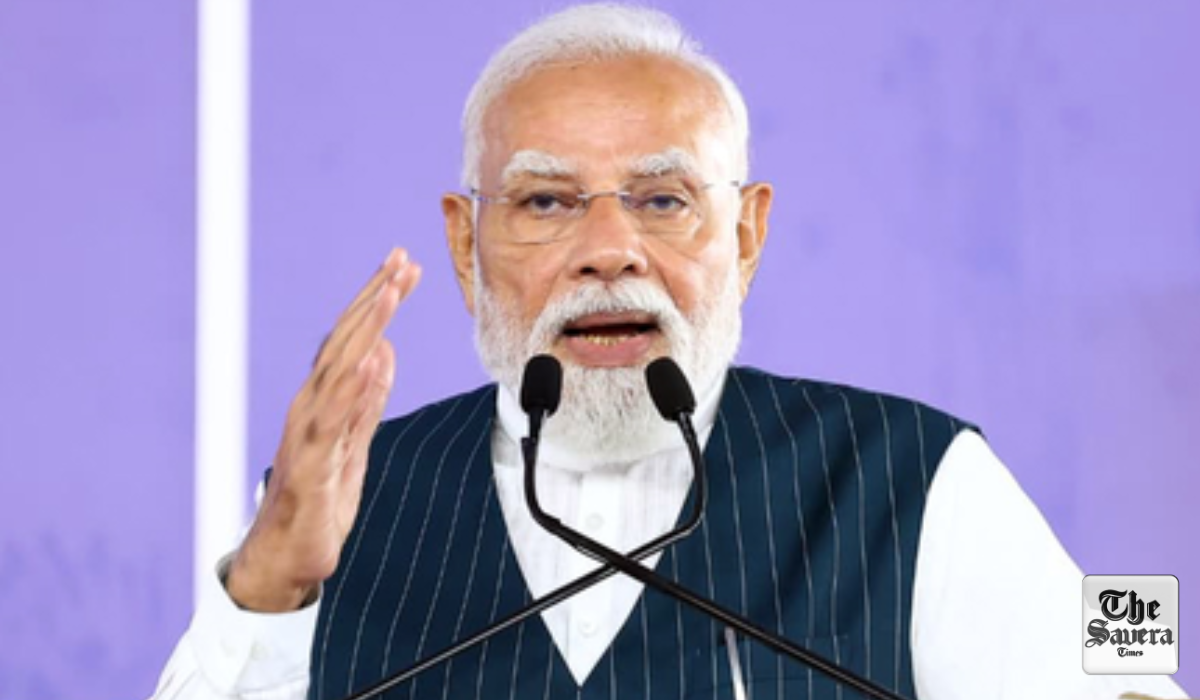
Official visits are usually measured in kilometres of roads, crores of rupees, and the number of foundation stones unveiled. Prime Minister Narendra Modi’s visit to Chandigarh and Jalandhar on 17 July deserves another measure—the distance travelled by the Indian state towards recognising communities whose contributions have long exceeded the respect accorded to them.
In Jalandhar, the Prime Minister inaugurated and laid the foundation stone for rail and road projects worth more than ₹5,470 crore. The programme included the redeveloped Jalandhar Cantonment Railway Station, a new railway line linking Daulatpur Chowk and Kartoli, National Highway projects, and a new train connecting the Amritsar region with Varanasi. In Chandigarh, projects worth more than ₹4,700 crore covered healthcare, education, and road infrastructure. Together, these projects represent a significant addition to the infrastructure of Punjab and its adjoining region.
Yet the most significant element of the visit may well be a train.
The new Chheharta–Varanasi train service has been approved by the Railway Board as the Sant Ravidas Express. It creates a direct rail connection between the Amritsar region and Varanasi, the city most closely associated with the life and teachings of Guru Ravidass. For devotees from Punjab, particularly the large Ravidassia community of the Doaba region, the train transforms a difficult pilgrimage into a more accessible journey. It is not merely transport infrastructure but also a cultural bridge.
This follows a series of important initiatives for the community. On 1 February 2026, marking the 649th birth anniversary of Guru Ravidass, Prime Minister Modi visited Dera Sachkhand Ballan in Jalandhar district, one of the most influential spiritual institutions for the Ravidassia community in India and abroad. During the same visit, he announced the renaming of Adampur Airport as Shri Guru Ravidass Maharaj Ji Airport, Adampur, honouring Guru Ravidass’s teachings of equality, compassion, and human dignity.
These are not merely symbolic acts of renaming.
Guru Ravidass challenged the belief that dignity should be determined by birth. His vision of Begampura—an ideal society free from sorrow, fear, discrimination, and oppressive hierarchy—was both a spiritual and social revolution. His hymns were later included in the Guru Granth Sahib, giving his teachings an enduring place in Punjab’s religious and moral heritage.
For centuries, however, many of his followers continued to occupy disadvantaged positions within the social and economic order. Punjab has the highest proportion of Scheduled Castes among all Indian states, with particularly large populations in the Doaba region, including Jalandhar, Hoshiarpur, Kapurthala, and Shaheed Bhagat Singh Nagar. These communities have made valuable contributions to agriculture, industry, public service, the armed forces, and Punjab’s successful overseas diaspora. Yet economic progress has not entirely removed social discrimination.
Recognition, therefore, matters. Communities seek not only welfare programmes but also a respected place within the national narrative—through airports, railway routes, public institutions, and official recognition.
Prime Minister Modi’s engagement with the Ravidassia community may also be viewed through a political perspective, particularly with the Punjab Assembly elections in 2027 approaching. However, electoral politics and genuine recognition are not necessarily contradictory. Democratic politics often compels governments to acknowledge communities that were historically neglected. The true test lies in whether symbolic recognition is accompanied by sustained development.
Judged by that standard, the July programme deserves attention.
The Jalandhar Cantonment Railway Station is one of 75 railway stations across 20 states redeveloped under the Amrit Bharat Station Scheme, with a total investment of approximately ₹1,570 crore. The redevelopment follows the principle of “Virasat Bhi, Vikas Bhi”, combining modern passenger amenities with architectural elements reflecting local culture and heritage. Passengers are expected to benefit from cleaner stations, improved accessibility, better circulation, and upgraded facilities.
The Daulatpur Chowk–Kartoli Railway Line, constructed at an estimated cost of ₹830 crore, forms part of the Nangal Dam–Talwara–Mukerian Railway Project. It strengthens connectivity between Punjab and Himachal Pradesh, particularly benefiting Hoshiarpur and Una, while also improving access to important pilgrimage destinations such as Anandpur Sahib and the Chintpurni Temple. A new Kartoli–Ambala train service will further enhance connectivity among Punjab, Haryana, and Himachal Pradesh.
Road infrastructure also forms an important part of the visit. The Prime Minister inaugurated Package-6 of the Delhi–Amritsar–Katra Expressway and laid the foundation stone for the six-lane Southern Ludhiana Bypass. The bypass is expected to reduce travel time between Ludhiana and Bathinda while improving connectivity to Punjab’s commercial centres. For a state whose industries often face logistical challenges, reducing transportation time and freight costs represents a significant economic advantage.
In Chandigarh, healthcare projects have an even wider regional impact. PGIMER serves as the principal tertiary-care medical institution for patients from Punjab, Haryana, Himachal Pradesh, Jammu & Kashmir, and neighbouring regions.
The Prime Minister inaugurated the 300-bed Advanced Mother and Child Centre, designed to provide specialised care for high-risk pregnancies, critically ill newborns, and children requiring advanced treatment. He also inaugurated the Advanced Neurosciences Centre, bringing together neurology, neurosurgery, neuro-critical care, and diagnostic services under one roof. In addition, he laid the foundation stone for a 150-bed Critical Care Block under the Pradhan Mantri Ayushman Bharat Health Infrastructure Mission.
For families across Punjab who regularly depend upon PGIMER for specialised treatment, these projects mean increased healthcare capacity, more specialised services, and potentially shorter waiting times during medical emergencies.
The Prime Minister also inaugurated the six-lane Greenfield Highway connecting IT City with Kurali in Mohali district. The project is expected to improve travel between Mohali, Kharar, and Kurali, while strengthening connectivity with Haryana, Himachal Pradesh, and Jammu & Kashmir. He also laid the foundation stone for the PR-7 Spur of the Ambala–Chandigarh Greenfield Highway, enabling long-distance traffic to bypass congestion around Zirakpur.
Infrastructure projects are ultimately judged not by announcements but by results. Citizens will assess them on whether trains operate efficiently, hospitals provide timely care, and roads genuinely reduce congestion and improve connectivity.
At the same time, public policy also has an important moral dimension. A railway connecting pilgrims to Varanasi, an airport named after Guru Ravidass, and an official visit to Dera Sachkhand Ballan cannot by themselves erase centuries of discrimination. Nor should they be viewed as substitutes for quality education, economic opportunity, equal representation, and the effective enforcement of equal rights.
However, they can signal that the Republic is beginning to recognise communities that history has too often overlooked.
The broader significance of Prime Minister Modi’s Punjab visit lies in combining cultural recognition with substantial investments in railways, highways, healthcare, and education. While debates over Centre–State relations will undoubtedly continue, they should not overshadow initiatives capable of improving the daily lives of the people of Punjab.
Guru Ravidass envisioned a society free from discrimination and imposed inferiority. Modern governments cannot create Begampura, but they can build institutions and infrastructure that make dignity more meaningful—a train carrying devotees to a sacred city, an airport bearing the saint’s name, a hospital caring for vulnerable children, and roads that bring opportunities closer to people’s lives.
That is a meaningful commitment, provided every inauguration is followed by efficient implementation and lasting public benefit.
The Gujarat Anti-Terrorist Squad (ATS) and the Valsad Special Operations Group (SOG) have arrested three accused in the...
The Aam Aadmi Party (AAP) strongly condemned Modi’s Delhi Police for entering Gurdwara Sri Bangla Sahib wearing shoes,...
The Aam Aadmi Party (AAP) Punjab on Saturday stood firmly with the youth-led Cockroach Janta Party (CJP) protest...
MOHALI (SAS NAGAR): Chief Minister Bhagwant Singh Mann on Saturday launched the final phase of ‘Yudh Nashean Virudh’...
Punjab’s ‘Sikhiya Kranti’ is bringing 21 lakh parents together with the Bhagwant Mann Government to transform 19,200 government...
Chief Minister Bhagwant Singh Mann has directed all departments to ensure world-class arrangements for the Asian Cup Hockey...
Aries: The day will be auspicious...