Last Updated: October 18, 2026
Last Updated: October 18, 2026





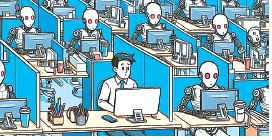
A new global survey has revealed a growing trend among companies across sectors: artificial intelligence is increasingly being chosen over human workers. As automation expands, businesses are scaling back on hiring, particularly in junior and entry-level positions, reshaping the future of employment and raising questions about how young professionals will gain experience in an AI-dominated economy.
According to the survey, 41 percent of business leaders said that AI adoption has already reduced their workforce. Many companies now rely on AI systems to perform tasks that were traditionally assigned to entry-level employees, from data entry and analysis to customer support and content creation. The report adds that two-fifths of respondents confirmed they had cut junior roles due to AI integration, while nearly a quarter believe that most entry-level work could soon be automated altogether.
The global employment data appears to back this trend. In 2025 alone, more than 180,000 technology jobs have been eliminated worldwide. This comes alongside a noticeable drop in early-career opportunities. In the United States, for instance, job postings for entry-level positions fell by 15 percent last year, as firms across industries—from finance to media and software—redirected investments toward automation tools and AI infrastructure.
The impact has been particularly sharp among younger workers. Employment among 22- to 25-year-olds in roles exposed to AI automation has reportedly fallen by 13 percent since 2022. Economists and workforce experts warn that the decline of such roles may hinder skill development and limit career progression for a generation entering the workforce at a time of unprecedented technological disruption.
Traditionally, entry-level positions have been the first stepping stone for fresh graduates to gain on-the-job experience, develop practical skills, and build professional networks. However, as AI-driven systems take over repetitive and routine tasks, many of these opportunities are disappearing. Experts say that while automation can make organizations more efficient, it also risks creating a gap between academic training and practical experience.
Large corporations are leading this transformation. Many have ramped up investment in AI tools to streamline operations, reduce costs, and improve productivity. From automated coding assistants in software firms to AI chatbots in customer service departments, the technology is proving both cheaper and faster than human labor.
Executives justify the shift as a business necessity. AI, they say, enables teams to do more with fewer people. It reduces errors, operates around the clock, and delivers quick insights from vast data sets. Yet, critics argue that the rapid pace of automation could come at a long-term cost, hollowing out the foundation of the professional workforce.
The World Economic Forum had earlier warned that AI adoption could displace millions of jobs while simultaneously creating new ones that require different skill sets. However, the balance between job losses and new opportunities remains uncertain. While AI-related roles—such as prompt engineers, data scientists, and machine learning specialists—are in high demand, these positions often require advanced training and technical expertise that most young graduates lack.
This widening skills gap presents a challenge for governments and educational institutions. Policymakers have been urging companies to invest in training programs to prepare workers for the changing job landscape. Some universities are also revising their curricula to include AI literacy and digital skills. But experts say progress remains slow compared to the speed at which automation is transforming workplaces.
Recruiters are also noticing the change. Many firms now prefer candidates who can work alongside AI tools rather than compete with them. As a result, soft skills—such as creativity, critical thinking, and emotional intelligence—are being valued more, as these are harder to replicate through machines.
Despite growing concern, most analysts agree that AI will not eliminate all entry-level roles but will redefine them. Future jobs may involve more supervision of AI systems rather than performing manual or repetitive work. For example, in marketing, young professionals may spend less time drafting reports and more time interpreting AI-generated insights. Similarly, in finance, analysts may rely on automated tools for basic data processing while focusing on strategic decision-making.
Still, the transition period poses significant challenges. For Gen Z workers hoping to start careers, fewer openings mean stiffer competition and longer job searches. For employers, it raises questions about where the next generation of talent will gain experience.
As automation deepens its reach across industries, experts believe the conversation must shift from job elimination to job evolution. The coming years, they say, will test how societies balance efficiency and opportunity in the age of artificial intelligence.
Increasing Houthi attacks on Saudi Arabia are testing Pakistan’s ability to defend Riyadh without affecting its ties with...

Nepal is seeking substantial financial assistance from India ahead of Prime Minister Balendra Shah’s proposed visit to New...

The race to succeed Antonio Guterres remains uncertain after three leading candidates faced opposition from two permanent members...

Democratic lawmakers have criticised Donald Trump for waiving key sanctions and tariff provisions under the Graham Act, citing...

Shipping Minister Sarbananda Sonowal confirmed that all 24 Indian seafarers aboard two vessels struck in separate incidents in...

Katie Zacharia has left her role as White House press secretary less than a week after her appointment....

Aries: The day will be auspicious...