Last Updated: October 22, 2026
Last Updated: October 22, 2026





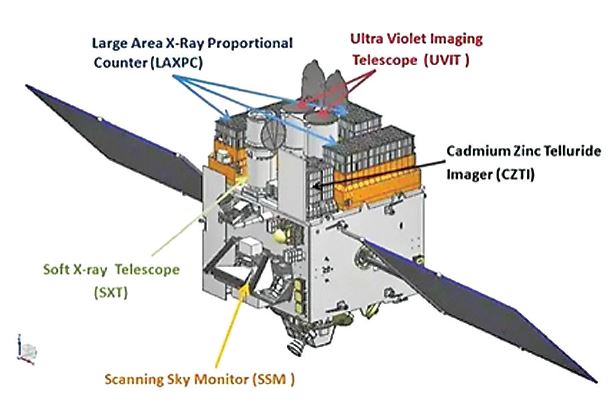
AstroSat, India’s first multi-wavelength astronomy observatory, has completed a decade of scientific observations, the Indian Space Research Organisation (ISRO) announced on September 28, 2025. Launched on September 28, 2015, the satellite has exceeded its planned life span and delivered a string of discoveries that have raised India’s profile in observational astrophysics.
AstroSat was placed into a 650-kilometre orbit by the PSLV-C30 rocket from Satish Dhawan Space Centre, Sriharikota. The observatory carried a lift-off mass of 1,515 kilograms and five scientific payloads designed to observe the universe across a broad energy range, from far-ultraviolet and visible light to high-energy X-rays. This simultaneous, multi-band capability makes AstroSat a versatile tool for studying diverse cosmic phenomena.
Among the mission’s headline achievements is the detection of far-ultraviolet photons from galaxies roughly 9.3 billion light-years away. That result relied on AstroSat’s ultraviolet instruments, described by ISRO as the sharpest and widest-angle UV eye in space. The observatory has also contributed important findings on high-energy phenomena, including the discovery of very fast-spinning black holes and detailed studies of X-ray emission from binary star systems in the Milky Way.
AstroSat resolved a two-decade-old puzzle about a red giant that appeared unusually bright in both ultraviolet and infrared wavelengths. The mission’s imaging and spectroscopic data have extended known structures in well-studied objects, notably showing that emission from the Butterfly Nebula extends up to three times the size previously recorded. The satellite has also enabled X-ray polarisation studies, captured rare episodes of a star appearing to “relive its youth,” and recorded instances of galactic mergers, all of which have added to understanding of stellar life cycles and galaxy evolution.
Beyond headline discoveries, AstroSat has become an instrument for capacity building. ISRO reports that the mission has engaged researchers and students from 132 Indian universities and built a global user base nearing 3,400 registered researchers from 57 countries. Roughly half of AstroSat’s users are Indian scientists and students, a contribution ISRO highlights as evidence of the mission’s role in popularising space science and expanding astrophysics research within India.
Operated by ISRO, AstroSat collects data from its five experiments to study black holes, quasars and supernovae, among other targets. The payloads continue to function, and ISRO stated that all five scientific experiments are working satisfactorily. Initially designed for a five-year operational life, the observatory has far outlived that benchmark and is expected to yield further results in coming years.
The decade of observations has also shown AstroSat’s value as a complement to international facilities. Its multi-wavelength approach allows simultaneous coverage that can be coordinated with ground-based telescopes and other space observatories, producing richer data sets for time-sensitive events such as flares, transient sources and binary interactions.
As AstroSat moves into its second decade, ISRO and the Indian astronomy community face the dual task of extracting further science from the existing instruments and using the mission’s legacy to inform future projects. The satellite’s record of discoveries, its academic reach, and its extended operational life together mark it as a milestone for Indian space science. ISRO has signalled confidence that AstroSat will continue to produce new results while helping to train a new generation of observational astronomers.
Good Evening Viewers! Get the latest updates from India and around the world with The Savera Times Evening...

Bharatiya Janata Party (BJP) National General Secretary Smriti Zubin Irani launched a scathing attack on Congress MP and...
New Delhi: Cockroach Janata Party (CJP) leaders Saurav Das and Ashutosh Ranka will be released from judicial custody...
According to police, three suspicious young men are seen in CCTV footage. Efforts are underway to identify them....
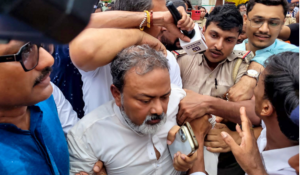
A video has surfaced of an alleged attempted assault on Jan Suraj Party's Bihar president Manoj Bharti. The...
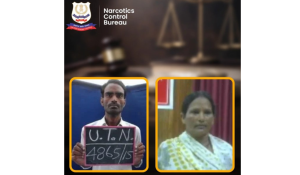
Two accused have been convicted and sentenced to 10 years of rigorous imprisonment in a 2017 drug trafficking...
Aries: The day will be auspicious...