Last Updated: October 10, 2026
Last Updated: October 10, 2026





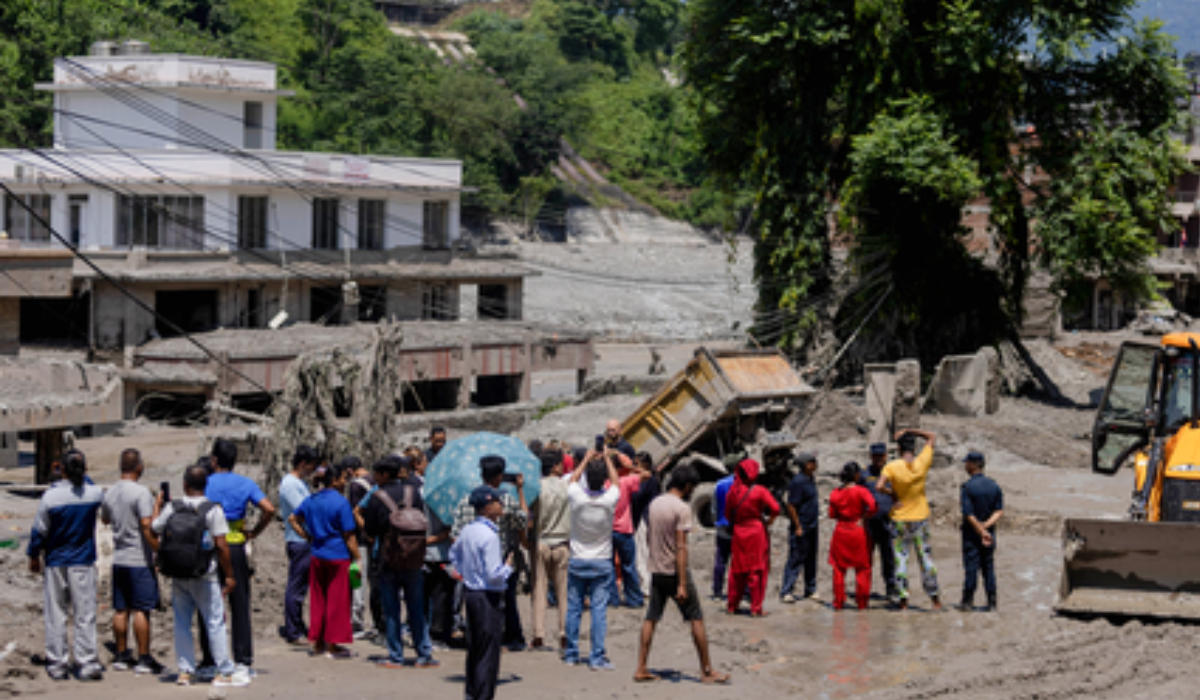
Nearly a month has passed since Nepal was rocked by multiple waves of floods. Nepal’s Ministry of Foreign Affairs has established an Environment Diplomacy Division for the first time to strengthen climate diplomacy amid devastating floods that have severely affected the country. The bodies of 1,411 people swept away by the deadly floods have been recovered, while 5,875 people — including Nepali and foreign nationals — remained missing as of Saturday evening following the devastating floods of August 26. Experts have identified global warming caused by climate change as a likely factor that contributed to the collapse of a Himalayan slope, triggering catastrophic flooding in Nepal. World Weather Attribution said in a report last week that human-caused global warming had thinned glaciers and thawed mountain permafrost, which likely contributed to the destabilisation of a Himalayan slope that collapsed on August 26, causing catastrophic flooding in Nepal. World Weather Attribution (WWA) is an international scientific collaboration that analyses whether and to what extent human-caused climate change influences the intensity and likelihood of specific extreme weather events. Warming and permafrost degradation likely weakened the source rock wall by increasing bedrock temperatures and thawing ice within fractures. Loss of ice bonding reduces fracture strength, while meltwater can increase water pressure and further destabilise preexisting geological weaknesses. Thus, permafrost degradation may have acted as an additional climate-related factor preconditioning the slope for failure. As the risk of disasters grows in the wake of the devastating floods, the Nepali government decided to establish a separate division within the Foreign Ministry to carry out focused climate diplomacy. The ministry decided to set up the division considering the growing impacts of climate change and the need to address emerging challenges through a dedicated institutional mechanism. Nepal has consistently participated in national, regional and international forums on climate change and environmental protection. The new division has been set up to advance these efforts in a more coordinated and institutionalised manner. The division will facilitate international diplomatic initiatives related to climate and environmental issues and coordinate with relevant agencies. Foreign Minister Shishir Khanal said Nepal has been continuously working on climate diplomacy at various international forums. Now, there is a need to institutionalise these efforts further. Climate diplomacy cannot be advanced simply by focusing on participation in events ranging from one Conference of the Parties (COP) to another or in other international programmes. The Minister also emphasised that climate diplomacy should not focus only on issues related to the impacts of climate change and disasters, but should regularly advance Nepal’s priorities and initiatives in climate diplomacy. The Foreign Ministry’s move comes just ahead of the 81st Session of the United Nations General Assembly (UNGA), where Nepal plans to raise the issue of climate change and its growing impacts on countries such as itself. The Nepali government has already decided that Prime Minister Balendra Shah will participate in the High-Level Week of the 81st Session of the UNGA. Nepal lost or disabled several critical hydrological monitoring stations during the devastating August 26 Bhote KoshiTrishuli flood, undermining the availability of real-time river data as the extreme flood wave moved rapidly downstream, according to a government assessment. The Assessment Report II, prepared by the Centre of Hydrology and Water Resources Research (CHWRR) under the Water and Energy Commission Secretariat of the Government of Nepal, said the flood was severe enough to destroy or disable several key hydrological monitoring stations along the Bhote KoshiTrishuli river corridor. The affected stations included those at Rasuwagadhi, Syaphru Besi, Betrawati and Phurke Khola in Malekhu, all located along the Bhote Koshi and downstream Trishuli river corridors, which were badly affected by the devastating floods, the report said. At Rasuwagadhi (Timure), data transmission ceased at 8:40 a.m., with the final recorded water level at 3.8 metres, after which the station was washed away by the flood in the Bhote Koshi River. At Syaphru Besi, transmission stopped at 8:50 a.m., when the last recorded water level was 1.62 metres, and the station was subsequently swept away by the deadly flood in the Bhote Koshi, a transboundary river between Nepal and China. The Phurke Khola station at Malekhu in Dhading district was destroyed after the water level exceeded the danger threshold at 11:43 a.m. The flood also washed away the associated bridge. The report said the loss of these stations “highlights the extreme nature of the flood event” and poses challenges for future monitoring in the affected region. The destruction of the monitoring network was particularly significant because the flood developed with exceptionally rapid propagation and a very short warning lead time. An assessment estimated that the flood wave travelled about 22 km from its source area to the Rasuwagadhi border in approximately seven minutes, at an average speed of about 188 km per hour. Following the loss of the hydrological stations at these sites, Nepal has installed a CCTV camera at Timure, Rasuwagadhi, to visually monitor river conditions. Likewise, the process of installing flood-monitoring systems in the Betrawati and Phurke Khola areas has been initiated. The locations for installing the flood-monitoring systems have been identified at these two locations following field visits. However, there are currently not enough flood-monitoring systems in place following the latest disaster.
Jaipur: The Anti-Narcotics Task Force (ANTF) of Rajasthan Police has arrested wanted drug smuggler Sohanlal, alias Sonu, carrying...

Imagine a foreign national standing among Indian citizens at a political protest, raising questions about the government or...

Aizawl: The Assam Rifles, in coordination with other law enforcement agencies, seized methamphetamine tablets and foreign-made cigarettes worth...
Kolkata: A Returning Officer (RO), acting on behalf of the Election Commission of India (ECI), has lodged a...

New Delhi: The Delhi BJP Mahila Morcha staged a protest on Saturday to demand the expulsion from Congress...
Sanaa: Saudi warplanes launched fresh airstrikes on Houthi-held areas in northwestern Yemen on Saturday as fighting intensified between...