Last Updated: October 18, 2026
Last Updated: October 18, 2026





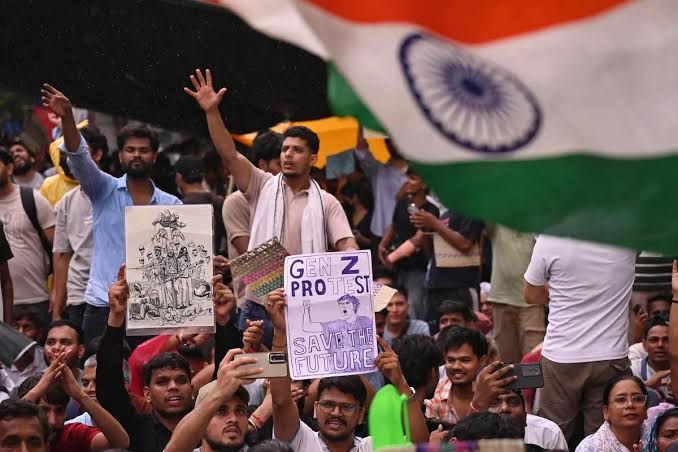
The rhetoric of regime change and the romanticisation of Bangladesh’s uprising risk undermining the very democratic institutions that protesters claim to defend. India’s democracy needs accountability, not a politics that treats street mobilisation as a substitute for the ballot.
The language of political protest in India is acquiring a troubling new vocabulary. What began as an agitation over the Election Commission’s Special Intensive Revision (SIR) of electoral rolls and allegations of electoral irregularities has increasingly become entangled with talk of regime change and inspiration from the upheaval in Bangladesh. Two recent interventions — by senior advocate Prashant Bhushan and student leader Neha Bora — illustrate why this shift deserves serious scrutiny.
At a press conference in New Delhi on October 15, Bhushan declared that the agitation was a battle for regime change. Around the same time, Bora, president of the All India Students’ Association (AISA), invoked the student-led uprising in Bangladesh, congratulating its participants for having shown the way. The remarks have understandably generated a political controversy, with the BJP alleging that the protests conceal a wider agenda to destabilise the elected government.
It would be simplistic to suggest that demanding a change of government is inherently undemocratic. Indeed, replacing governments is central to democracy. Every opposition party seeks to do precisely that. Bhushan is correct when he argues that citizens have a constitutional right to oppose the government and campaign for its removal.
But there is a crucial distinction between seeking political change through constitutional processes and invoking a movement whose defining outcome was the collapse of an elected government amid extraordinary street unrest. The distinction is not semantic. It goes to the heart of how a constitutional democracy is expected to function.
India is not Bangladesh, and the differences matter.
The uprising that forced Sheikh Hasina from office in August 2024 emerged from student protests against public-sector job quotas. It expanded dramatically following a violent state crackdown, ultimately culminating in Hasina’s flight from the country. The events exposed the dangers of authoritarian governance, but also the enormous institutional and human costs of political breakdown.
To celebrate that episode merely as a triumphant example of youth mobilisation is to overlook its darker consequences. Political upheaval does not automatically produce democratic renewal. The collapse of an established political order can create a vacuum in which institutional weakness, competing ideological forces and insecurity become more difficult to contain.
India’s constitutional framework offers a fundamentally different route to political change. Governments are elected for defined terms, Parliament provides a forum for opposition, courts exercise judicial review, and citizens retain the right to organise, criticise and mobilise peacefully. These institutions are imperfect, sometimes seriously so. Yet their imperfections strengthen the case for reform, not for treating constitutional continuity as an obstacle.
The Election Commission, in particular, must remain open to the closest public scrutiny. Questions about electoral rolls, voter exclusions, transparency and institutional independence deserve substantive answers. The credibility of elections depends not simply on the integrity of the process but also on public confidence that it is fair.
However, allegations of electoral manipulation cannot become established facts merely through repetition at political rallies. They require evidence, transparent examination and, where necessary, judicial intervention. Equally, the government and Election Commission cannot dismiss every criticism as an attempt to undermine democracy. Institutional credibility is built through accountability, not assertions of infallibility.
The danger arises when legitimate concerns about electoral administration are converted into a sweeping narrative that the entire democratic process has lost legitimacy. Such rhetoric risks producing a self-fulfilling crisis of confidence. Citizens may begin to believe that elections are meaningful only when their preferred political formation wins.
That is a profoundly corrosive proposition.
There is another reason why the Bangladesh analogy is particularly ill-judged. The scale of human suffering associated with that upheaval should caution against its romanticisation. A United Nations fact-finding report published in February 2025 estimated that as many as 1,400 people may have been killed during the protests and crackdown. It also documented retaliatory violence and attacks on vulnerable communities after the fall of the government. These are not incidental footnotes to a successful revolution. They are warnings about what happens when political confrontation overwhelms institutions.
India has its own rich tradition of democratic resistance. From the freedom struggle to the movement against the Emergency, mass mobilisation has repeatedly challenged arbitrary authority. But the enduring lesson of the Emergency is especially instructive. Indira Gandhi’s government was ultimately removed in 1977 through an election. The ballot, not the collapse of the constitutional order, delivered the verdict.
Victories in universities and colleges underline the organisation’s campus presence, with similar gains reported in Delhi, Punjab and...
A three year old Swarnlata Mishra was travelling with her father through Katni in Madhya Pradesh. As their...

In the past few years, incidents of religious conversion have been increasing in the country. Discussions about Christian...

India’s space sector is undergoing a rapid commercial transformation following policy reforms that have opened the industry to...

Can former Kerala Chief Minister Pinarayi Vijayan emerge from a barrage of investigations with his political reputation intact,...
The holy days of Navratri are currently underway. Dussehra and Diwali are near. This is followed by the...
Aries: The day will be auspicious...