Last Updated: October 26, 2026
Last Updated: October 26, 2026





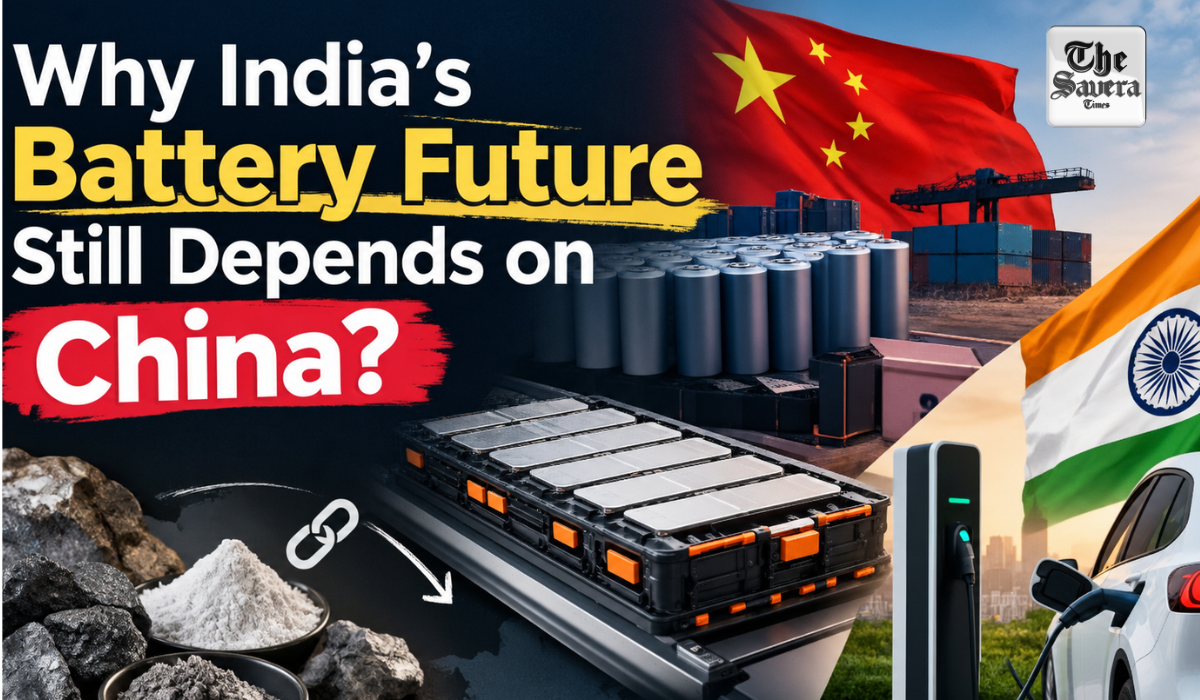
Think of an electric car, a solar power plant or a battery storage system. At the centre of all three is the same thing — the battery cell.
India’s demand for advanced chemistry cell batteries was about 28 GWh in 2025. Industry projections indicate this could rise to around 272 GWh by FY2030. At current cell prices, meeting that demand mainly through imports could create an annual battery import bill of more than $23 billion.
This is why India is racing to build its own battery manufacturing industry.
From Imported Cells to Indian Gigafactories
For years, India’s battery industry has largely focused on assembling imported cells into battery packs. By the end of 2025, India had around 60 GWh of battery-pack manufacturing capacity, but cell production was only around 1 GWh.
The government started changing this with the Advanced Chemistry Cell Production Linked Incentive scheme in 2021. The scheme has an outlay of Rs 18,100 crore and aims to create 50 GWh of domestic ACC manufacturing capacity. By 2026, 40 GWh had been awarded to four companies.
But execution remains a challenge. As of March 2026, only about 1 GWh of the awarded 40 GWh capacity had been installed.
Why China Is Still Difficult to Replace
Building a factory is only one part of the battery supply chain. India also needs lithium, graphite, nickel, cobalt, cathode materials, anode materials and specialised manufacturing equipment.
And this is where China becomes critical.
According to the International Energy Agency, China produces almost 85 per cent of global cathode active materials and more than 90 per cent of anode active materials, mainly graphite. China also has a dominant position in battery manufacturing and processing.
So even when a battery is assembled in India, some of the materials, components or technology behind it can still come from China.
India-China Ties: Cooperation and Competition
India and China have a complicated relationship. The two countries have long-standing economic links, but they also have an unresolved border dispute.
India recognised the People’s Republic of China soon after its establishment, but the relationship suffered a major setback after the 1962 border war. Relations improved significantly after Prime Minister Rajiv Gandhi’s 1988 visit to China, followed by years of diplomatic and economic engagement.
However, the 2020 border crisis again strained ties. India has since pushed for peace and disengagement along the Line of Actual Control. In October 2024, the two sides reached an agreement on patrolling arrangements in Depsang and Demchok.
This creates a difficult balance. India wants to reduce strategic dependence on China, but completely removing China from supply chains is not easy.
What India Is Trying to Do
India is now looking beyond gigafactories. The National Critical Mineral Mission, approved in 2025, aims to strengthen the entire critical-mineral chain — from exploration and mining to processing and recycling.
India is also encouraging battery recycling and domestic production of components such as cathode and anode materials.
The challenge is speed. Battery demand is rising much faster than domestic cell manufacturing.
The Bigger Question
India’s battery race is therefore not simply about making batteries in India. It is about controlling the supply chain behind them.
If India succeeds, batteries can become a new pillar of domestic manufacturing, electric mobility and renewable-energy security.
But if cell production grows without local raw materials, components and technology, India could simply replace dependence on imported oil with dependence on imported batteries.
And that is the real strategic question behind the $23-billion battery race: Can India build a battery industry that is truly Indian — or will China remain hidden inside the supply chain?
Imagine opening WhatsApp on your phone, but the SIM card linked to your account is not inside the...

Delhi’s air pollution is once again raising health concerns, with the Air Quality Index (AQI) entering the ‘poor’...

Ladakh is seeing two changes at once: a new district has been announced, and the Centre has proposed...

What if a decision taken in Washington could influence India’s oil bills, export earnings and trade relations with...

What happens when the world’s richest business leaders clash over one of the world’s biggest internet markets? A...

Pakistan is heading into its wheat-growing season with a serious water problem. The country is facing a projected...
Aries: The day will be auspicious...