Last Updated: October 22, 2026
Last Updated: October 22, 2026






For decades, Punjab’s green fields have fed India. But the state that still delivers ~17% of the nation’s wheat and ~12% of rice is facing a double squeeze: groundwater running dry in 117 of 153 blocks and farm incomes trapped in the wheat-paddy treadmill. The question is no longer whether Punjab can keep sowing the same way; it’s whether a new policy architecture can keep its villages viable.
The Centre’s approach in 2024–25 has been both direct and structural. PM-KISAN, the Rs 6,000 annual support scheme, remains the anchor. On September 26, 2025, its 21st installment was advanced for Punjab, Haryana and Himachal Pradesh—Rs 540+ crore sent digitally to 27 lakh farmers battered by floods. Critics scoff at the modest sum. But for a tenant farmer in Sangrur, it means seed without a moneylender. The key is its reliability: 11 crore farmers nationwide, Rs 3 lakh crore disbursed since 2019, with leakages near-zero thanks to Aadhaar-linked transfers.

Structural fixes are where the real transformation lies. The Agriculture Infrastructure Fund (Rs 1 lakh crore corpus) has begun bankrolling cold storages, dryers and decentralised warehouses. Punjab’s cooperatives have plugged into the World’s Largest Grain Storage Plan, designed around Primary Agricultural Credit Societies (PACS). If scaled, this ends the “distress sale” trap that shaves 10–15% off farm gate prices.
Meanwhile, the Centre’s Viksit Krishi Sankalp Abhiyan (VKSA)—a fortnight-long outreach in May–June 2025 across 700+ districts—brought farmers face-to-face with natural farming methods, crop diversification models, and water-saving practices. The science is clear: ICAR studies show input costs fall 20–30% under natural farming. In a state where 40% of soil is degraded, the cost savings may matter more than ideology.
Technology is being quietly mainstreamed. The Digital Agriculture Mission (Rs 2,817 crore) and the broader Crop Science outlay (Rs 3,979 crore) push AI-powered crop estimation, geospatial advisories and digital credit scoring. In a sector where 86% of holdings nationally are small and marginal, these tools aren’t luxuries—they are access to survival. Punjab, with its literacy and cooperative networks, could be the fastest adopter.

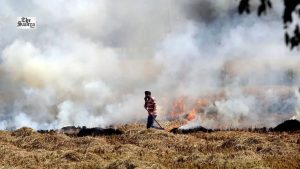
Perhaps the biggest climate dividend comes from stubble-burning. Punjab recorded just 10,909 incidents in 2024, down from 36,000+ the year before—its lowest in decades. Subsidised machinery, crop residue management schemes, and biomass linkages all played a role. Yes, the data isn’t perfect: some analysis suggests burnt areas may have grown larger even if the number of fires fell. But for Delhi NCR’s lungs, this is the first good news in years.
The Centre is also nudging Punjab towards bio-based value chains. The BRIC–National Agri-Food Bio-Manufacturing Institute, inaugurated in Mohali in October 2024, is developing enzyme technologies and high-yield sustainable crops. For a state stereotyped as stuck in “mandi politics,” this is a glimpse of a very different agri-future—higher value per acre, fewer litres per kilo.
Yet challenges are real. PRS Legislative Research classifies Punjab’s water use as “highly stressed.” Smallholders still form the overwhelming majority, but access to markets, insurance and tech is uneven. The announced Punjab Kisan Loan Waiver/interest-free programs remain patchy.
What is clear is that Delhi has put its heft where Punjab needs it most: stabilising incomes, investing in storage, cutting input costs, and giving technology scale. If Chandigarh complements this with state-level irrigation reform and enforcement of crop diversification, Punjab could again lead India’s farm story—this time with pumps turned down, not up.
Member Parliament Gurmeet Singh Meet Hayer today said that in a monumental milestone for the state’s sporting history,...

The Punjab government has suspended DSP Harjinder Singh Gill and drug inspector Naresh Kumar in connection with the...

To honour the valiant police personnel who laid down their lives while fighting militants and criminals for the...

Punjab government employees are observing a two-day mass casual leave protest on October 21 and 22. The agitation...

Punjab Police have arrested seven people in a suspected drug, arms and explosives smuggling case in Amritsar. A...

Punjab has reported 404 stubble-burning incidents, with Tarn Taran and Amritsar accounting for the highest numbers. Authorities have...
Aries: The day will be auspicious...