Last Updated: October 15, 2026
Last Updated: October 15, 2026





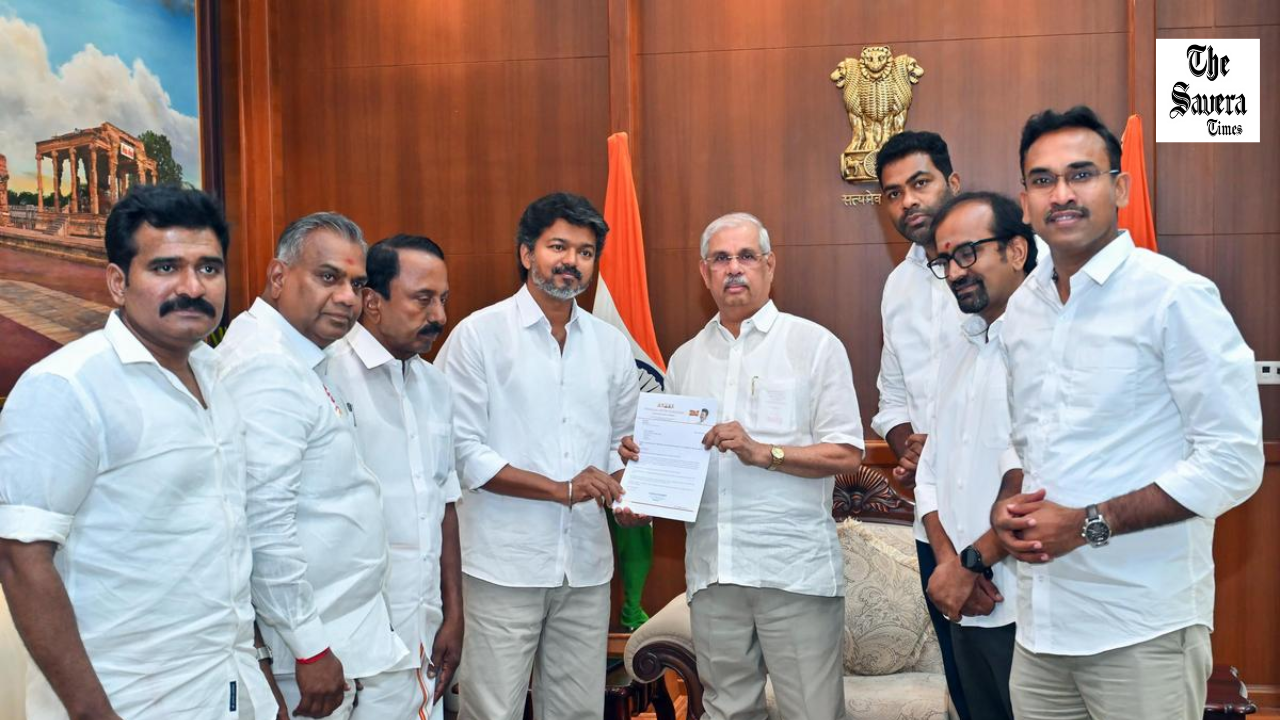
In the aftermath of the 2026 Tamil Nadu Assembly elections, the debate surrounding the Governor’s role in government formation has once again brought constitutional propriety and political morality into sharp focus. The fractured mandate delivered by the electorate has created a situation where no single party has secured the majority mark in the 234-member Assembly, compelling the Governor to exercise constitutional discretion before inviting any claimant to form the government. The controversy emerged after TamilagaVettriKazhagam (TVK), led by actor-turned-politician Vijay, staked claim to form the government despite falling short of the required majority. TVK reportedly secured 108 seats and, even with the support of Congress MLAs, remained below the 118-seat majority mark needed to establish a stable government. In this backdrop, Governor RajendraArlekar sought documentary proof of majority support before taking a decision on government formation. Critics have accused the Governor of delaying the democratic process and denying the single-largest party an opportunity to prove its strength on the floor of the House. However, constitutional experts argue that the Governor’s responsibility is not merely ceremonial. Under Article 164(1) of the Constitution, the Governor appoints the Chief Minister, but this power is linked to the expectation that the chosen leader is capable of commanding majority support in the Assembly. In situations involving a hung verdict, the Governor acts under discretionary powers provided by Article 163 to determine who is most likely to provide a stable administration. The central concern behind the Governor’s cautious approach appears to be the possibility of political horse-trading. Inviting a party that clearly lacks the numbers and granting it time to secure support could potentially trigger unethical political negotiations, defections, and instability. Supporters of the Governor’s stance argue that insisting on written letters of support before swearing in a Chief Minister is not anti-democratic, but rather an attempt to preserve the sanctity of the mandate given by the people. The constitutional debate has also revived references to several past precedents. The Supreme Court’s landmark judgment in S.R. Bommai v. Union of India is often cited in such situations, particularly for its emphasis on floor tests as the ultimate method of proving majority. However, constitutional scholars point out that the Bommai ruling primarily dealt with the dismissal of elected governments under Article 356 and did not eliminate the Governor’s discretion before appointing a Chief Minister in a hung Assembly. Similarly, the political history of Karnataka offers multiple examples of differing gubernatorial decisions in hung assemblies. In 2004, the Governor invited the post-poll Congress-JD(S) coalition despite the BJP being the single-largest party, as the alliance had demonstrated a clear majority. In 2008, the BJP was invited first as the largest party and later secured the required numbers with external support. Again in 2018, the Governor invited the BJP to form the government even though Congress and JD(S) claimed majority support together, leading to intense political and legal debate before a floor test was ordered by the Supreme Court. Against this backdrop, the Tamil Nadu situation reflects the continuing ambiguity surrounding conventions in coalition-era politics. The Constitution does not provide a rigid formula for government formation in a hung Assembly, leaving room for interpretation and discretion. Much depends on whether the Governor prioritises the single-largest party, a pre-poll alliance, or a post-poll coalition that can demonstrate majority support on paper. At a broader level, the issue is not merely about one political party or one Governor. It is about balancing democratic legitimacy with constitutional stability. A hurried invitation without verified support could lead to a failed trust vote, political uncertainty, and even fresh elections – an outcome that neither the administration nor the public would welcome. In that sense, the Governor’s insistence on concrete proof of majority may be viewed less as a political intervention and more as an institutional safeguard. Whether one agrees or disagrees with the approach, the Tamil Nadu episode underlines the larger challenge of maintaining constitutional balance in an increasingly fragmented political landscape.
New Delhi: The Delhi High Court on Thursday recorded the assuarance by Delhi Polices promise that all legal...
New Delhi: The Ministry of Defence on Thursday said it has signed contracts worth Rs 4,106 crore for...

Patna: An Excise Department constable was killed after suspected liquor smugglers and an alleged accomplice opened fire on...

New Delhi: Amid the ongoing protests, investigators have found that certain elements backed by Pakistan launched a multi-layered...
Good Afternoon Viewers! Stay updated with The Savera Times Afternoon Bulletin, bringing you the latest news from Punjab,...

New Delhi: Heavy rain and thunderstorms swept parts of Delhi-NCR on Thursday as dark clouds covered the national...
Aries: The day will be auspicious...