Last Updated: October 21, 2026
Last Updated: October 21, 2026





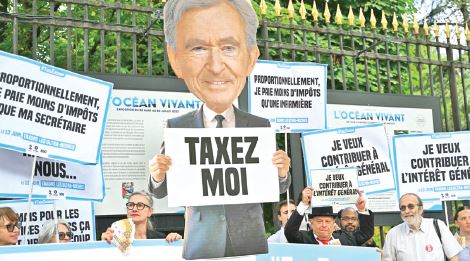
France is preparing for a major battle over a proposed tax on the ultra-wealthy, a measure that has split opinion across politics, business, and academia. At the center of the debate is French economist Gabriel Zucman, whose name has become synonymous with the plan that could reshape how wealth is taxed in one of Europe’s most unequal economies.
The proposal, widely referred to as the “Zucman tax,” comes at a time of political instability. President Emmanuel Macron has faced successive government collapses as efforts to pass austerity budgets have triggered no-confidence votes. His newly appointed prime minister, Sébastien Lecornu, is now under pressure to deliver a budget by early October, balancing the demands of Socialists in his coalition with opposition from the right.
What is the ‘Zucman tax’?
Gabriel Zucman, a professor at Paris’s École Normale Supérieure and the University of California, Berkeley, rose to prominence after conducting a study for the G20 on the impact of wealth taxation. Backed by Nobel Prize-winning economists, he argues for a two per cent levy on households with assets exceeding \$117 million (Rs 1.03 lakh crore).
The plan would affect around 1,800 households in France and, according to Zucman, could raise as much as \$23 billion (Rs 20.28 lakh crore) annually. That figure is nearly half the savings targeted in the austerity budget of former prime minister François Bayrou, whose government fell earlier this year. Zucman bases his argument on the rapid increase in the share of wealth controlled by the richest. In 1996, France’s wealthiest held assets equivalent to 6 per cent of GDP. Today, that figure stands at 40 per cent.
Studies by the Institute for Public Policy (IPP) suggest billionaires in France currently pay an effective rate of just 0.3 per cent of their net worth in taxes, far lower than middle-income households. While the top 0.1 per cent of earners contribute around 46 per cent of their income in taxes, the billionaire class pays only about 26.2 per cent, using holding companies and other structures to minimize liabilities.
Why is it different from earlier wealth taxes?
France has experimented with wealth taxes before. The solidarity tax on wealth (ISF) once covered real estate, savings, and investments, while its successor, the real estate wealth tax (IFI), focuses only on property. The Zucman tax goes further, covering all assets and applying only to households above the \$117 million threshold.
By comparison, the IFI affects around 186,000 households and generates about \$2.6 billion (Rs 2.28 lakh crore) annually. Zucman insists his proposal would bring in nearly ten times that amount. Critics, however, argue the real figure may be closer to \$6 billion, warning that the ultra-rich could restructure their finances or move abroad. Zucman disputes this, citing studies suggesting only a handful of billionaires would consider leaving France.
Billionaires push back
France’s wealthiest citizens are pushing back strongly. Bernard Arnault, Europe’s richest man and head of luxury group LVMH, has warned the tax would “destroy the French economy.” With a personal fortune of \$169 billion (Rs 148.95 lakh crore), Arnault argues the proposal reflects ideology rather than sound economics.
Zucman has responded by insisting that the measure is not punitive but corrective. “Billionaires would pay as much – but no more – than the social categories directly below them,” he told Le Monde. He has also warned of the risks of unchecked wealth concentration, writing earlier this year that “unprecedented wealth concentration – and the unbridled power that comes with it – has distorted our democracy and is driving tensions.”
The political test
The Socialists, who are key to Macron’s fragile coalition, are pressing for the tax to be included in the 2026 budget. The left already succeeded in pushing it through the lower house earlier this year, though it was blocked in the Senate. Now, with Macron’s government vulnerable to another no-confidence motion, Lecornu may have little choice but to accommodate their demands.
Still, constitutional hurdles remain. Legal experts point to jurisprudence against “confiscatory” taxation, warning that a levy aimed exclusively at billionaires could face challenges. Zucman counters that the principle of equal taxation is enshrined in the 1789 Declaration of the Rights of Man and Citizen. “The current system violates that principle,” he argues. “This proposal simply restores equality before taxation.”
For now, the French public appears firmly behind him. A survey by the French Institute of Public Opinion found 86 per cent support for the Zucman tax, including 92 per cent among voters of Macron’s own Renaissance Party.
With Lecornu walking a political tightrope and billionaires sounding alarms, the fate of the proposal will determine not only France’s fiscal future but also whether the government can survive its latest test.
A Cessna 177A crashed onto Capitol Expressway in San Jose on October 17. Three people on board, including...

Protests in Jakarta, Yogyakarta and Bandung brought students onto the streets over rising costs, forest fires and civil...

Organisations linked to Neville Roy Singham are under US congressional scrutiny over funding. Their coverage of protests in...

US President Donald Trump says Washington and New Delhi are close to a trade agreement that will differ...

Iran has ruled out transferring its enriched uranium stockpile outside the country, with security official Mohsen Rezaei reiterating...

Donald Trump has urged Volodymyr Zelensky to pursue a peace deal with Russia, warning that Ukraine could face...

Aries: The day will be auspicious...