Last Updated: October 12, 2026
Last Updated: October 12, 2026





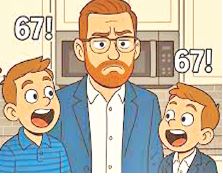
Every few months, a new social media trend takes hold among young users, spreading across schools and shaping how children communicate. Some are creative or amusing, while others are strange, senseless, or even disruptive. The latest example is the viral “6-7” phenomenon, in which students in the United States, the United Kingdom, and Australia yell “six-seveeeen” across classrooms and hallways, often while making a hand gesture. The fad has become so widespread that several schools have banned the phrase, calling it a classroom menace.
Despite appearing numerical, the trend has nothing to do with mathematics. Its origins trace back to a song titled Doot Doot (6 7) by American rapper Skrilla. The phrase appears in the song’s chorus, and while some speculate it may reference the U.S. police code “10-67” used to report a death, this has not been confirmed. Shortly after the song’s release, U.S. high school basketball player Taylen Kinney popularised the “6-7” gesture on TikTok, where he has more than a million followers. As his videos spread, the trend gained traction among teenagers, sports creators, and meme accounts. It has since appeared in pop culture, including an episode of Abbott Elementary and as the central joke in the 28th season premiere of South Park.
While the sound and gesture are instantly recognisable, their meaning remains uncertain. Teenagers offer conflicting explanations — some say it refers to something being “so-so,” others claim it’s used to describe someone tall, while many admit it means nothing at all. A middle-school student in California told The Times that it is simply random but funny, and that most students enjoy being part of the joke. Teachers, however, say the confusion is part of the appeal. As one educator put it, “Nobody knows what it means, and that’s kind of the funny thing about it.”
Experts say the “6-7” trend serves a deeper social function despite its apparent meaninglessness. Linguist and social scientist Taylor Jones described it as a “shibboleth” — a phrase that signals belonging to an “in-group.” Similarly, Gail Fairhurst, a communication professor at the University of Cincinnati, called it a “language game” where participation shows social inclusion. Child psychologist Jennifer Wills Lamacq explained that such in-jokes are a normal part of adolescent development. They help children feel connected and create a shared identity that excludes adults. “As children grow older, belonging to a group becomes very important,” she said. “‘Six seven’ is ideal because it’s totally meaningless. You either know or you don’t, and that makes it powerful.”
For teachers, though, the trend has become a serious classroom distraction. Some say it interrupts lessons every time the numbers six or seven are mentioned. “I’ve been teaching for 20 years and I’ve dealt with all sorts of slang — nothing has driven me crazier than this one,” said Adria Laplander, a sixth-grade teacher in Michigan. Monica Choflet, who teaches fourth grade in New Jersey, said her students shout “six-seven” even when she reads out the time. “I could say it’s 1:16 pm, and someone will yell ‘67!’” she said.
In the United Kingdom, primary school maths teacher Alex Turnham told The Times that he has had to alter his lessons to avoid mentioning the two numbers. “Counting to ten is a nightmare,” he said. “They think they’ve told the world’s greatest joke every time they say it.” Online, the hashtag #67 has generated more than two million TikTok posts, showing how deeply the trend has taken root.
Schools are now taking varied approaches to control it. Some have banned the words altogether, while others are turning the fad into a learning opportunity. One teacher in the U.S. makes students write “I will not say ‘67’ in class” as punishment — six times for a first offence, seven for a second, and 67 for a third. Others have decided to embrace the humour instead. A parent told the New York Post that her child’s teacher now pauses after counting to five, allowing students to chime in with “six, seven” before everyone laughs and the class moves on.
Educators like South Dakota teacher Gabe Dannenbring believe this approach is more effective. “If you don’t play into it, it becomes disruptive,” he said. “If you acknowledge it, it’s over in 15 seconds.”
For now, the “6-7” chant continues to echo through classrooms, a fleeting but revealing example of how viral culture shapes youth behaviour — even when no one quite knows what it means.
A shooting occurred at a school in the French city of Aubagne on Monday.

A Pakistani Army training aircraft crashed near Quetta, the capital of Pakistan's Balochistan province, on Monday.

The Royal Swedish Academy of Sciences on Monday announced the 2026 Nobel Prize in Economics to American economists...
A Sudanese rights group says at least 72 gold miners were killed in an air strike near the...

US President Donald Trump is scheduled to attend the ASEAN summit in Manila on November 16 before travelling...

An Indian national injured in the October 10 attack on Riyadh’s King Khalid International Airport has died, taking...

Aries: The day will be auspicious...