Last Updated: October 29, 2026
Last Updated: October 29, 2026





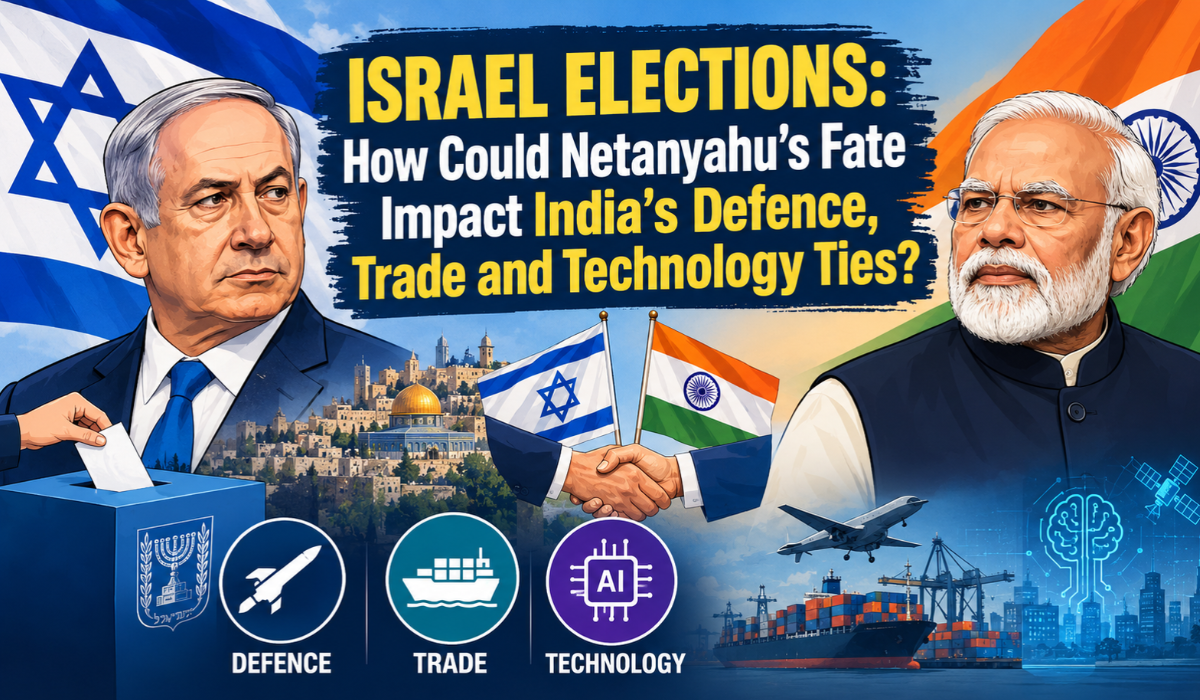
Could a change of government in Israel affect its close relationship with India? Israelis voted on October 27 in an election, the first poll since the Hamas-led October 7, 2023 attack and the wars that followed. As votes are counted on October 28, neither Prime Minister Benjamin Netanyahu’s camp nor its rivals have secured a clear parliamentary majority. The result remains uncertain.
What is happening in Israel?
Netanyahu’s Likud party is competing against challengers, including centrist Gadi Eisenkot. Early results and exit polls show a tight contest, with neither side clearly reaching the 61 seats needed for a majority in Israel’s 120-member parliament, the Knesset. Arab-led parties could influence coalition negotiations. Netanyahu remains in office during the process. Voters have focused on security, the aftermath of the Gaza war, tensions with Iran and Lebanon, military-service exemptions, and criticism of Netanyahu’s leadership.
India-Israel ties recently upgraded
India is watching because its relationship with Israel now covers much more than defence purchases. During Prime Minister Narendra Modi’s state visit on February 25 and 26, 2026, the countries elevated ties to a “Special Strategic Partnership for Peace, Innovation and Prosperity.” Their joint statement outlined cooperation in defence, trade, artificial intelligence, cybersecurity, semiconductors, agriculture, water management, space, energy, education and scientific research.
The visit produced agreements on artificial intelligence, an Indo-Israel Cyber Centre of Excellence in India, and an India-Israel innovation centre for agricultural research. The governments welcomed a defence cooperation memorandum signed in November 2025. Their impact will depend on implementation. These sectors matter to both countries.
Why the Modi-Netanyahu bond matters
Modi and Netanyahu have built a working relationship. Modi visited Israel in 2017, becoming the first Indian prime minister to do so, while Netanyahu visited India in 2018. Their February 2026 meeting elevated the partnership. Personal rapport can help keep dialogue moving, but agreements are signed by governments and institutions, not just individuals. A new Israeli prime minister would inherit an established framework for cooperation, even if priorities or the tone changed.
What could change in defence?
Israel is a supplier of military technology to India, including air-defence systems, drones, surveillance and precision capabilities. Both countries want joint research and manufacturing. If Netanyahu stays, existing plans may continue under current leadership. If he is replaced, the new government could adjust priorities, budgets or timelines. But a change of prime minister would not automatically cancel contracts. Military requirements, institutional links and India’s push for domestic manufacturing will remain important.
Trade and technology: more than weapons
Bilateral trade in goods was about US$3.75 billion in the 2024–25 financial year, according to an official country brief. The relationship includes investment and cooperation in farming, water conservation, health and digital technology. New leadership could influence trade negotiations, investment priorities and the pace of technology agreements. For Indian businesses, researchers and farmers, continuity matters because partnerships need predictable rules, funding and access to expertise.
Where does India stand amid regional tensions?
India has close ties with Israel, while maintaining relations with Arab countries and Iran. The Middle East matters to India for energy supplies, trade routes, investment and the welfare of Indian nationals. Escalation involving Israel, Iran, Lebanon or Gaza can put shipping, oil prices and regional stability at risk. New Delhi must protect its strategic interests while supporting dialogue and de-escalation.
What happens next?
The election will determine who gets the chance to form Israel’s next government, but it will not by itself decide the future of India-Israel relations. Coalition partners may shape the government’s approach to security and foreign policy. For India, the key question is whether commitments made in 2026 become practical cooperation.
Netanyahu’s political future matters, but India’s partnership with Israel is now wider than one leader. Defence, trade and technology ties will depend on the next government’s policies—and on how consistently both countries turn agreements into action.
Imagine a company that helped make mobile internet affordable for millions of Indians is now preparing to enter...

Imagine opening WhatsApp on your phone, but the SIM card linked to your account is not inside the...

Delhi’s air pollution is once again raising health concerns, with the Air Quality Index (AQI) entering the ‘poor’...

Ladakh is seeing two changes at once: a new district has been announced, and the Centre has proposed...

What if a decision taken in Washington could influence India’s oil bills, export earnings and trade relations with...

What happens when the world’s richest business leaders clash over one of the world’s biggest internet markets? A...

Aries: The day will be auspicious...