Last Updated: October 21, 2026
Last Updated: October 21, 2026





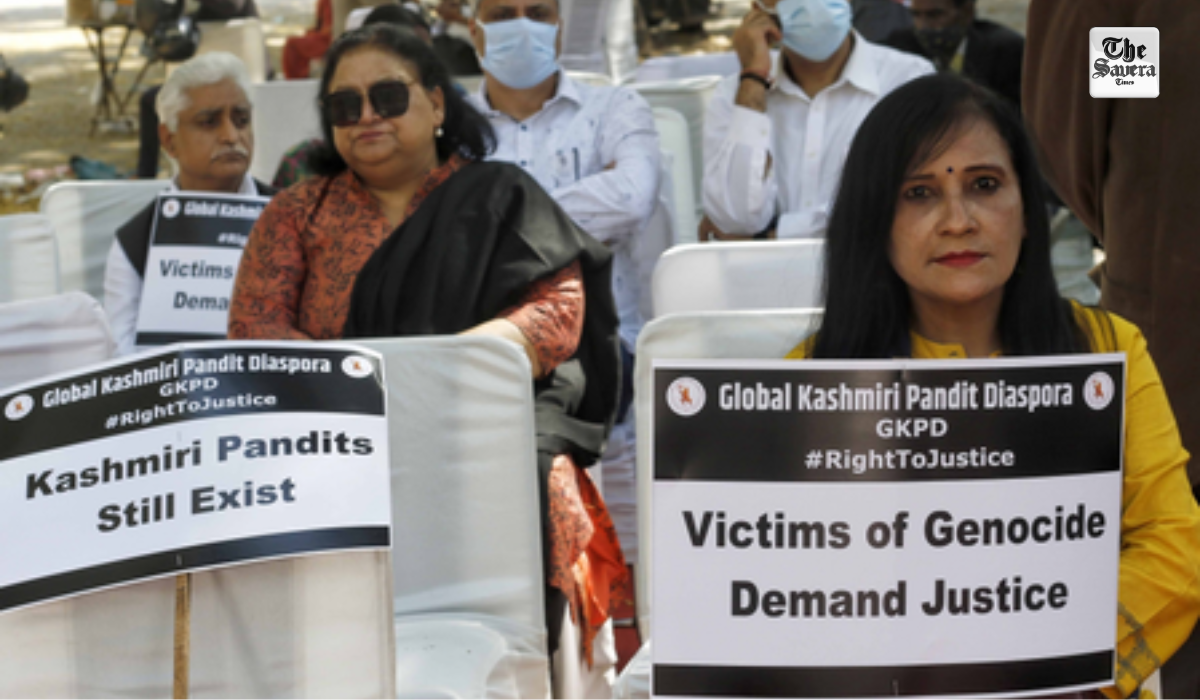
Jammu and Kashmir: Former Chief Minister of Jammu and Kashmir and President of the People’s Democratic Party (PDP), Mehbooba Mufti, recently made a controversial remark linking some protests in Jammu to the decision of Jammu and Kashmir’s accession to India in 1947. She made this statement while criticizing the National Medical Commission’s (NMC) revocation of the permission for the Shri Mata Vaishno Devi Medical College, which she described as “dangerous and unfortunate.”
Referring to the Jammu protesters as “right-wing Hindu groups,” Mehbooba Mufti said, “The recent developments by right-wing Hindu organizations like the BJP, RSS, and Bajrang Dal have negated the decision of our leaders to reject Jinnah’s two-nation theory and to become part of Gandhian secular India.” He also said that if the demand for statehood for Jammu based on religion proceeds, the very basis for Kashmir’s integration into India will be proven wrong.
From Protest to Ideological Warning
Pretending a simple protest as communal incitement raises serious questions. Critics say that linking disagreement with a policy to the legitimacy of Jammu and Kashmir’s accession to India is a political exercise in ideological pressure. They argue that this is not the first time leaders in the Valley have used such language.
Former Chief Minister Farooq Abdullah has also frequently referenced Pakistan in domestic politics and demanded autonomy for Jammu and Kashmir, repeatedly fueling old ideological disputes.
Questioning Selective Secularism
If a protest in Jammu can be labeled a threat to secularism, why isn’t attention paid to a much more serious issue—the persecution and mass exodus of Kashmiri Pandits? If Muslim-majority Kashmir had decided to remain with secular India, how did the Hindu minority, comprising only two percent of the valley’s population, become victims of violence, intimidation, and displacement?
More than 35 years have passed since Kashmiri Pandits were forced to flee their homes through organized terror, intimidation, and targeted violence. Critics say that the leaders who now proclaim secularism were virtually silent at that time.
Failure of Leadership During the Exodus
Law and order in Kashmir completely collapsed in the late 1980s and early 1990s. During Farooq Abdullah’s tenure, kidnappings, murders, arson, and attacks on Hindu families became commonplace. The state machinery at that time completely failed to curb religious extremism.
Similarly, Mehbooba Mufti’s father, Mufti Mohammad Sayeed, was the Home Minister in the central government during his tenure. During his tenure, the security and administrative infrastructure collapsed, leaving minorities vulnerable. Critics say the failure of political leadership in both Srinagar and Delhi proved disastrous for Kashmiri Hindus.
Sacrifice, suffering, and justice still undelivered
As the violence escalated, the Kashmiri Pandit community received no support from the government, neighbors, allies, or civil society. To save their lives and honor, they were forced to leave the Valley. Even after the exodus, their suffering remained unabated—homes were occupied, temples were damaged, and no concrete justice process was initiated.
Critics say that despite repeated returns to power, neither the Abdullahs nor the Muftis took any concrete steps toward the return of displaced Pandits, the prosecution of perpetrators, or an official acknowledgement of the tragedy.
Three decades of silence
Over the past 35 years, Valley leaders have neither demanded a comprehensive investigation into the atrocities against Kashmiri Hindus, nor initiated the return of properties or systematic rehabilitation. This silence is even more painful when the same leaders invoke secularism in other matters.
The question is: why wasn’t Gandhian secularism considered threatened when an entire minority community was displaced from its land?
Conclusion: A glaring contradiction
Critics say this contradiction is glaring. The same leaders who talk about the threat to secularism in the face of protests remain silent on one of India’s most painful communal crises. Their selective sensitivity undermines the very values they claim to protect.
The continued acceptance of these leaders by so-called secular political parties further deepens this irony. Critics say that by remaining silent on the suffering of Kashmiri Pandits, they allowed the ill effects of divisive ideologies to flourish—and that too within India.
Two people were killed and ten injured after a passenger bus met with an accident at Gala Pachound...

A Srinagar-bound bus with a Jammu and Kashmir registration number was attacked with stones outside the Divine Star...

An encounter broke out in Jumgund in Jammu and Kashmir's Kupwara district after troops detected suspicious movement near...

Higher reaches of Jammu and Kashmir received the season’s first snowfall, covering Doda, Gurez Valley and Pir Ki...
Several high-altitude areas in Jammu and Kashmir have received the season's first snowfall in the past 24 hours....
Jammu: Joint security forces recovered a cache of arms and ammunition during a search operation in Jammu and...
Aries: The day will be auspicious...