Last Updated: October 12, 2026
Last Updated: October 12, 2026





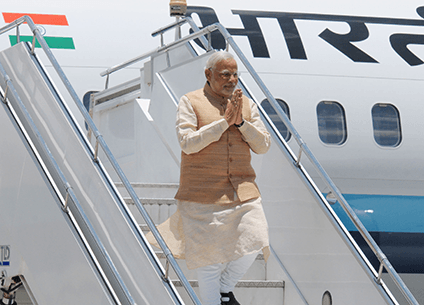
Prime Minister Narendra Modi has been on a series of foreign visits over the past few days. He first traveled to Indonesia, then to Australia, and now to New Zealand. When these visits are evaluated, it becomes evident that India has gained significantly from them. They demonstrate that India has stable leadership under a Prime Minister who enjoys considerable popularity on the global stage.
Indonesia is a Muslim-majority nation, yet Prime Minister Modi invoked the name of God and “Om” during his visit. This reflects the message that the future world must move away from fanaticism and embrace a secular outlook that respects all religions. This message appears to have been well received in Indonesia.
After Indonesia, Modi visited Australia. The historic civil nuclear agreement between India and Australia has now been approved in India as well. Under this agreement, Australia will supply uranium—the primary fuel used in nuclear energy generation—to India. Uranium is a strategically important resource, and its significance has become even more evident in recent global conflicts. Similarly, one of the major factors in the Russia–Ukraine conflict has been the competition for rare earth minerals.
This was the third India–Australia Annual Summit held in Australia, during which 18 agreements were signed between the two countries. Modi’s phrase, “Australia and India, one plus one equals eleven,” has emerged as a popular slogan symbolizing the growing partnership.
India aims to generate 100,000 megawatts of electricity from nuclear energy by 2043. Therefore, securing uranium supplies from Australia will prove highly beneficial and cost-effective. Australia possesses nearly one-third of the world’s uranium reserves, making it an ideal long-term partner.
Looking back, Australia had refused to supply uranium to India in 2010. The agreement reached under Prime Minister Narendra Modi marks a significant diplomatic achievement. The five major announcements made jointly by India and Australia further strengthen bilateral ties.
The first announcement focuses on defense and security cooperation, enhancing interoperability between the armed forces of both nations, expanding defense industrial collaboration, strengthening cybersecurity, and increasing cooperation in combating terrorism. A roadmap for maritime security cooperation has also been developed.
A joint declaration on energy security has been issued, under which both countries will work together to promote clean and reliable sources of energy. The civil nuclear agreement will enable Australia to supply uranium to India. Both countries have also agreed to expand cooperation in the supply of critical and rare minerals, cybersecurity, and emerging technologies such as artificial intelligence.
Following Australia, Prime Minister Modi visited New Zealand. One of the key announcements made during the visit was that 57 percent of New Zealand’s exports to India will receive duty-free access, further strengthening trade relations between the two nations.
These foreign visits hold immense strategic importance. At present, tensions involving Iran and the United States have disrupted global trade, with the Strait of Hormuz once again facing blockages and cargo ships being delayed. Despite these challenges, India was able to safeguard itself from a potential oil and gas crisis by diversifying its international partnerships and reducing excessive dependence on Gulf nations.
Wherever Prime Minister Modi travels, he places strong emphasis on expanding trade, investment, and industrial cooperation. These visits reflect India’s broader strategy of strengthening economic partnerships, enhancing energy security, and reinforcing its position as an influential global power.
Shiv Sena (UBT), in its mouthpiece Saamana, has criticised the Centre over security measures and detentions during anti-government...
Former BJP MLA Attar Singh Bhedana died at Jaipur’s SMS Hospital after a violent clash at a crusher...

An eyewitness has recounted the fatal Mini Cooper crash in Nedumbassery, Kochi, claiming the driver said his father...

The Cockroach Janata Party plans to approach Parliament Street Police Station for permission to hold a peaceful protest...
BJP leader Kirit Somaiya has announced plans to file a complaint against actor Imran Khan over alleged OCI...

Start your day with The Savera Morning Brief, bringing you the top India and world news, breaking developments,...

Aries: The day will be auspicious...