Last Updated: November 5, 2026
Last Updated: November 5, 2026





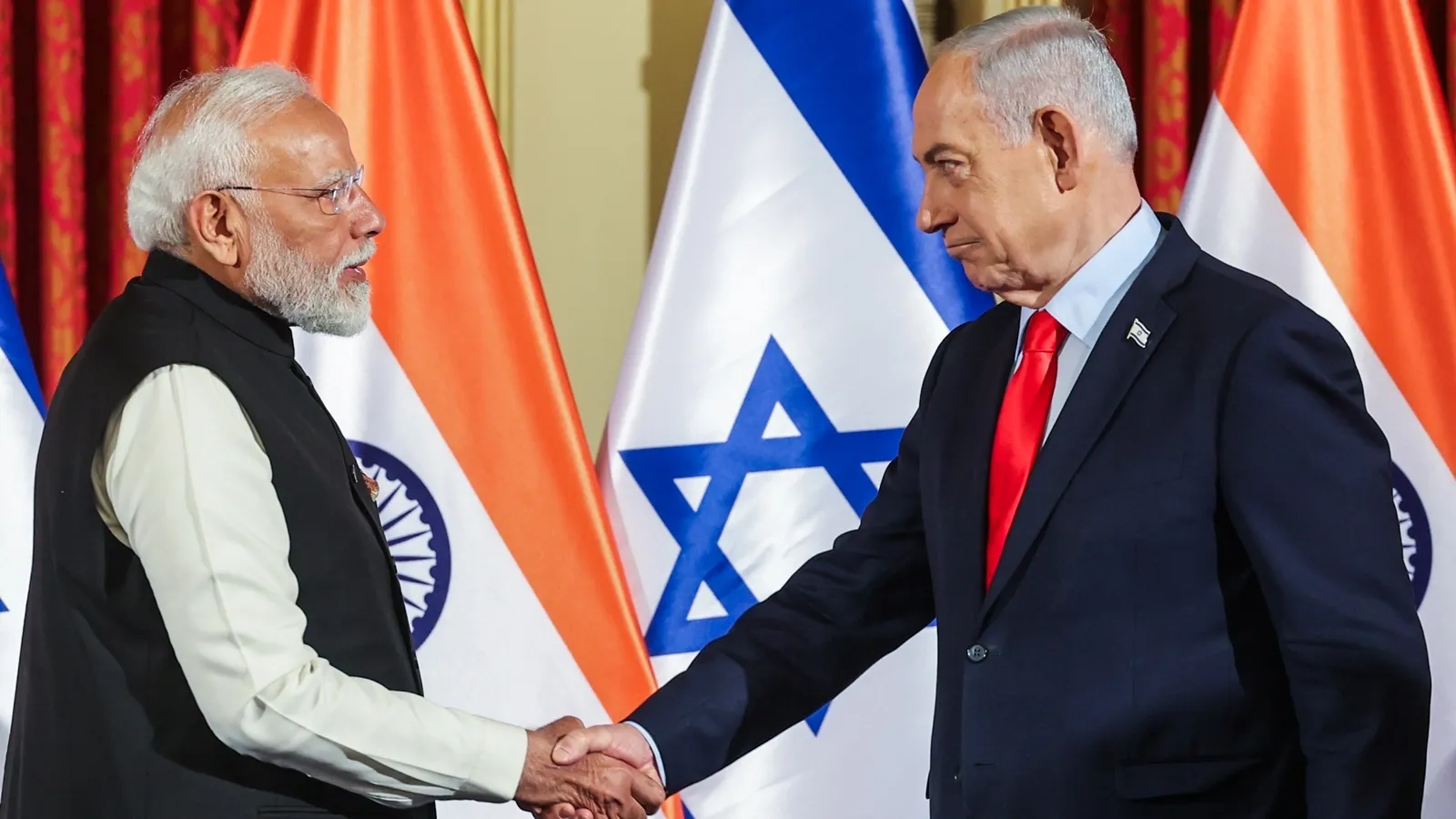
Prime Minister Narendra Modi and his Israeli counterpart Benjamin Netanyahu have brought renewed energy and momentum to IndiaIsrael relations, with their close personal equation helping strengthen mutual trust and accelerate bilateral engagement. While full diplomatic relations were established in 1992 and security cooperation continued under successive governments, the two leaders have played a significant role in elevating the partnership, bringing greater visibility to longstanding ties and taking them to a new level. Some relationships between states are best explained by interest. Others only make sense once you add something harder to measure: trust.
The bond between Narendra Modi and Benjamin Netanyahu belongs to the second kind. Commentators call it a ‘bromance’ and treat it as chemistry or choreography, a photograph on a beach or an embrace on a tarmac. That reading is too small. The warmth between the two men is the visible surface of something deeper, a confidence between two old societies that each recognise in the other a long memory, a stubborn continuity and an unwillingness to disappear. Whoever forms Israel’s next government inherits that confidence.
The question is whether they will understand what they have been handed. Both countries are ancient civilisations that endured major catastrophes before emerging as modern states. It added that both face challenging neighbourhoods, where terrorism and national security remain key concerns. And, India’s Jewish communities, in Kochi, Mumbai and elsewhere, lived for centuries as part of Indian life, an unusual record in Jewish history, and one that gives the two societies a shared past that few other pairings can claim. Defence, agriculture, water, cyber and technology cooperation grew from that soil. The contracts followed the confidence, not the other way round.
The lasting significance of the PM Modi-Netanyahu relationship will be determined not by their personal rapport or regular meetings, but by whether the partnership remains strong beyond their tenures. It noted that friendships between leaders often end with their departure from power, but a truly enduring partnership is one that survives beyond those who built it. That is the responsibility facing Israel’s next government. It should not manage the relationship as a diplomatic gesture, or discard it as an inheritance from a rival. It should treat it as a national asset to be institutionalised, shielded from partisan contest and extended into society. If it does, the personal chemistry of two leaders will have become something far more lasting, a trust between two peoples that no longer depends on anyone’s presence to survive.
Notably, Netanyahu a couple of months thanked Prime Minister Narendra Modi for his leadership and enduring friendship, reciprocating PM Modi’s greetings on the Jewish New Year, Rosh Hashanah. To understand how remarkable this was, it helps to recall where India began. India’s first prime minister, Jawaharlal Nehru, was a founding voice of the Non-Aligned Movement. Solidarity with the Arab states, and particularly the Palestinian cause, formed a cornerstone of India’s foreign policy identity. Israel was recognized in 1950 but kept at a diplomatic distance for four decades, a studied ambiguity designed to placate domestic Muslim constituencies while simultaneously protecting India’s relationships with Arab oil exporters and the large Muslimmajority populations of the Middle East, whose remittances and goodwill New Delhi could not afford to alienate.
Full diplomatic relations were established only in 1992, after the Cold War reshuffled the geopolitical deck and the Oslo Accords provided India political cover. hat grew in the decades between 1992 and Modi’s first visit was a relationship of striking practical depth beneath a surface of continued political caution. Israel became one of India’s largest defense suppliers, providing weapons systems, drone technology, and intelligence cooperation that India could not easily source elsewhere. The two countries’ security establishments also grew closer, particularly following the 2008 Mumbai terrorist attacks. Yet Indian officials continued to hedge, supporting Palestinian statehood in international forums and avoiding the kind of public embrace that would have complicated relations with Arab partners.
India reaffirms commitment to strengthen ties with Israel As Israelis voted to elect members of the 26th Knesset, the country’s Parliament, India reaffirmed its commitment to further strengthen bilateral ties with Israel. Meanwhile, Israeli President Isaac Herzog accepted the certified results from last week’s vote, and said he would begin consultations with party representatives regarding the formation of a new government. Neither the party of Prime Minister Benjamin Netanyahu nor that of his main challenger, former military chief Gadi Eisenkot, secured an outright majority in parliament. The two sides are now in hard-fought negotiations to convince smaller parties to join forces to create a new government.
Israel’s election commission said it has found no fraud in last week’s vote, dealing a blow to Prime Minister Benjamin Netanyahu’s attempts to discredit the results. Netanyahu and his supporters have repeatedly made unsubstantiated claims that Arab-led parties had “stolen” the election, possibly with foreign assistance. The results showed Netanyahu’s religious-nationalist bloc losing its parliamentary majority,while Arab-led parties made substantial gains. The review found no evidence of irregularities that compromised the integrity of the election or affected its results
India is emerging as a global healthcare partner through affordable medicines, large-scale public health programmes, digital innovation and...

In India, there is a tradition of gifting during festivals. Dhanteras is a festival in which, according to...

Bhopal: The Madhya Pradesh High Court on Wednesday rejected the bail application of Giribala Singh, a former District...
New Delhi: Union Commerce and Industry Minister Piyush Goyal on Wednesday inaugurated Vanijya Bhawan and Udyog Bhawan in...
Mumbai: Foreign airlines operating from Mumbai’s Chhatrapati Shivaji Maharaj International Airport have recommended moving some international flights to...
Bengaluru: Karnataka Transport Minister Byrathi Suresh on Wednesday announced an increase in ticket fares of all four state-run...

Aries: The day will be auspicious...