Last Updated: October 12, 2026
Last Updated: October 12, 2026





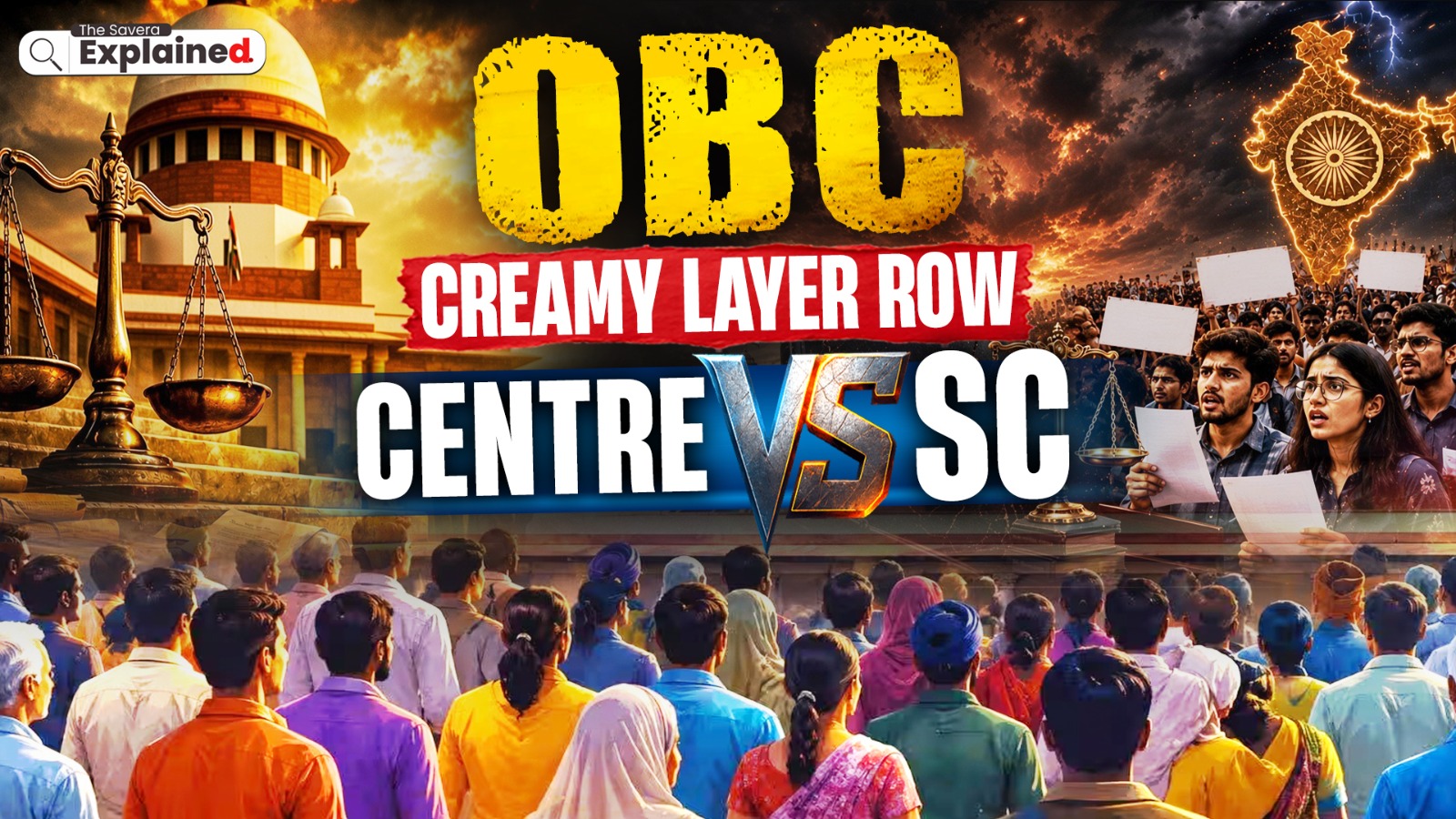
What happens when a rule meant to decide who needs reservation becomes a question of income, social status and government job position? That is at the heart of the latest OBC creamy layer controversy. The Centre has now approached the Supreme Court seeking clarity on its March 2026 judgment, including whether the ruling should apply retrospectively to the Civil Services Examination, or CSE, 2025 and 2026. The move has raised questions because the government had earlier started preparing to implement the judgment.
First, What Is the OBC Creamy Layer?
The creamy layer concept is designed to ensure that the benefits of OBC reservation reach those who continue to face social and educational backwardness, rather than the relatively advanced sections within the OBC category.
Its roots go back to the Supreme Court’s 1992 Indra Sawhney judgment, which upheld OBC reservation but said the socially advanced sections, or the “creamy layer”, should be excluded.
Following this, the Centre issued an Office Memorandum in 1993 laying down criteria for identifying the creamy layer.
Importantly, the original framework was not simply an income test. It also considered the status and position of parents. Salary and agricultural income were treated differently under the original rules.
Where Did the Dispute Begin?
The controversy became sharper in 2004 when a DoPT clarification directed that salary income of parents working in PSUs, banks and certain other organisations could be considered while determining creamy-layer status.
This created a difference between government employees and employees of PSUs or other organisations.
For example, if two OBC families had parents earning similar salaries, but one parent was a government employee and the other worked in a PSU, their children could be treated differently depending on the applicable service-status rules.
Several candidates affected by this interpretation challenged it in courts.
What Did the Supreme Court Say in March 2026?
On March 11, 2026, the Supreme Court delivered its judgment in Union of India v. Rohith Nathan and Others.
The Court held that parental salary alone cannot be used mechanically to decide whether an OBC candidate belongs to the creamy layer.
It said the creamy-layer framework has to be understood along with the status of the parents’ posts. The Court also found that treating children of PSU or private-sector employees differently from similarly placed government employees, merely because of salary treatment, could amount to hostile discrimination.
The Court directed reconsideration of the affected candidates and also provided for supernumerary posts where necessary.
Why Has the Centre Returned to the Supreme Court?
This is where the current controversy begins.
The Centre, through the Department of Personnel and Training, has now asked the Supreme Court to clarify the application of the March judgment. It wants the CSE 2025 and 2026 processes to continue under the earlier interpretation rather than having the new ruling applied retrospectively.
The government says the issue is much bigger than a few civil-service candidates.
According to the Centre, retrospective implementation could affect more than 3.7 lakh OBC recruitments in central government posts since 2016, apart from recruitment processes in 18 states and Union Territories. It has warned that organisations such as Railways, banks, the Department of Posts and paramilitary forces could face a large number of representations and legal challenges.
The government has also argued that determining equivalence between posts in different public-sector organisations and government services could take considerable time, with the process potentially requiring consultations with states and Union Territories.
Why Is It Called a U-Turn?
The term “U-turn” comes from the apparent change in the Centre’s approach.
After the March judgment, preparations were reportedly made to examine the claims of affected candidates. But the government has now returned to the Supreme Court seeking protection for the ongoing CSE cycles and clarity on retrospective application.
The Centre’s argument is mainly about administrative stability and the possible impact on candidates who have already been selected under the earlier rules.
What Is the Bigger Debate?
At a broader level, the controversy raises one fundamental question: Should OBC creamy-layer status be decided mainly through income, or should social and occupational status carry greater weight?
The Supreme Court’s position is that reservation is linked to social and educational backwardness and cannot simply be reduced to a financial test.
At the same time, critics of a purely status-based approach ask whether economically and socially advanced families should continue receiving reservation benefits simply because their parents’ jobs do not automatically place them in the creamy layer.
So, this is not just a dispute about one UPSC examination. It is a larger debate over how India defines backwardness, how reservation benefits should reach the most disadvantaged, and how a major judicial change can be implemented without disturbing thousands of existing selections.
The Supreme Court’s response to the Centre’s latest application will therefore be important not only for CSE candidates, but potentially for the wider framework of OBC reservation in government recruitment and education.
New Delhi: The Indian Navy’s guided missile stealth frigate INS Trishul has arrived at the United Kingdom’s Plymouth...

Chandigarh: The Aam Aadmi Party (AAP) Punjab on Sunday condemned the Delhi Police action against protesters in the...
Tehran: Iranian Foreign Minister Seyed Abbas Araghchi said on Sunday the US-Israeli attacks on Iran’s oil, refinery, and...

Bhopal: The CBI arrested an official of the CGST and Central Excise department in Bhopal for taking a...

New Delhi: Leader of the Opposition in the Lok Sabha, Rahul Gandhi, on Sunday released a video on...

Mumbai: Shweta Bachchan Nanda once opened up about how the entry of Aishwarya Rai changed the dynamics in...

Aries: The day will be auspicious...