Last Updated: October 19, 2026
Last Updated: October 19, 2026





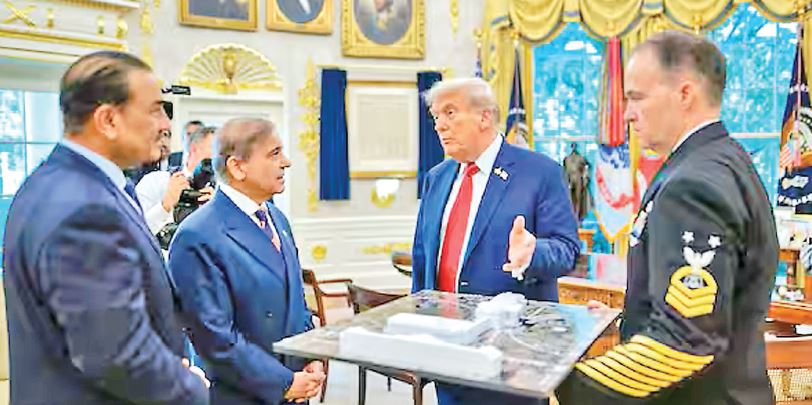
Pakistan has sent its first shipment of rare earth and critical minerals to the United States, a move that follows a recently signed agreement with an American company to explore and develop the country’s mineral resources, officials and media reports said. The shipment, dispatched days after Pakistan’s Army Chief Asim Munir and Prime Minister Shehbaz Sharif presented samples of the country’s mineral deposits to US President Donald Trump during his Washington visit, has produced both diplomatic interest and domestic scrutiny.
The consignment includes antimony, copper concentrate, and rare earth elements such as neodymium and praseodymium, Dawn reported. According to that report, the samples were prepared locally in collaboration with the Frontier Works Organisation, a unit of the Pakistani military, ahead of the shipment to the United States.
The delivery follows a memorandum of understanding signed in September between US Strategic Metals, a Missouri-based company, and the Frontier Works Organisation. Under the MoU, US Strategic Metals is expected to invest about $500 million to establish mineral processing and development facilities in Pakistan. US Strategic Metals described the shipment as a “significant milestone in the strategic partnership between Pakistan and the United States,” and said the MoU “lays out a comprehensive framework for collaboration across the full mineral value chain — spanning exploration, processing, and the development of refining facilities within Pakistan.”
US Strategic Metals, which focuses on producing and recycling critical minerals, said it will target materials that the US Department of Energy regards as essential for various technologies. The company statement positioned the shipment as a step toward building a domestic supply chain for critical minerals that are in high demand for manufacturing and energy applications.
The high-profile delivery came in the wake of a White House photo that showed President Trump inspecting a box of rocks described as rare earth minerals, while Army Chief Asim Munir and Prime Minister Shehbaz Sharif stood nearby. The image and the subsequent announcement drew immediate attention inside Pakistan and abroad, and prompted a range of reactions.
Dawn, in its coverage, noted skepticism about the commercial scale and verifiability of Pakistan’s mineral claims. The newspaper quoted critics who said Pakistan has repeatedly advertised large mineral reserves that later proved difficult for investors to locate, and observed that several multinational companies had withdrawn after failing to find the promised riches. Pakistan’s mineral wealth has been estimated at around $6 trillion, a figure cited frequently in commentary and political debate.
Domestically, the development has triggered calls for transparency. The Pakistan Tehreek-e-Insaf, led by Imran Khan, demanded full disclosure of the terms of the agreements with the US and with American firms. PTI Information Secretary Sheikh Waqqas Akram said Parliament and the public should be informed, and demanded that “full details of all such deals be made public,” Dawn reported.
Concerns voiced by PTI extend beyond the financial deal. The party has warned that Pakistan may be considering offering Pasni Port, on the Arabian Sea, to the United States to facilitate mineral access. Reports in the Financial Times suggested Pakistan proposed offering a port in Balochistan near Chabahar, Iran, a location with strategic maritime significance. PTI warned that such an arrangement could have long-term geopolitical implications and likened secrecy around the talks to historical concessions that preceded foreign control, citing Mughal-era precedents in parliamentary remarks.
PTI officials described the proposed arrangements as potentially “reckless, one-sided, and secretive,” and warned they could aggravate an already fragile domestic situation. The party urged the Shehbaz Sharif government to publish the full text of any agreements and to ensure that strategic considerations, national interest, and public oversight were not sidelined.
At the same time, US Strategic Metals framed the shipment and the MoU as a commercial and strategic partnership intended to develop Pakistan’s mineral sector and strengthen supply chains for critical materials. The company and its Pakistani counterpart, the Frontier Works Organisation, have emphasised the industrial and technological potential of establishing processing and refining capacity inside Pakistan.
The shipment marks an early and visible step in what backers describe as a longer-term collaboration. It has, however, underlined the political and strategic sensitivities that accompany resource diplomacy in Pakistan. Opposition parties and commentators have called for parliamentary scrutiny and public disclosure, while proponents point to potential investment and industrialisation benefits. The government and the parties involved have not released a detailed public account of the MoU or of any subsequent commercial contracts, and the debate over transparency and national interest is likely to continue as further details emerge.
Iran's Islamic Revolutionary Guard Corps (IRGC) Navy claimed early Monday that an oil tanker, violating regulations, had struck...
Amid ongoing protests and violence in Italy, the Indian Embassy on Monday issued an advisory for Indian citizens...

The number of Ebola virus cases in Kenya has risen to eight. Health officials have confirmed that a...

Houthi rebels fired several ballistic missiles at a government army training camp in Yemen's Shabwa province on Monday.

US Secretary of State Marco Rubio indicated on Monday that a trade agreement between the US and India...
Pakistan is among the 10 countries most affected by the global food crisis. According to a report, food...
Aries: The day will be auspicious...