Last Updated: October 16, 2026
Last Updated: October 16, 2026





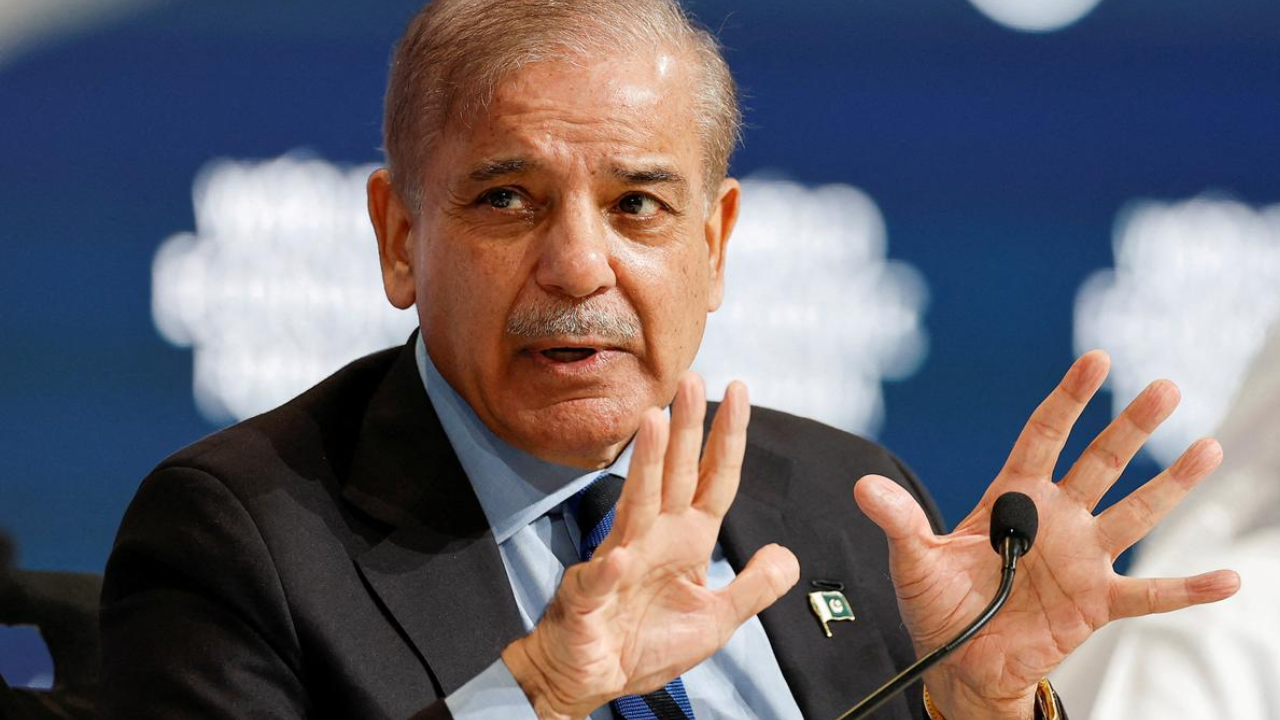
Pakistan has announced several emergency measures to conserve fuel and control spending after global oil prices surged sharply due to the escalating conflict in the Middle East. The rise in energy prices has raised concerns in many countries that rely heavily on imported fuel, including Pakistan.
Prime Minister Shehbaz Sharif said the government was taking steps to deal with the global fuel crisis triggered by the ongoing tensions involving the United States, Israel and Iran. In an address to the nation, Sharif said the regional situation and the war were beginning to affect Pakistan’s economic stability. However, he added that the government was trying to ensure that the burden of the crisis does not fall heavily on ordinary citizens.
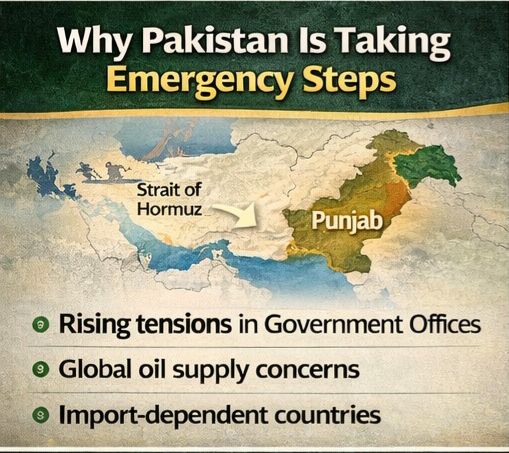
The announcement came shortly after the Pakistani government increased fuel prices significantly, pushing petrol rates to their highest levels in the country. Authorities have also indicated that prices could be reviewed frequently depending on international market trends.
Government Spending and Operational Changes
To manage the situation, the government has introduced a number of fuel-saving and austerity measures. Government offices will reduce staff attendance and shift to a four-day workweek, while overall government spending will also be reduced for the next two months. Fuel allocations for official government vehicles will be cut by about half as part of efforts to conserve energy.
The government has also announced that schools will remain closed for two weeks, while universities will shift to online classes during that period. In another step to reduce spending, members of the federal cabinet have agreed not to take salaries for the next two months.
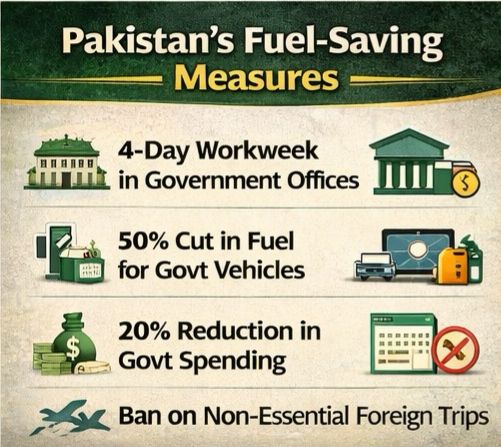
Authorities have also restricted unnecessary official foreign travel, and government departments have been directed to hold seminars and conferences inside official buildings rather than expensive hotels.
Economic experts say rising fuel costs could push inflation higher in the coming months, adding pressure on households and businesses. Analysts believe inflation may increase further if global oil prices remain unstable.
Punjab Implements Additional Measures
Meanwhile, Maryam Nawaz Sharif, the Chief Minister of Pakistan’s Punjab province, has also announced several measures to save fuel in the state. Petrol and diesel allowances for government officers’ vehicles will be reduced, and the number of vehicles accompanying ministers and senior officials has also been restricted.
Government offices in Punjab have been advised to adopt a work-from-home system wherever possible, with only essential staff required to be physically present. Educational institutions across the province will remain closed from March 10 to March 31, though examinations will continue as scheduled. Online classes may be conducted during this time.
The provincial government has also suspended outdoor government events, and official meetings will be conducted through online platforms whenever possible. Authorities have also set up monitoring committees in every district to keep a close watch on fuel supplies and prevent hoarding.
The government has urged private companies to adopt work-from-home policies where possible and avoid unnecessary gatherings. Citizens have also been advised to limit late-night outings and avoid stockpiling essential goods.
Impact of Global Oil Market
The measures come as global oil markets reacted strongly to the conflict in the Middle East. Oil prices briefly crossed $100 per barrel, reaching levels not seen in several years. The sharp rise was largely driven by concerns about supply disruptions and tensions around the Strait of Hormuz, one of the world’s most important oil shipping routes.
International benchmark Brent crude jumped sharply during the spike, while West Texas Intermediate (WTI) crude in the United States also rose significantly.
However, oil prices later eased after US President Donald Trump suggested that the conflict with Iran could end soon. His remarks helped calm markets and reduce fears of a prolonged disruption to global oil supplies.
Following his statement, oil prices fell noticeably, offering some relief to global markets. Despite the drop, analysts warn that continued tensions in the Middle East could keep oil prices volatile in the coming weeks, which may continue to affect fuel-importing countries like Pakistan.
Air India and Air India Express have suspended flights to Riyadh, Jeddah and Dammam until October 20. IndiGo...

Manjit Singh Bedi, 64, has been returned to the United States after being arrested in India. He faces...

A Houthi attack on the al-Maashiq Presidential Palace in Aden killed five people and injured 16, amid intensifying...
A shooting at Silver Rail Elementary School in Bend, Oregon, left three children and a teacher dead. The...

Prime Minister Narendra Modi will visit Canada on December 11-12, 2026, with both countries aiming to strengthen strategic...
US Vice President JD Vance has warned that anyone found selling access to the White House should face...
Aries: The day will be auspicious...