Last Updated: October 14, 2026
Last Updated: October 14, 2026





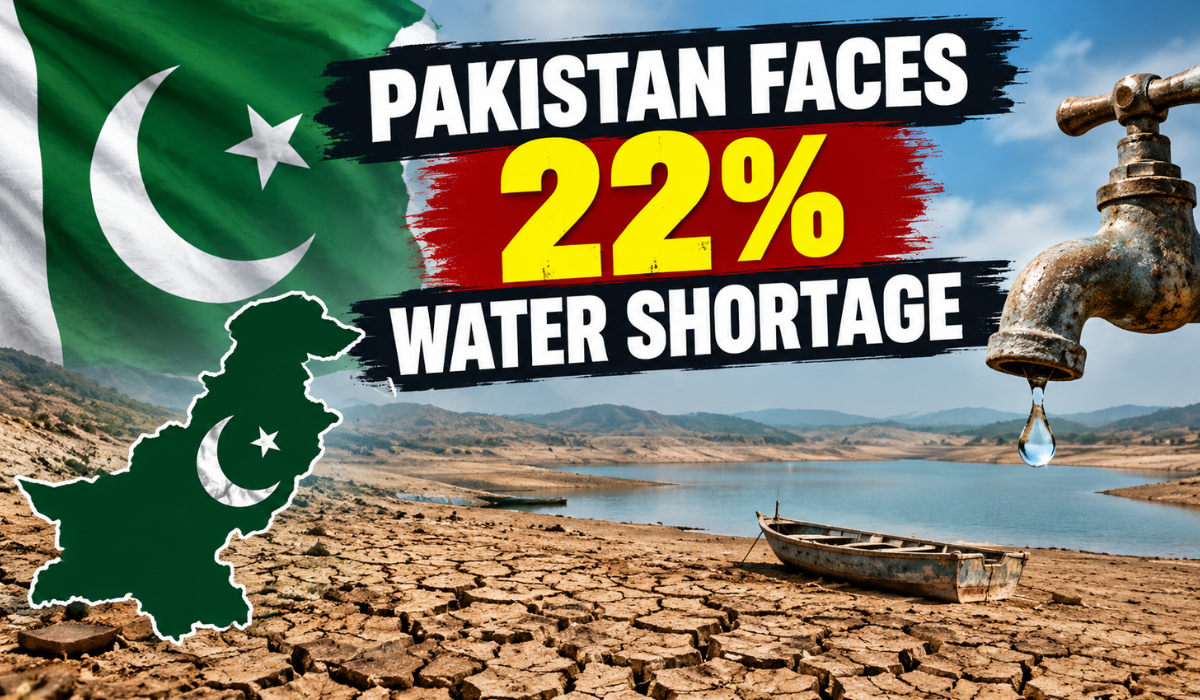
Pakistan is heading into its wheat-growing season with a serious water problem. The country is facing a projected 22 per cent water shortage, raising concerns about wheat production, food prices and the livelihood of millions of farmers.
But here is the big question: Is this shortage the result of India putting the Indus Waters Treaty on hold, or is Pakistan also facing a crisis because of its own water management problems?
The answer is not that simple. To understand what is happening, we need to look at the treaty, the growing tensions between India and Pakistan, and the reasons behind Pakistan’s water shortage.
What is the 22% water shortage?
Pakistan’s Indus River System Authority (IRSA) approved a projected 22 per cent water shortage for Punjab and Sindh for the Rabi season, which runs from October 2026 to March 2027.
The authority expects river inflows of around 21.268 million acre-feet of water. One million acre-foot is a large volume of water, roughly enough to cover one million acres with one foot of water.
The shortage matters because Rabi is the main winter crop season, when farmers grow wheat, barley, mustard, gram and other crops.
Why is the Indus Waters Treaty important?
To understand the dispute, we must go back to 1960.
India and Pakistan signed the Indus Waters Treaty with the help of the World Bank after years of negotiations. Under the agreement, the three eastern rivers — Ravi, Beas and Sutlej — were allocated to India, while the three western rivers — Indus, Jhelum and Chenab — were allocated mainly to Pakistan.
The treaty created a system for sharing river water and resolving disagreements. It continued to operate through wars and several periods of tension between the two countries.
For Pakistan, the Indus river system is essential for farming, drinking water and electricity generation.
Why did India put the treaty on hold?
Relations between India and Pakistan deteriorated sharply after the Pahalgam terror attack on April 22, 2025, in which 26 people were killed.
On April 23, 2025, India announced that the Indus Waters Treaty would remain in abeyance until Pakistan credibly and irrevocably ended its support for cross-border terrorism, according to the Indian government’s statement.
Pakistan opposed India’s decision and argued that it had no legal basis. The dispute over the treaty has since become another major point of tension between the two countries.
Islamabad has repeatedly warned that any attempt to deprive Pakistan of its water share could have serious consequences for regional peace and security.
However, the current 22 per cent shortage should not automatically be blamed on India’s decision. The reasons behind the shortage need to be examined separately.
Is India’s treaty decision responsible for the shortage?
The latest figures point to several domestic and environmental factors.
According to IRSA, river inflows during Pakistan’s April-September 2026 Kharif season were 22 per cent lower than the previous year and 8 per cent below projections.
Pakistan is also facing problems with water storage. Reports by Dawn have highlighted delays in major works at the Tarbela Dam, including the T4 and T5 projects. These delays have limited the country’s ability to store water for future use.
Below-normal rainfall has added to concerns about soil moisture and irrigation needs.
India’s treaty decision remains an important political and diplomatic issue. But the available data does not establish that it caused the projected 22 per cent shortage. Lower inflows, limited storage and infrastructure delays are documented factors.
What does this mean for Pakistan’s wheat crop?
The biggest concern is food security.
Pakistan already faced a wheat production shortfall in the previous season. According to Dawn, production was estimated at around 27.5 million tonnes, against a target of 29.7 million tonnes and domestic requirements of approximately 31.9 million tonnes.
If farmers receive less irrigation water this season, wheat yields could fall further. This could increase flour prices and force Pakistan to import more wheat.
The impact may also extend to other winter crops and farmers’ incomes.
Conclusion: A water crisis with more than one cause
Pakistan’s 22 per cent water shortage comes at a sensitive time in its relations with India. The suspension of the Indus Waters Treaty has added to political tensions, but the shortage also reflects problems with river inflows, water storage and infrastructure.
The immediate challenge for Pakistan is to manage the available water carefully and protect its winter crops. For India and Pakistan, the wider challenge is to prevent an already difficult political relationship from making the management of a shared river system even more complicated.
The key point is this: the treaty dispute is real, but the current water shortage cannot be explained by the treaty dispute alone.
Police have arrested chemist Ashwini Kumar in connection with the shooting death of anti-drug activist Parvinder Jhota (45)...

Reacting to the arrest of Cockroach Janata Party (CJP) leaders on Wednesday, Leader of the Opposition in the...

Thirteen children aged 15 years or below died after a boat carrying them capsized in Bihar's Vaishali district...

The war in the Middle East and the closure of the Strait of Hormuz will push the Middle...

A major train accident occurred on Tuesday in the Multan district of Pakistan's Punjab province. At least four...

New Delhi: A Supreme Court lawyer has approached Chief Justice of India (CJI) Surya Kant seeking consideration of...

Aries: The day will be auspicious...