Last Updated: November 26, 2026
Last Updated: November 26, 2026




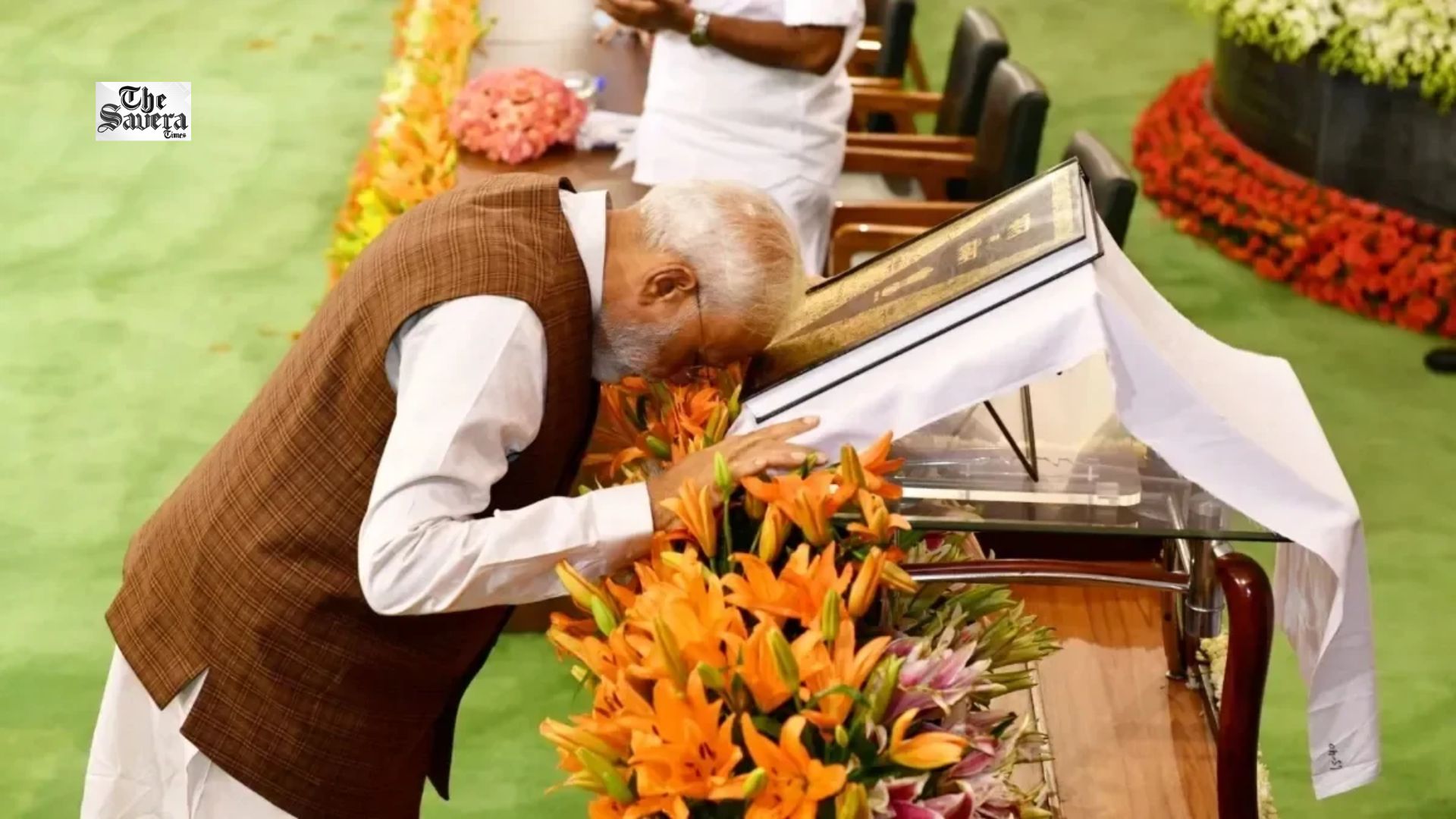
New Delhi: Prime Minister Narendra Modi launched a sharp criticism of previous Congress-led governments in an article published on Constitution Day, raising questions over the Emergency, constitutional amendments, the use of Article 356 to dismiss elected state governments and the former special status of Jammu and Kashmir.
Modi also accused the Opposition of obstructing legislation aimed at ensuring greater representation for women in legislatures. He questioned its position on OBC reservation and said political parties should fulfil their constitutional responsibilities instead of disrupting democratic processes.
In this OpEd, I highlight the following:
UNIQUENESS of our Constitution and Constituent Assembly.
How the Constitution of India is an INSEPARABLE part of my journey.
Ways the NDA Government has STRENGTHENED the Constitution.
Efforts towards boosting SOCIAL AND ECONOMIC JUSTICE.
I have also highlighted:
How the Constitution was trampled over by those who ruled the nation for 5 decades.
How one party has devolved from being a Virodh Paksh to AVRODH PAKSH.
English – https://t.co/6g2CZtbOYg
हिन्दी – https://t.co/CNDyRbDwmC
— Narendra Modi (@narendramodi) November 26, 2026
PM Modi Questions First and 42nd Constitutional Amendments
Highlighting the 75th anniversary of the First Constitutional Amendment of 1951, the Prime Minister alleged that the then government used its majority in the Provisional Parliament to restrict fundamental freedoms despite not having been directly elected through a general election.
He also questioned the timing of the amendment, which was introduced just months before India’s first general elections. Modi argued that the move was intended to influence the electoral process and suppress public opposition.
“This year marks 75 years since the First Amendment of 1951, when a government that was not popularly elected used its majority in the Provisional Parliament to restrict fundamental freedoms. Its timing, barely months before India’s first general election, proves that it was intended to influence the electoral process and stifle public opposition,” he wrote.
The Prime Minister also criticised the 42nd Constitutional Amendment, introduced during the Emergency in 1976, arguing that it curtailed judicial review and altered the balance of power among constitutional institutions.
“It is also 50 years since the 42nd Amendment at the height of the Emergency. This curtailed judicial review and fundamentally altered the balance of institutional powers,” he said.
He further urged young people to study the 38th and 39th Constitutional Amendments to understand the changes made during the Emergency.
Modi Accuses Previous Governments of Misusing Article 356
The Prime Minister also raised the issue of Article 356, which provides for President’s Rule in states under specified constitutional circumstances.
He alleged that successive governments led by one political party had repeatedly misused the provision to dismiss elected state governments. Modi claimed that Article 356 had been imposed nearly 100 times by one party, with one former Prime Minister accounting for around half of those instances.
“The repeated misuse of Article 356 to dismiss elected state governments presents another troubling chapter. One party has the dubious record of imposing Article 356 almost a hundred times, and one former Prime Minister has scored a half-century in this field,” he wrote.
He further accused previous governments of weakening the Constitution despite being entrusted with its protection.
PM Modi Raises Article 370 and 35A, Defends 2019 Decision
Another major issue in the Prime Minister’s article was the former special constitutional status of Jammu and Kashmir.
Referring to Articles 370 and 35A, Modi argued that these provisions prevented the full implementation of the Indian Constitution in the region for more than seven decades. He claimed that the arrangement affected the rights of Scheduled Castes, Scheduled Tribes, Other Backward Classes and women in Jammu and Kashmir.
The Prime Minister described the Centre’s 2019 decision to withdraw the region’s special status as the correction of a historical wrong.
“The makers of our Constitution had hoped that it would be implemented in letter and spirit across India. But, for over 70 years, Articles 370 and 35A did not allow the full Constitution to be implemented in Jammu and Kashmir, thus trampling over the rights of SC, ST, OBC communities and women. It was only in 2019 that this historical wrong was corrected,” he wrote.
Article 370 was effectively abrogated in August 2019 through a series of constitutional and parliamentary measures. The erstwhile state was subsequently reorganised into the Union Territories of Jammu and Kashmir and Ladakh.
Women’s Reservation, OBC Quota and Opposition’s Role
Women’s representation in legislatures also featured prominently in the Prime Minister’s criticism. Modi accused the Opposition of preventing the passage of legislation intended to ensure adequate representation for women in legislative bodies.
He said the role of women in shaping the Constitution deserved greater recognition and maintained that their political empowerment was essential to ensuring constitutional justice.
“I assure the Nari Shakti of India that no force can prevent us from ensuring that justice is done to them,” he wrote.
The Prime Minister also criticised the Opposition’s position on reservation, alleging that the country’s largest Opposition party wanted to reduce OBC reservation and introduce reservation for Muslims. He referred to Dr BR Ambedkar while arguing against reservation based on religion.
Modi also questioned the role of the Opposition in parliamentary democracy, saying that constructive criticism should not be replaced by disruptions of democratic proceedings.
He argued that political parties must fulfil their constitutional responsibilities and contribute to democratic processes.
Tamil Nadu Chief Minister C. Joseph Vijay will present scholarships and certificates to Class 10 and 12 toppers...
Chief ministers Yogi Adityanath, Devendra Fadnavis, Bhajanlal Sharma and Mohan Yadav paid tribute to the victims and security...
Chief Election Commissioner Gyanesh Kumar's photographs with Congress MLA Ajay Singh at a private wedding in Bhopal have...
The Samyukt Kisan Morcha has planned nationwide protests to mark six years of the farmers' movement. In Delhi,...
Prime Minister Narendra Modi extended greetings on Samvidhan Divas, paid tribute to Dr BR Ambedkar and other architects...
As World Mental Health Day is marked on October 10, post-COVID mental health challenges continue to surface in...

Aries: The day will be auspicious...