Last Updated: October 7, 2026
Last Updated: October 7, 2026





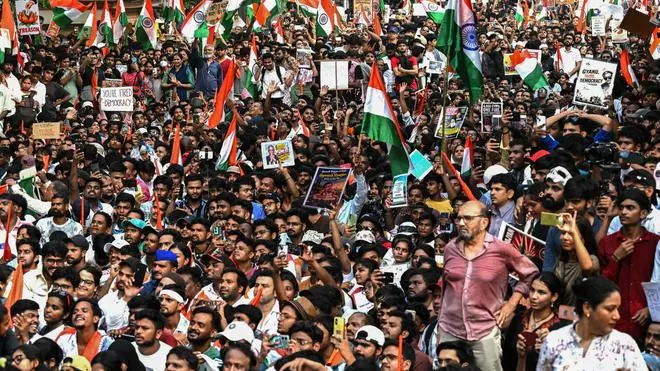
The controversy over the Special Intensive Revision of electoral rolls raises legitimate questions. But political parties cannot demand transparent electoral rolls and simultaneously treat every attempt to verify them as an assault on democracy. The real test is whether the process allows errors to be identified, challenged and corrected. The right to protest is integral to democracy. When citizens believe an institution has acted unfairly, they are entitled to question it, approach the courts and, peacefully, take their disagreement to the streets. The Election Commission of India is no exception. But protest cannot become a substitute for participation in the very process being challenged. That distinction is becoming increasingly important in the debate over the Special Intensive Revision (SIR) of electoral rolls. Over the past few weeks, the argument has moved beyond criticism of individual procedures to demands for the resignation of the Chief Election Commissioner, marches against the Commission and sweeping claims that crores of Indians have simply been deprived of their vote. Opposition leaders joined a major protest in Mumbai on October 4, where the SIR, the Election Commission and even electronic voting machines became part of the same political indictment. There are genuine reasons for concern. More than 13 crore names have been left out of draft electoral rolls during the nationwide exercise. That is an extraordinary number and deserves close scrutiny. There have also been troubling reports of procedural difficulties, questionable bulk applications for deletion and, importantly, disagreements within the Election Commission itself over aspects of implementation. These cannot be brushed aside. But neither should a draft exclusion automatically be described as a final disenfranchisement. That is where much of the political argument has become misleading. A draft roll is not the final roll Electoral rolls inevitably become inaccurate over time. People die. Families migrate. Voters change residence. Some names appear more than once. New voters become eligible every year. Correcting these records is not an attack on democracy; it is one of the requirements of democracy. The Supreme Court has now examined the SIR in considerable detail. In its May 27 judgment, it upheld the Commission’s authority to conduct the exercise and also upheld the broad documentation framework, while recognising that the Commission’s inquiry for electoral-roll purposes has defined limits. That should settle one part of the argument. SIR itself cannot reasonably continue to be portrayed as an exercise that has no legal basis. It does not, however, settle whether every decision taken during such an enormous exercise is correct. No court judgment can guarantee that a Booth Level Officer will never make a mistake, that software will never create an anomaly or that an eligible voter will never be wrongly classified. The answer to such mistakes is precisely why the claims-andobjections process exists. The Election Commission’s own framework provides for door-to-door verification, publication of draft rolls, claims and objections, appeals and participation by Booth Level Agents nominated by political parties. That distinction between a draft exclusion and a final deletion is fundamental. Yet public discussion increasingly collapses the two. If a person who has died, permanently shifted or is duplicated elsewhere is identified during enumeration, that entry requires examination. If an eligible citizen has wrongly been classified as absent or untraceable, that decision must be corrected. Both propositions can be true simultaneously. Where the Opposition has a case The Opposition’s concerns should not simply be dismissed as politics. When 13 crore names do not appear in draft rolls, the burden on the Election Commission to explain what has happened becomes exceptionally high. The Commission should publish clear state-wise and constituency-wise data showing how many electors were classified as deceased, shifted, duplicated, absent or otherwise requiring verification — and, eventually, how many were restored. There are also examples showing why vigilance is necessary. In Karnataka, complaints were made about bulk Form 7 applications seeking deletion of voters. The state’s Chief Electoral Officer subsequently directed action over allegedly false claims. More recently, the Bombay High Court at Goa questioned the difficulties faced by voters whose names were deleted after they had sought changes of address, highlighting the danger of citizens becoming trapped between different electoral forms and procedures. These are not trivial matters. A citizen should not need to understand the architecture of Form 6, Form 7 and Form 8 simply to preserve his or her vote. Indeed, the Election Commission itself has recognised some of these difficulties. It has now directed Booth Level Officers to visit voters who have received notices, collect documents at their homes and reduce the need for personal hearings. Help desks and special camps have been ordered for workers, homeless people and other vulnerable groups. It has also directed states where SIR has been completed to undertake a special drive for eligible voters left out of the rolls. These are sensible corrections. An institution does not weaken itself by correcting its procedures. It strengthens itself. But the Opposition must answer a question too The scrutiny, however, cannot run only in one direction. If political parties genuinely believe that eligible citizens are being excluded, why should their principal response be protest rather than an equally massive effort to identify those citizens and get their names restored? Political parties have an institutional mechanism for precisely this purpose: Booth Level Agents. Yet consider what happened in Pune district. During the SIR, official district data reported by The Indian Express showed that the BJP had appointed 6,201 BLAs. The Congress had appointed just 225 — and none at all in 16 of the district’s 21 Assembly constituencies at that stage. The NCP had appointed 3,270, Shiv Sena (UBT) 2,168, Shiv Sena 2,371 and NCP (SP) 990. That gap deserves attention. A political party cannot convincingly argue that lakhs of its supporters are in danger of disappearing from the electoral roll while failing to fully deploy the machinery specifically available to it for examining those rolls. If even a fraction of the energy spent organising rallies were directed towards checking every polling booth, contacting excluded voters, filing claims and following each claim until disposal, the result might be far more consequential. That is not an argument against protest. It is an argument for doing the harder work after the protest ends.
The Supreme Court’s refusal to pass an interim order against Chief Election Commissioner Gyanesh Kumar has put the...
On October 7, 2026, Narendra Modi completes 25 years as the head of a government. This journey in...
El Nino and warming in the tropical Atlantic could help provide early warning of extreme heat in the...

Prime Minister Narendra Modi marks 25 uninterrupted years in public executive office on Tuesday, October 7, establishing a...
It has been almost two years since the Aam Aadmi Party government in Punjab has been enthusiastically launching...
Currently, very optimistic data is emerging about India’s economic growth rate. Crisil has also recently stated that India...

Aries: The day will be auspicious...