Last Updated: October 24, 2026
Last Updated: October 24, 2026






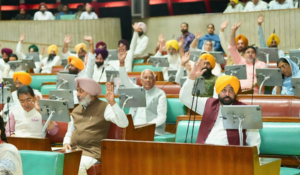
The AAP government of Punjab has introduced the Jogat Jot Sri Guru Granth Sahib Satkar (Amendment) Bill, 2026 regarding sacrilege. To get it passed, the government had called a special session of the Assembly. Now, once signed by the Governor, this bill will become law.
In this new bill, punishments in cases of sacrilege have been made stricter. Provisions have been made for life imprisonment if the accused is found guilty. Additionally, crimes have been divided into five different categories based on their severity, so that appropriate punishment can be determined in each case.
A special feature of this bill is that if an accused claims mental distress as an excuse, in such cases, members of their family can also be prosecuted, and action will be taken according to the law.
What constitutes desecration, which acts have been considered desecration in the new bill, what punishment and fine have been prescribed for it, and how different is this bill from the old law
Question: What is sacrilege?
Answer: In Sikhism, ‘sacrilege’ means disrespecting Sri Guru Granth Sahib or things related to Sikh discipline. The Sikh community regards Guru Granth Sahib as the ‘living Guru,’ so disrespecting it is considered very serious. This includes damaging the pages of Guru Granth Sahib, disrespecting the turban (dastaar), hair (kesh), and religious symbols such as the kirpan.
Question: Which bill did the government pass?
Answer: The AAP government of Punjab unanimously passed the Jagat Jyot Sri Guru Granth Sahib Satkaar (Amendment) Bill-2026.
Question: What is the Jagat Jyot Sri Guru Granth Sahib Satkaar (Amendment) Bill, 2026?
Answer: This is a new bill made by amending the 2008 Act, with the aim of preventing sacrilege, imposing strict punishments, and strengthening communal harmony and national unity.
Question: What is the purpose of the bill?
Answer: This bill has been introduced to make amendments to the old law of 2008. Its main objective is to maintain respect for the forms (copies) of Shri Guru Granth Sahib Ji and to prevent incidents of desecration.
Question: What is considered desecration under the bill?
Answer: Deliberately tearing, burning, or otherwise mutilating the ‘forms’ (holy scripture) of Shri Guru Granth Sahib Ji. Spitting on the holy scripture, touching it with dirty hands, or placing it in a location that violates its dignity. Publicly throwing the Guru Sahib’s form or leaving it abandoned in streets/drains. Stealing the holy form or keeping it against its sanctity. Consuming or carrying alcohol, tobacco, or any intoxicants in the presence of Shri Guru Granth Sahib Ji. Making disrespectful comments or creating insulting photos/videos of the holy Bani or Guru Sahib through social media or any other medium.
Question: How different is the new bill from the old law?
Answer: The original 2008 law was mainly limited to regulating the printing, transportation, and handling of sacred forms, as well as setting standards of etiquette, and it did not prescribe severe legal punishment for violators. In contrast, the 2026 amendment transforms it into a strict criminal bill. Under the 2026 bill, punishments for those guilty of disrespecting holy texts have been increased to life imprisonment. Now, only the Shiromani Gurdwara Parbandhak Committee (SGPC) or with its permission can print, publish, or distribute the forms of Shri Guru Granth Sahib Ji. No other individual or organization will be able to do so.
Question: What has changed in the new bill?
Answer: The previous law used the word ‘beed’. Now it has been changed to ‘swarup’, which is considered more respectful.
Question: For which religions is the new bill applicable?
Answer: The bill will currently apply only to the desecration of Sri Guru Granth Sahib. There is currently no provision for punishment under this bill for tampering with the holy scriptures and religious places of non-Sikhs (Hindus, Muslims, Christians, etc.). The CM said that a law will soon be made after consulting people of other religions as well.
Question: What punishment will be given under the new bill?
Answer: For desecration (damaging, tearing, or burning), 7 to 20 years of imprisonment and a fine of up to 2 to 10 lakh rupees. If the act is committed under a conspiracy to disturb peace, the punishment is 10 years to life imprisonment and a fine of 5 to 25 lakh rupees. For violating other rules, 5 years of imprisonment and a fine of up to 10 lakh rupees.
Question: Can bail be granted in cases of desecration?
Answer: No, under this law, the offense will be non-bailable, and compromise will not be allowed. Police can take action without a warrant. The hearing of such cases will be in the session court.
Question: Will an attempt at desecration also be considered a crime?
Answer: Yes, attempting it can result in 3 to 5 years of imprisonment and a fine of 1 to 3 lakh rupees.
Question: What action will be taken against those who help in desecration?
Answer: Those who help will also be punished equally as the main accused.
Question: What happens if someone uses mental illness as an excuse?
Answer: The bill provides that in such cases, family members can also be held responsible, and action can be taken against them.
Question: What changes have been made regarding the investigation process?
Answer: No officer below the DSP level will be able to investigate these cases.
Question: Will all crimes be considered the same?
Answer: No, crimes have been divided into five different categories, according to which punishment will be determined.
Question: What are the five categories of crime?
Answer: Simple violation – not following the prescribed rules of law. Desecration – insulting, damaging, or behaving wrongly towards something sacred. Severe desecration – such desecration intended to disturb religious or social harmony. Assistance or support – providing any kind of help or support in committing desecration. Attempt – trying to commit desecration, even if the act is not completed.
Question: When will the new law be enacted?
Answer: The bill has been passed in the Assembly. Now it will be sent to the Governor. After this, the Governor’s legal team will review it, and once the Governor signs it, it will take the form of law.
Punjab Chief Minister Bhagwant Singh Mann claimed in the Assembly on Friday that the central government first denied...

BJP leader Kewal Singh Dhillon has criticised the Punjab government over its Assembly priorities, raising the killing of...

The Punjab Assembly on Friday unanimously passed a resolution to protect the voting rights of eligible citizens during...
Chief Minister Bhagwant Mann has hit back at Union Home Minister Amit Shah's statement regarding the drug problem...
Congress MLA Sukhpal Singh Khaira was suspended from the Punjab Assembly for the remainder of the session. The...
The Chief Electoral Officer of Punjab has announced special camps across the state on Saturday, October 24th, 2026....
Aries: The day will be auspicious...