Last Updated: October 26, 2026
Last Updated: October 26, 2026





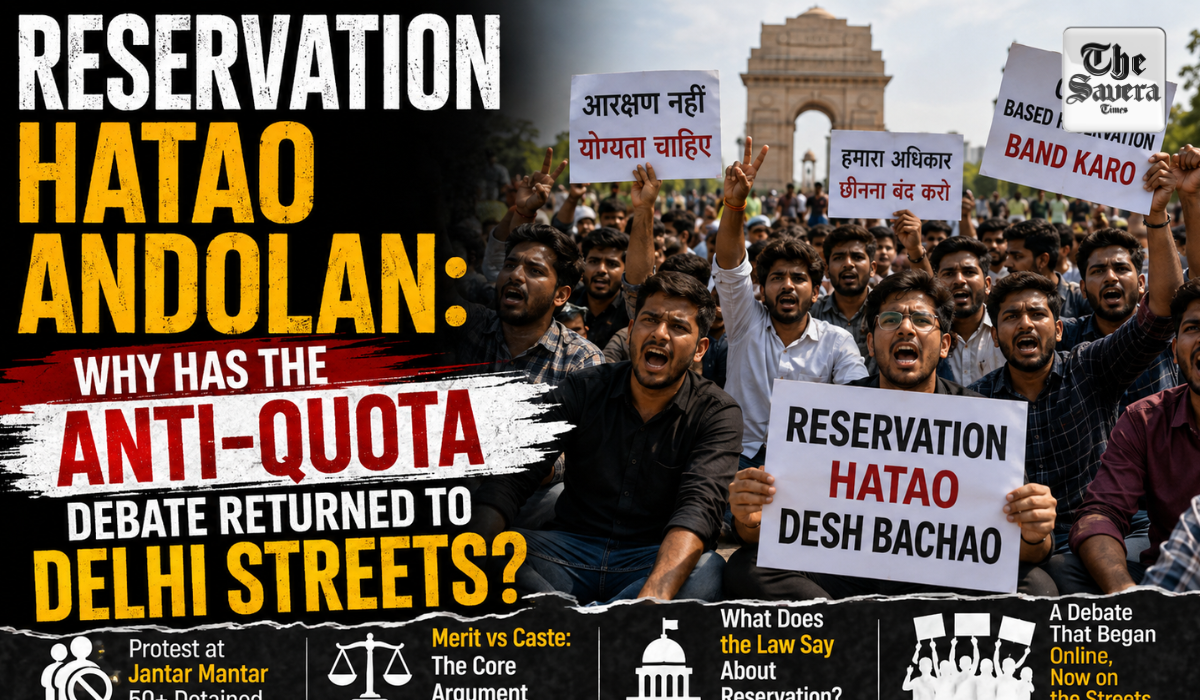
A reservation debate that was largely playing out on Instagram has now moved to the streets of Delhi. On August 21, hundreds of people gathered at Jantar Mantar under the banner of Reservation Hatao Andolan. More than 50 protesters were detained by police, according to reports. Their central argument was simple: government support should reach the poor, not be decided by caste alone.
But what exactly is this movement, why has it gained such attention, and what does the law say about reservation?
What Happened in Delhi?
The protesters gathered at Jantar Mantar demanding changes in the existing caste-based reservation system. They called for economic conditions to play a bigger role in deciding who receives government support, including assistance for education and other opportunities. They also sought a review of the reservation policy and raised the issue of the creamy layer.
There was also a venue dispute. Delhi Police had issued an NOC for a peaceful protest at Ramlila Ground, allowing up to 500 people until 4 p.m. However, protesters gathered at Jantar Mantar, where police said permission had not been granted. Security was increased and barricades were placed. More than 50 people were subsequently detained.
What Is Reservation Hatao Andolan?
Reservation Hatao Andolan is a citizen-led campaign that has grown rapidly through social media. Its central position is against caste-based reservation and in favour of a system that gives greater importance to merit and economic disadvantage.
The movement’s online campaign has become particularly visible among young people. By late July, its Instagram account had crossed 5.6 million followers. Reports have described its core demands as merit-based opportunities, equal fees, a uniform age limit and a common cut-off.
Why Does Reservation Exist?
To understand the protest, we first need to understand why reservation was introduced.
India’s reservation system developed in response to centuries of caste-based exclusion and discrimination. The Constitution allows the State to make special provisions for socially and educationally backward groups and for their representation in education and public employment.
The debate expanded significantly after the Mandal Commission recommendations led to the implementation of 27 per cent reservation for Other Backward Classes in central government jobs in 1990.
So, reservation was not originally designed simply as a poverty-relief programme. Its broader purpose includes representation and addressing social and educational disadvantage.
What Are Protesters Saying?
The protesters’ argument is that a person’s economic condition should matter more.
They ask: if two people are poor, why should caste determine who gets government assistance?
They also argue that reservation should be periodically reviewed, that relatively better-off beneficiaries should not receive benefits indefinitely, and that merit and equal opportunity should remain important.
The demand for a stronger creamy-layer principle is part of this argument. The Supreme Court’s Indra Sawhney judgment recognised the exclusion of the socially advanced “creamy layer” from OBC reservation.
But What Do Supporters of Reservation Say?
Supporters argue that poverty and caste discrimination are not the same thing.
A financially poor person may face economic hardship, but caste-based exclusion can continue even when a person is not poor. Their argument is that reservation addresses historical exclusion and under-representation, not simply lack of income.
So, for supporters, replacing caste-based reservation entirely with income-based support could ignore the social barriers reservation was created to address.
If Poverty Is the Problem, Why Not Give Reservation Only on Income?
India already has a form of economic reservation.
The 103rd Constitutional Amendment, 2019, introduced up to 10 per cent reservation for Economically Weaker Sections, or EWS, through Articles 15(6) and 16(6). In 2022, the Supreme Court upheld the constitutional validity of the EWS quota by a 3:2 majority.
But EWS is different from SC, ST and OBC reservation. The government has stated that the two operate under separate constitutional provisions.
This is at the heart of today’s debate: Should economic disadvantage become the main basis of affirmative action, or should caste and social disadvantage continue to remain separate considerations?
What Does the Supreme Court Say?
One of the biggest legal milestones is the 1992 Indra Sawhney, or Mandal, judgment. The Supreme Court generally held that reservations under Articles 15(4) and 16(4) should not exceed 50 per cent, while also recognising the creamy-layer principle for OBCs.
Later, the Economically Weaker Sections amendment created a separate 10 per cent quota. In 2022, the Supreme Court held that the 50 per cent ceiling applicable to reservations under Articles 15(4), 15(5) and 16(4) did not invalidate the separate EWS provision.
From 2006 Anti-Quota Protests to 2026’s Digital Movement
India has seen major anti-reservation protests before. In 2006, medical students and doctors protested against the proposed expansion of OBC reservation in central educational institutions. The protests spread to several cities and brought the reservation debate back into national focus.
The difference today is the platform.
In 2006, protests were driven largely by student groups, marches and television coverage. In 2026, the debate has first exploded through Instagram and other social media platforms, with millions of followers before the movement reached Delhi’s streets.
And that is perhaps the biggest reason this debate matters again: Reservation Hatao Andolan has turned an old policy battle into a new-generation question — should affirmative action be based primarily on caste, economic disadvantage, or a combination of both?
The Delhi protest may have ended with detentions, but the larger debate over merit, equality, caste, poverty and social justice is far from over.
Leader of the Opposition in the Lok Sabha, Rahul Gandhi, will visit Punjab's Sangrur district on November 4....

Good Evening Viewers! Stay updated with The Savera Times Evening Bulletin, bringing you the latest news and top...

The weather system forming in the Bay of Bengal is steadily strengthening. In view of this, Cyclone Warning...

A major road accident occurred in southeastern Kenya on Sunday morning. At least 22 people were killed and...
Hereditary Prince Alois of Liechtenstein will be on a four-day state visit from October 25 to 28 at...
Prime Minister Narendra Modi inaugurated the Reserve Bank of India’s new data centre and Cybersecurity Training Institute in...
Aries: The day will be auspicious...