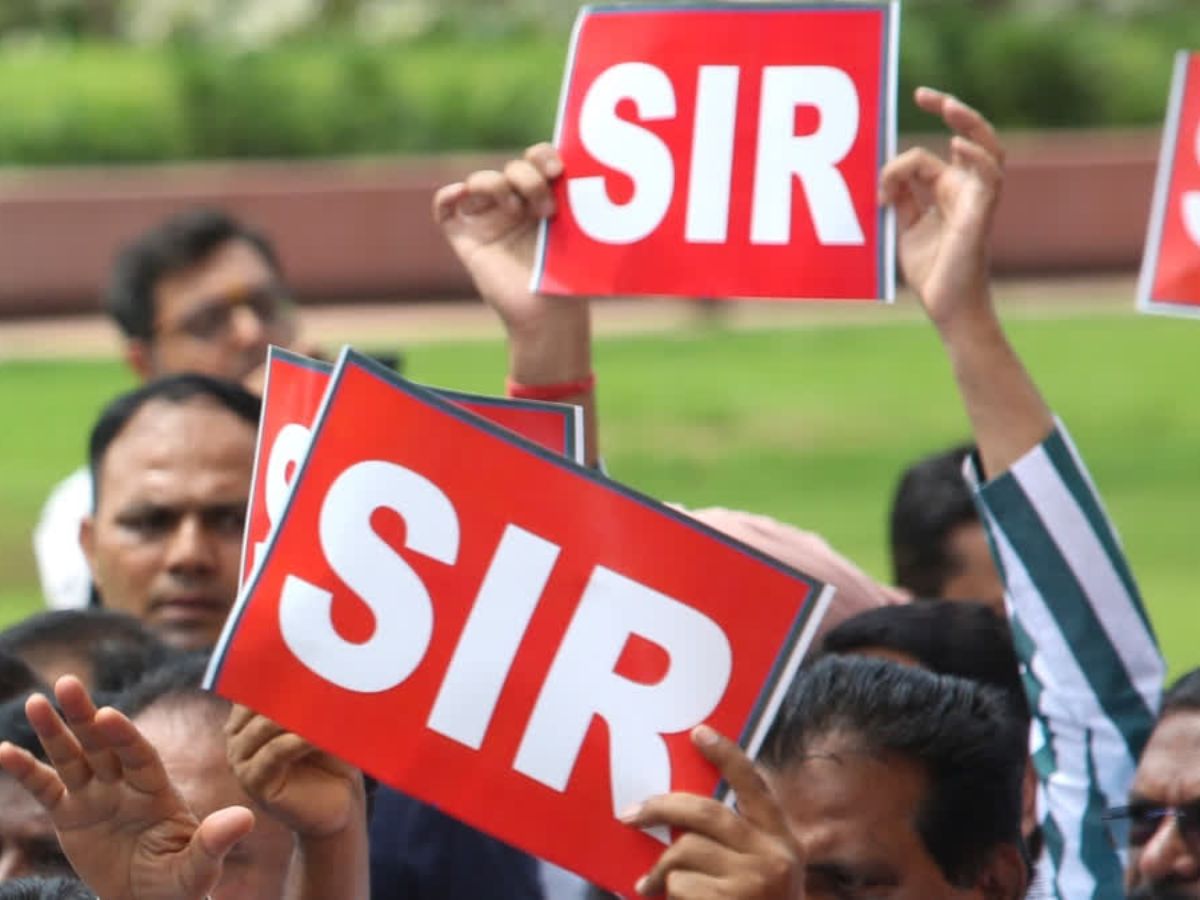
A massive campaign for the Special Intensive Revision (SIR) of voter lists is set to commence on May 30 across 16 states and 3 Union Territories, including Punjab. This campaign will continue until December. In Punjab, the SIR process will be conducted for one month, from June 25 to July 24. BLOs (Booth Level Officers) will go door-to-door to assist voters in filling out the necessary forms.
In Punjab, the entire workforce—comprising 24,453 BLOs, 2,476 Supervisors, 117 EROs (Electoral Registration Officers), and 234 AEROs (Assistant Electoral Registration Officers)—has been deployed for this task. On average, each BLO has been assigned to verify 300 households and 1,200 voters. All voters are required to fill out a form for the SIR, and January 1, 2003, has been designated as the qualifying date.
Following the verification process, the draft list will be published on July 31. Objections and claims will be adjudicated between July 31 and September 28, and the final voter list will be published on October 1. This is a massive undertaking, and to execute it, employees have been drawn from the Education Department and other government departments and deputed to this assignment. As these appointments have already begun, work in the respective offices from which these employees were drawn has started to slow down.
It is pertinent to recall that between now and 2029, elections are scheduled to be held for the Lok Sabha as well as for the Legislative Assemblies of 24 states and Union Territories. The first phase of the voter list revision was conducted in 2025, spanning from June to September. The second phase was completed between October 28 and February 2026. To date, 49.2 million names have been removed during this revision process.
The controversy surrounding this process, raised by the opposition, centers specifically on the removal of these names. Their grievance is that, under the guise of the SIR process, the government is systematically removing the votes of committed opposition supporters in select constituencies where the opposition holds a strong foothold. Consequently, they allege, the ruling party is able to secure power by relying solely on the strength of its own supportive voters.
It is evident that the state’s electorate does not accept this. Quite recently—prior to the Bengal elections—this issue sparked a major uproar. The Supreme Court ruled that individuals whose names had been struck off the rolls possessed the right to file an appeal to have their names reinstated. While hundreds of thousands of people filed appeals, by the time the elections actually commenced, only a few hundred cases had been resolved.
The Honorable Court went so far as to suggest that if a resolution could not be reached this time around, those affected could cast their votes once a decision was delivered in the future. Terming this situation unjust, Mamata Banerjee asserted that in West Bengal, it was not the BJP, but rather the SIR process itself, that had contested the election against her.
The SIR process frequently gives rise to controversies regarding the names of voters who have been removed from the rolls. Consequently, the SIR process has long faced accusations of operating in a manner that favors the ruling establishment. Now, a massive campaign is set to be launched across Punjab, 16 other states, and three Union Territories.