Last Updated: November 12, 2026
Last Updated: November 12, 2026





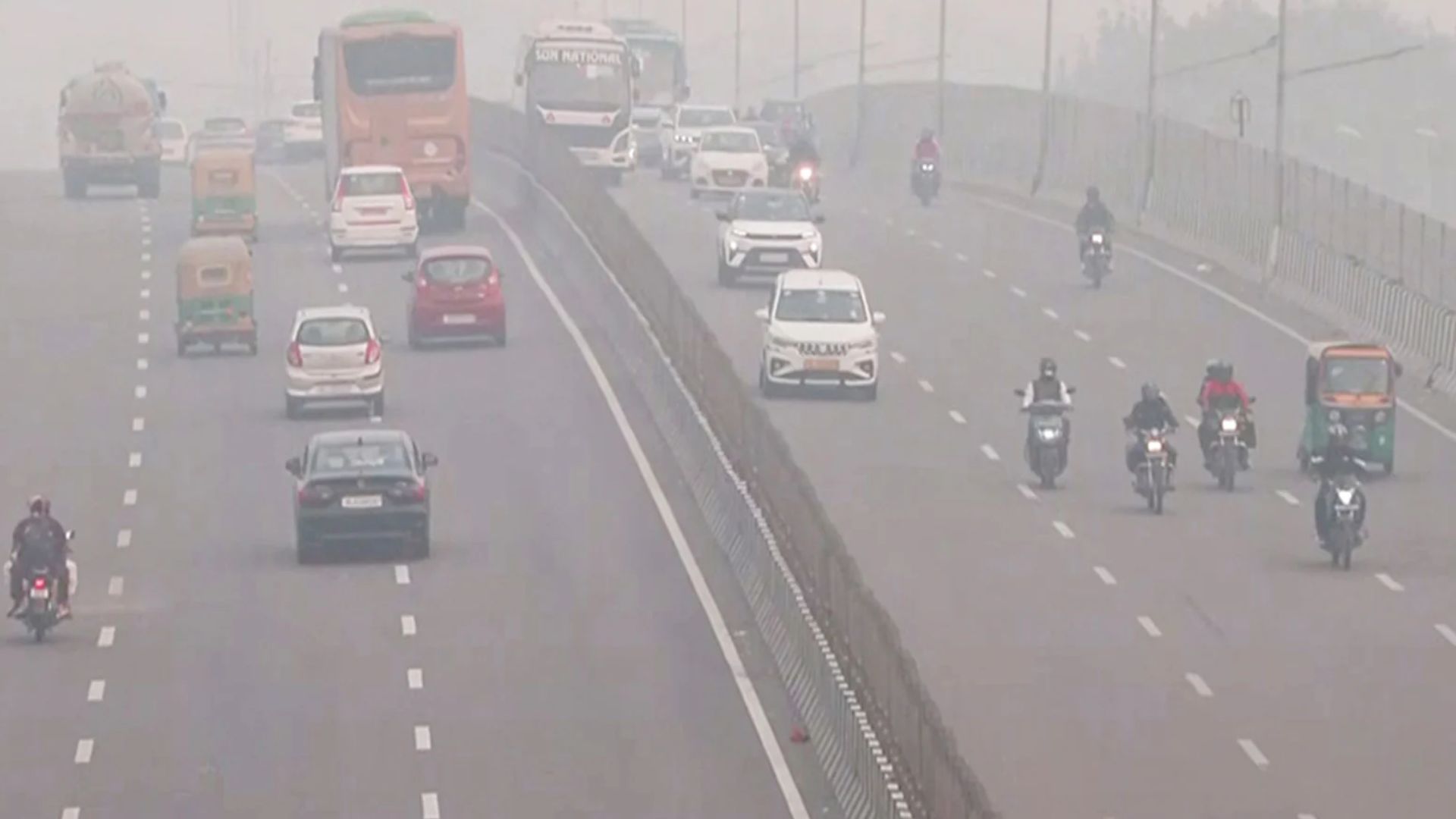
New Delhi: A slight improvement was recorded in the air quality of the national capital, Delhi, on Thursday morning. Despite this, the air quality remains in the ‘very poor’ category. Delhi’s average Air Quality Index (AQI) was recorded at 321. A thick blanket of haze covered several parts of the city during the morning hours, affecting visibility.
According to data from the Central Pollution Control Board (CPCB) at 7:00 AM, PM10 and PM2.5 remain the primary pollutants in the capital.
Among the various monitoring stations in Delhi, the highest AQI was recorded at NSUT Jafarpur (399). This was followed by 387 in Chandni Chowk, 386 in Pusa (IITM), 383 in NSIT Dwarka, and 378 at JNU. The AQI level stood at 371 in Punjabi Bagh, while 365 was recorded at CRRI Mathura Road.
AQI Crosses 350 in Several Areas of Delhi
At other monitoring stations, the AQI was recorded at 368 in Chhawla, 363 in Aya Nagar, 362 in Talkatora Garden, 352 at the Commonwealth Sports Complex, and 347 in Siri Fort.
The AQI was 331 in Ghumanhera, 320 in Tikri Kalan, 316 in Shadipur, 314 in Burari, 309 in Uttam Nagar, and 304 in Jharoda Kalan.
Meanwhile, an AQI of 256 was recorded in Karala, 289 in Maidan Garhi, 289 in Mandir Marg, and 269 in Pusa (DPCC). Data for Lodhi Road and Badarpur was not included in the available information on the Air Quality Index (AQI).
Notably, air quality in the capital deteriorated following the Diwali celebrations on November 8. On Monday morning, residents encountered dense smog, with the AQI exceeding 400 at several monitoring stations—a level classified as ‘severe.’ Visibility was also significantly reduced during the morning hours.
A drop in temperature and the presence of moderate fog have further exacerbated the pollution situation.
Restrictions under GRAP-3 remain in place; Delhi government intensifies efforts
The Delhi government is taking several measures to curb pollution. These include the deployment of water sprinklers across various parts of the capital to reduce dust and pollutant particles in the air.
Meanwhile, on Wednesday, the Member Secretary and technical members of the Commission for Air Quality Management (CAQM) met with a delegation from the Aam Aadmi Party (AAP) at the Commission’s office. During the meeting, the delegation’s concerns and grievances regarding air pollution in Delhi were addressed.
This development comes after the CAQM implemented Stage III of the Graded Response Action Plan (GRAP-3) in Delhi-NCR on November 6—three days before Diwali—in anticipation of a potential rise in pollution levels.
With GRAP-3 in effect, existing restrictions remain in place. Additionally, further pollution control measures are being implemented, and relevant agencies have been directed to ensure strict compliance with the regulations.
This emergency action plan applies not only to Delhi but also to the surrounding districts in Haryana, Uttar Pradesh, and Rajasthan. It is implemented as a precautionary measure, based on weather and pollution forecasts provided by the India Meteorological Department (IMD) and the Indian Institute of Tropical Meteorology (IITM). The objective is to implement necessary restrictions before the AQI reaches the ‘severe’ category.
GRAP (Graded Response Action Plan) is a four-stage emergency framework managed by the CAQM (Commission for Air Quality Management), in collaboration with the CPCB (Central Pollution Control Board) and the respective state governments, to combat pollution. As air quality deteriorates, the restrictions under this framework become increasingly stringent.
Mumbai’s air better than Delhi’s; AQI recorded at 146
Meanwhile, according to CPCB data, the AQI in Mumbai was recorded at 146 on Thursday morning, which falls under the ‘moderate’ category. At 7:10 AM, an AQI of 199 was recorded in the Bandra Reclamation area.
Among cities in Maharashtra, Bhiwandi recorded the highest AQI at 221, while Malegaon stood at 208. The air quality in both these cities fell into the ‘poor’ category.
The AQI was recorded at 182 in Pimpri-Chinchwad, 180 in Sangli, 177 in Parbhani, 165 in Jalgaon, 163 in Nanded, and 162 in Chandrapur.
In other cities, the AQI was 152 in Nashik, 150 in Belapur, 149 in Mahad, 146 in Mumbai, 146 in Thane, 144 in Dombivli, 140 in Navi Mumbai, 139 in Ambernath, 138 in Dhule, 134 in Jalna, 125 in Mira-Bhayandar, and 118 each in Ahmednagar and Virar. Additionally, the AQI was recorded at 113 in Vasai, 111 in Ulhasnagar, 108 in Akola, 103 in Kolhapur, 101 in Kalyan, 100 in Amravati, 97 in Solapur, 95 in Satara, 93 in Aurangabad, 90 each in Badlapur and Latur, 88 in Boisar, 83 in Beed, and 62 in Hingoli.
According to the CPCB classification, an AQI of 0–50 is considered ‘good’, 51–100 ‘satisfactory’, 101–200 ‘moderate’, 201–300 ‘poor’, 301–400 ‘very poor’, and 401–500 ‘severe’.
A new political alliance is taking shape in Uttar Pradesh ahead of the 2027 assembly elections.

Two Special Police Officers (SPOs) went missing on Wednesday from the upper reaches of the Dachhan area in...

With growing interest in healthier diets, mushroom cultivation is gaining importance in India’s horticulture sector and offers scope...

As part of the strengthening bilateral energy ties, India’s imports from the UAE have risen sharply over the...

It is good news that the Indian government, heeding the Supreme Court’s advice, has initiated an effort to...

India is seen as a credible country that can help in the peace talks between Russia and Ukraine...

Aries: The day will be auspicious...