Last Updated: October 15, 2026
Last Updated: October 15, 2026





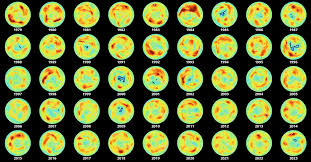
This year’s ozone hole over Antarctica ranked among the smallest since the early 1990s, reflecting steady progress from decades of global action under the Montreal Protocol.
Declining chlorine levels and warmer stratospheric temperatures helped limit ozone destruction. Scientists say the layer remains on track to recover later this century.
Scientists from NOAA and NASA report that this year’s ozone hole over Antarctica is the fifth smallest seen since 1992, the year that the Montreal Protocol, a landmark international agreement to phase out ozone-depleting chemicals, began to take effect.
During the peak of the 2025 ozone depletion season, from September 7 through October 13, the ozone hole covered an average of about 7.23 million square miles (18.71 million square kilometres).
It is already breaking apart almost three weeks earlier than the typical timing over the past ten years.
In earlier assessments, NASA and NOAA rated ozone hole severity using records that extend back to 1979, when satellites first began tracking ozone levels above Antarctica.
Using this longer 46 year record, the 2025 ozone hole ranks as the 14th smallest in terms of area.
According to NOAA and NASA scientists, this year’s measurements support the conclusion that restrictions on ozone-depleting chemicals set by the Montreal Protocol and its later amendments are steadily helping the ozone layer recover.
They note that the layer is still expected to return to pre-ozone hole conditions later this century as countries worldwide continue to replace ozone-depleting substances with less harmful alternatives.
“Since peaking around the year 2000, levels of ozone depleting substances in the Antarctic stratosphere have declined by about a third relative to pre-ozone-hole levels,” said Stephen Montzka, senior scientist with NOAA’s Global Monitoring Laboratory.
Mumbai Police has issued a 'Leave India' notice to Bollywood superstar Aamir Khan's nephew and actor Imran Khan....

Ram Kumar Singh, a 71-year-old retired Customs officer, was shot dead outside his home in Ara’s Kanakpuri locality....

Punjab AGTF and Haryana STF arrested Gurlal Singh in connection with Ajmeet Singh’s September 11 murder in Naushera...

Uttar Pradesh Police arrested a 28-year-old alleged criminal after an encounter in Noida’s Sector 63. Police said around...

Indian equity benchmarks opened higher on Thursday, with the Sensex rising 183.91 points and the Nifty gaining 48.60...

Union Home Secretary Govind Mohan has tendered an unconditional apology to the Supreme Court over alleged non-compliance with...

Aries: The day will be auspicious...