Last Updated: November 8, 2026
Last Updated: November 8, 2026





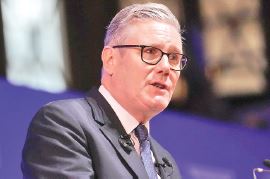
Keir Starmer’s journey from a landslide election victory to record unpopularity has been one of the swiftest reversals in modern British political history. Just fifteen months after leading Labour to power with its largest majority in decades, he now holds the unenviable title of the least popular prime minister in recorded polling. In July 2024, Labour swept into government with 411 seats and a commanding majority of 174, ending 14 years of Conservative rule. The result was hailed as a historic realignment.
Yet beneath the triumph lay a more fragile reality. Labour secured only about one-third of the national vote on low turnout, meaning roughly one in five eligible voters backed the party. Polling expert John Curtice observed at the time that Starmer’s victory was a “loveless landslide.” That fragility has since become clear. Ipsos surveys now show just 13 per cent of voters satisfied with Starmer’s leadership, compared with 79 per cent dissatisfied, placing him below even Liz Truss’s brief and tumultuous premiership.
A YouGov poll puts his net favourability at -47 per cent, with nearly seven in ten voters viewing him unfavourably. The discontent has roots in Britain’s ongoing economic and social difficulties. After years of austerity and pandemic pressures, public services were already in crisis when Labour took office. The National Health Service faced record waiting lists, prisons were overcrowded, and infrastructure continued to decline. Labour had pledged to restore and strengthen these services, but the financial outlook quickly constrained those promises.
Tax cuts introduced by the outgoing Conservative government left a gap in the public finances, while Starmer’s pledge not to raise taxes on “working people” narrowed the options further. Instead, the government resorted to smaller, often unpopular revenue measures, leaving critics to accuse Labour of lacking a coherent economic plan. Meanwhile, the wider economic picture worsened. Britain’s economy remains stagnant, with inflation high and real wages barely above 2008 levels.
Among G7 nations, the UK has been forecast to record the highest inflation this year. For households already struggling with the cost of living, this has sharpened disillusionment. Compounding economic frustrations is a perception problem surrounding Starmer himself. He has presented himself as pragmatic and non-ideological, avoiding the kind of defining political identities that past leaders cultivated. But this has left many voters unclear about what he stands for. Curtice described the situation as “the mystery of Keir Starmer – who is he, what does he stand for?” The political vacuum has been filled by rivals. Nigel Farage’s Reform UK has surged to 30–35 per cent support in some polls, overtaking Labour, which has slumped to around 20–23 per cent.
Farage has capitalised on concerns over immigration and the cost of living, while portraying himself as a straight-talking alternative. Starmer’s attempts to counter this by hardening Labour’s stance on immigration have instead alienated parts of his own base.Internal divisions within Labour have deepened the crisis. The resignation of deputy leader Angela Rayner over tax allegations forced a reshuffle, destabilising the government further. Rumours of alternative leadership figures, notably Manchester mayor Andy Burnham, have circulated despite his denials. On the left, former leader Jeremy Corbyn and MP Zarah Sultana are preparing to launch a new party, “Your Party,” which could draw support from disaffected Labour voters.
Meanwhile, other traditional Labour supporters have drifted toward the Greens, Liberal Democrats, and nationalist parties in Scotland and Wales. Polling shows Labour’s support dropping by more than 14 points in less than a year — an unprecedented collapse in modern British politics.International comparisons underscore the depth of Starmer’s unpopularity. His net approval rating is worse than Italian Prime Minister Giorgia Meloni, Spain’s Pedro Sánchez, and even Donald Trump in his second term.
Only French President Emmanuel Macron fares worse. In an attempt to regain momentum, Starmer’s government has unveiled measures such as suspending the UK’s family reunion policy for asylum seekers, framed as evidence of toughness on migration. But critics argue these steps reflect short-term damage control rather than a clear governing vision. Starmer had promised at Labour’s annual conference that difficult decisions would pave the way for “a new country, a fairer country, a land of dignity and respect.” Yet with approval ratings in freefall, internal fractures mounting, and an emboldened opposition led by Farage, the challenge for Labour is no longer how to shape the future of Britain, but how to halt its own rapid political decline.
At least 11 people were killed after airstrikes hit Ash Sharyah village near Yemen's capital, Sanaa, according to...

A mural of Rabindranath Tagore at Bangladesh's Khulna Railway Station was defaced with black ink. Police have launched...

US President Donald Trump has described the confrontation with Iran as “not a war”, claiming Washington has made...

American governors and federal leaders celebrated Diwali while recognising the contributions of Indian Americans. President Donald Trump received...
Washington: A 30-year-old Venezuelan national was arrested near the White House after US Secret Service agents discovered three...

Washington: US President Donald Trump outlined plans for a sprawling aerospace exhibition venue at Florida’s former space shuttle...
Aries: The day will be auspicious...