Last Updated: October 14, 2026
Last Updated: October 14, 2026





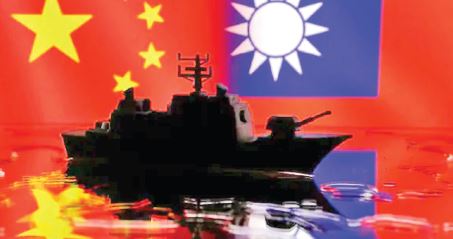
Taiwan has entered a new phase in its defence preparedness by signing landmark agreements with a United States defence firm to co-develop advanced weapons systems. For the first time, the self-governing island will manufacture a missile and an underwater drone in partnership with a foreign company. The move comes amid heightened concerns over China’s aggressive military posturing in the region and growing pressure from Washington for Taipei to expand its own defence capabilities.
At the centre of this effort is Taiwan’s National Chung-Shan Institute of Science and Technology (NCSIST), a state-run defence research body, which earlier this year announced a collaboration with Anduril Industries, a US-based defence technology firm. Their first project involves the Barracuda-500, a low-cost autonomous cruise missile designed for mass deployment. This week, the two sides deepened their partnership with a fresh agreement to co-produce Anduril’s underwater drones, marking Taiwan’s entry into unmanned maritime defence manufacturing. Speaking at the Taipei Aerospace and Defense Technology Exhibition, where the Barracuda was on display, NCSIST president Li Shih-chiang underscored the importance of domestic production.
“Our purpose is if in the warfare, even the blockade, we can manufacture every weapon we need to protect ourselves,” Li said. He stressed that Taiwan’s goal is to build a self-reliant supply chain to sustain military needs under potential conflict conditions, particularly if China attempts to cut off imports through a naval blockade. According to NCSIST, establishing the industrial base for the Barracuda-500 will take 18 months. The project aims to use entirely Taiwanese components, a step intended to avoid dependence on foreign supply lines that could be disrupted during wartime.
The missile’s low-cost design is intended to allow for large-scale production, giving Taiwan the ability to saturate its defences and potentially complicate Chinese military planning. The significance of these agreements extends beyond technology. They are Taiwan’s first formal defence co-production deals with a foreign partner, signalling a shift in how the island approaches its long-term security. By linking its domestic defence sector with an innovative US firm, Taiwan not only gains access to advanced designs but also embeds itself more closely into a Western defence ecosystem that could prove crucial in the event of hostilities.
The timing is critical. China continues to ramp up military exercises around Taiwan, including frequent air and naval manoeuvres that simulate blockades and invasions. Beijing claims Taiwan as part of its territory and has refused to rule out the use of force to bring the island under its control. Taipei, in turn, has accelerated its military planning, with officials openly preparing for the possibility of war. A senior Taiwanese lawmaker told AFP last week that the defence ministry will request up to NT\$1 trillion (about \$33 billion) in special funding for upgrades to the island’s security. If approved, it would represent one of the largest investments in Taiwan’s defence in history. The plans include integrating and modernising air defence systems, acquiring advanced technology from international partners to detect small drones, rockets and missiles, boosting the domestic production of ammunition, and expanding wartime stockpiles.
These measures reflect Taiwan’s growing concern about the scale and sophistication of China’s arsenal. With Beijing deploying increasingly capable missiles, cyber warfare tools and surveillance drones, Taipei’s strategy has shifted toward resilience and asymmetric warfare — building systems that can survive and fight even when under sustained attack. Beyond weapons development, Taiwan is also focusing on preparing its civilian population. Earlier this year, authorities released an updated civil defence handbook designed to help residents respond to emergencies. The manual outlines practical steps citizens should take during air raids, cyber disruptions or direct attacks, ranging from how to find shelters to what supplies to store. Lin Fei-fan, Deputy Secretary-General of Taiwan’s National Security Council, who oversaw the handbook update, said the initiative draws inspiration from survival guides published in other democracies, including the Czech Republic and France. He explained that Taiwan’s leadership sees it as essential to familiarise the population with survival tactics in advance, given that a sudden conflict could overwhelm state resources.
The broader strategy, therefore, rests on three pillars: enhancing military capacity, securing critical supply chains for weapons, and empowering civilians with knowledge and preparation. This approach reflects lessons drawn from conflicts elsewhere, particularly the war in Ukraine, where civilian readiness and rapid adaptation have played a critical role. For the United States, Taiwan’s moves are in line with longstanding calls for the island to invest more in its own security. Washington remains Taipei’s most important security partner, though it does not formally recognise Taiwan as an independent state. American officials have repeatedly urged the island to adopt “porcupine” strategies — inexpensive, resilient defences designed to make any invasion attempt costly and uncertain for Beijing.
The co-production agreements with Anduril suggest that Taipei is heeding that advice, moving from reliance on foreign arms sales toward building the capacity to manufacture its own systems. The projects are also symbolically significant. They represent Taiwan’s determination to stand firm against Chinese pressure, not only through diplomacy but through concrete steps to reinforce its defences. By collaborating with Anduril, a company known for cutting-edge unmanned systems, Taiwan signals its intention to invest in the future of warfare, where drones and autonomous weapons are expected to play an increasingly central role. For now, the Barracuda-500 and underwater drone projects are in their early stages. Yet their very existence demonstrates a shift in Taiwan’s defence posture — from reactive procurement to proactive development. As NCSIST builds the supply chain and gears up for production, the projects are expected to not only bolster Taiwan’s capabilities but also stimulate local industries and strengthen links with international partners.
Ultimately, Taiwan’s leadership is candid about its predicament. It faces a neighbour many times larger, with far greater resources, determined to assert control over the island. Yet through partnerships, innovation and preparation, Taipei hopes to complicate that ambition. The message conveyed at the Taipei defence exhibition was clear: Taiwan intends to prepare for the worst while signalling to its allies and adversaries alike that it will not be an easy target.
A major train accident occurred on Tuesday in the Multan district of Pakistan's Punjab province. At least four...
Canadian Foreign Minister Anita Anand will arrive in New Delhi on an official visit on Tuesday. During her...
International human rights organization Amnesty International has expressed serious concern over the alleged arbitrary arrests of prominent leaders...
US President Donald Trump says Vladimir Putin may be more willing than Volodymyr Zelenskyy to reach a peace...
A magnitude 6.1 earthquake struck Panama early Tuesday at a depth of 10 kilometres. The tremor followed a...
US President Donald Trump has indicated the possibility of meeting North Korean leader Kim Jong Un during his...
Aries: The day will be auspicious...