Last Updated: October 16, 2026
Last Updated: October 16, 2026





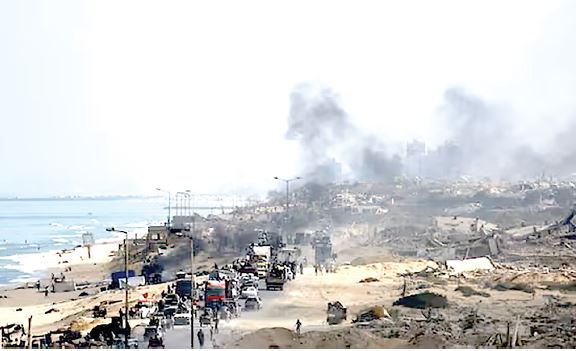
Palestinian envoy Abdullah Mohammad Abu Shawesh warned that releasing hostages from Gaza will be impossible so long as the enclave remains a “complicated war zone,” and said that Hamas’s reported acceptance of US President Donald Trump’s Gaza peace plan still required detailed discussion. Speaking to CNN News18, Shawesh said the Palestinian side would wait for those discussions to take place before any final positions were confirmed.
“Hamas accepted the President Trump Plan, but details have to be discussed,” Shawesh said, adding that the movement had reservations about the inclusion of Tony Blair’s name in any transitional formula. He stressed the Palestinian demand for unity, saying, “Our official position has been one force of Palestine, so Hamas giving up weapons is our official position.” On the practicalities of a hostage exchange, he warned, “Release of hostages cannot happen like that; it is a complicated war zone.”
The comments came after renewed assertions from President Trump and subsequent statements by Hamas that suggested a possible rapprochement on a negotiated deal. Trump’s plan, as described by supporters, called for an immediate end to fighting, an exchange of hostages and Palestinian prisoners within 72 hours of signing, a phased withdrawal of Israeli forces from Gaza, the disarmament of Hamas, and establishment of a transitional authority to oversee reconstruction and administration. The proposal also envisaged a surge of humanitarian aid and a reconstruction programme for the devastated strip.
Hamas issued its own statement endorsing elements of the proposal while reserving the right to negotiate other aspects. The group said it would give its “approval of releasing all occupation prisoners—both living and remains—according to the exchange formula contained in President Trump’s proposal, with the necessary field conditions for implementing the exchange.” Hamas also declared itself willing to transfer “the administration of the Gaza Strip to a Palestinian body of independent technocrats based on Palestinian national consensus and supported by Arab and Islamic backing.”
At the same time Hamas made clear that “other issues” in the Trump plan would require further discussion “within a unified Palestinian national framework.” Those issues were widely understood to include the future status of arms, the scope and timing of Israeli troop withdrawals, and the shape of any international guarantees for a lasting ceasefire. Shawesh’s comments underlined how those unresolved questions would determine whether any agreement could move from outline to execution.
Observers cited by supporters of the proposal have framed Trump as a pivotal figure capable of pressuring Israeli leadership toward an agreement. The plan’s proponents argue that swift implementation of an exchange and clear mechanisms for aid and reconstruction could halt the immediate humanitarian crisis in Gaza. Critics and analysts, however, have pointed to the plan’s demands—particularly disarmament and the role of external administrators—as major stumbling blocks for Hamas and for parts of the broader Palestinian political spectrum.
Hamas’s conditional acceptance of a hostage handover is significant because hostages have been central to bargaining throughout the conflict. The group said the exchange would follow the formula set out in the proposal, but it did not immediately accept disarmament or all other terms. Supporters of the plan noted that a successful exchange of hostages would remove key leverage that Hamas has used during negotiations and could alter the balance of incentives for further concessions.
Shawesh reiterated the historical and political context framing Palestinian decision making. He warned that any implementation would require clear, practicable field conditions and stressed the importance of Palestinian unity in negotiations. He also noted sensitivities over outside figures proposed to oversee or mediate transitions.
For now the picture remains fluid. Trump has publicly advanced the proposal and the parties have signalled tentative convergence on specific elements. Hamas has committed to a hostage exchange under conditions, but it insists that wider issues be negotiated within a unified Palestinian framework. The Palestinian envoy said the side would wait for detailed discussions to clarify the plan’s mechanics and guarantees before endorsing further steps.
Until those details are settled, and until the claim that an agreement is within reach is tested by concrete, verifiable steps on the ground, the release of hostages and a durable end to the fighting will remain contingent on complex negotiations and a sequence of operational conditions in an active conflict zone.
A Houthi attack on the al-Maashiq Presidential Palace in Aden killed five people and injured 16, amid intensifying...
A shooting at Silver Rail Elementary School in Bend, Oregon, left three children and a teacher dead. The...

Prime Minister Narendra Modi will visit Canada on December 11-12, 2026, with both countries aiming to strengthen strategic...
US Vice President JD Vance has warned that anyone found selling access to the White House should face...
Washington: US President Donald Trump has claimed that drug cartels effectively control Mexico and warned that his administration...

Bangladesh is home to around 41.6 million child brides, including 22.3 million who were married before the age...