Last Updated: October 25, 2026
Last Updated: October 25, 2026





By Dr. Maria Afzal
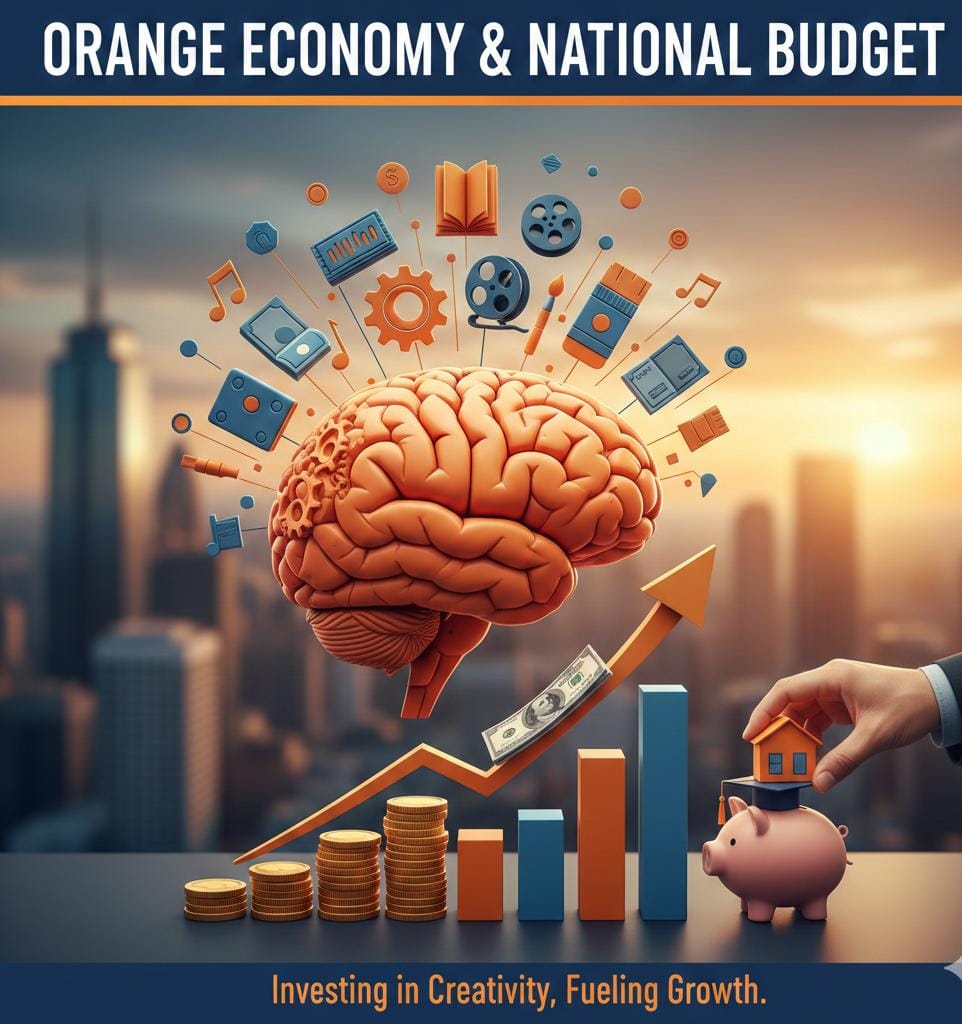
The Union Budget for 2026-27 turned its spotlight to orange economy, it did more than name a sector- signalled a strategic shift. The Finance Minister, Nirmala Sitharaman, announced targeted allocations for animation, visual effects, gaming, comics (AVGC), design and content creation, the Budget signals a shift in thinking: from seeing creativity as a cultural add-on to recognising it as an economic growth engine. The intent is clear: move from manufacturing-led to services-and-IP-led growth, and tap the enormous creative energy of India’s youth.
What Prompted India to focus on Orange Economy?
Strategic importance to focus on the orange economy in the budget lies in the overseas market. The creative economy has grown from a “soft” cultural industry overseas into a significant driver of employment, trade, and service expansion. According to UNCTAD’s Creative Economy Outlook 2024 report, creative services exports reached over US$ 1.4 trillion in 2022, and creative goods exports hit US$ 713 billion. This shows the sector’s importance to global trade and production. UNESCO estimates that 6.2% of the world’s occupations are in the cultural and creative industries, which are promising in emerging areas where young people need jobs. India follows the global trend. In 2023, creative exports generated over Rs 94,677 crore (US$ 11 billion), contributing to an industry of over Rs 3.01 lakh crore (US$ 35 billion). Women, marginalized groups, and informal workers are drawn to the industry, which accounts for 20% of Gross Value Added, 8% of employment, and well-paid jobs. Creative platforms and digital services were crucial to labor, culture, and social connection during COVID-19 lockdowns, proving the orange economy’s resilience. This model diversifies the economy through intellectual assets rather than natural resources.
Creative Economy at Glance
At the heart of this push, the government support for the Indian Institute of Creative Technologies (IICT), Mumbai, to establish AVGC and content-creator labs. According to the Budget speech, these labs will be rolled out across nearly 15,000 schools and 5000 colleges in a phased manner beginning in 2026–27. This is a significant intervention. India’s AVGC industry is projected to require nearly two million skilled professionals by 2030, and the lack of trained manpower has long been a bottleneck for the sector. The Budget also says that a new National Institute of Design will be built in eastern India using a “challenge route.” This shows that the government wants to spread creative education outside established centers. These projects all show a policy perspective that connects education, job readiness, and innovative entrepreneurship.
Key AVGC Provisions in Budget 2026–27: Promise, Pitfalls and the Path Ahead
The decision to reach nearly 15,000 schools is particularly strategic. It aims to create a broad foundational layer by introducing students to creative-digital production skills such as basic animation, game design and audio-visual storytelling. Additionally, it strives to normalize artistic occupations alongside academic and professional paths. The program intervenes before social and economic pressures limit expectations by engaging kids early, especially in non-metro and rural areas. This important because creative disciplines are popular, but systematic, scalable skill formation in AVGC has been limited to a few urban centers. School-level exposure fosters aspiration, the Budget’s inclusion of 5,000 colleges to acquire advanced AVGC abilities is more significant. Through portfolio development, project-based learning, internships, and apprenticeships, colleges are where creativity becomes employability. The scope of this effort allows regional creative clusters rather than isolated excellence centres. Sharing infrastructure, peer learning, and connection to local industry can create robust, self-sustaining ecosystems.
The possible benefits are very big. The orange economy needs a lot of workers, is focused on young people, and can grow digitally. Creative sectors create jobs with relatively little physical infrastructure, unlike manufacturing, which needs a lot of money. They also open up export markets because more and more animation, games, and digital content made in India are being sold throughout the world. More importantly, focusing on intellectual property like characters, concepts, games, and formats lets Indian artists and businesses make money in the long run instead of relying on outsourcing that doesn’t make much money.
Size does not guarantee success. Labs becoming symbolic installations instead than live learning places is risky. These resources may be underutilized without specific curricula, trained faculty, and industry-linked assessment. Rapid technological change is another issue. Static syllabi may become obsolete in a few years as AVGC technologies, software, and platforms evolve. Skills oversupply without demand can occur if industry participation is voluntary rather than incentivized.
How Budget 2026 Breaks from Tradition and Why It Speaks to India’s Youth?
Roads, railways, ports, energy, and urban assets received the majority of India’s capital investment of over Rs 11.21 lakh crore in the Union Budget for 2025-26, which mostly adhered to the country’s traditional development strategy. Creating assets is the primary generator of growth and jobs, according to the long-held idea. Capital expenditures are increased to Rs 12.2 lakh crore in Budget 2026-27, maintaining current momentum. Incorporating ecosystems for human capital and creative talents into the growth framework also demonstrates a significant shift in policy thinking. At long last, the orange economy has made it into the national strategy.
With the support of the Indian government, the IICT is assisting 15,000 secondary schools and 500 colleges in establishing Animation, Visual Effects, Gaming, and Comics (AVGC) laboratories. As a result, creative capacities are no longer seen as merely cultural assets, but as essential components of a robust economy. Education must be transformed into employment in a sector that is projected to require more than two million skilled people by the year 2030. In response to actual demands in the labor market, Budget 2026–27 adopts a sector-specific strategy. Budgets in the past relied on generalized skill sets, but this is different. This shift from an asset-heavy model of development to one that is capability-led is an effort to bridge the gap between young people’s goals, their abilities, and the employment opportunities that are available to them. But how many people outside of cities have access to it, how many companies participate, and how well it is executed will determine its success.
The focus on goals and objectives is what makes this budget unique. It intervenes early in the aspiration cycle of young people by integrating creative and digital skills into schools and institutions. This is before societal expectations confine them to restricted, conventional job paths. The budget legitimizes creative work as economic activity, which is great news for a generation that uses digital material every day for consumption, creation, and monetization. For young people in rural and non-metro areas of India, who frequently do not have access to formal channels for monetizing their skills, this is a huge change in the narrative. This aligns with a youth economy where creative services already generate Rs 94,677 crore in exports and employ nearly 8 percent of India’s workforce. By reallocating attention from assets to aspirations, the Budget speaks directly to young Indians seeking flexible, future-facing livelihoods rather than traditional salaried pathways.
Key Spending Comparison.
What will make the Orange economy work?
To turn budgetary goals into long-term changes to the workforce, a number of steps must be taken. First, curriculum need to be flexible and revised often by industry councils to make sure they are still useful without being too standardized. Second, faculty development is just as important; creative laboratories won’t work if there aren’t good mentors. Third, businesses should be encouraged to work together by offering financial or regulatory incentives. This would make internships and apprenticeships the standard instead of the exception. Finally, whether these labs become real talent streams will depend on whether they get long-term support for operations, improvements, and outreach, not only for equipment.
Yet, ambition alone will not guarantee outcomes. The first problem is putting it into action. Budget statements need to be turned into clear rules, timely fund flows, and demonstrable results. Without strong industry linkages with colleges and schools, there is a risk of producing trained graduates who remain unemployable. Apprenticeships, studio partnerships and industry-validated curricula will be crucial. There are also concerns around inclusion. Creative labs and premier institutes should not become urban enclaves accessible only to a few. Regional languages, local art forms, women creators and small-town youth must find space within this ecosystem. Otherwise, the orange economy risks deepening existing inequalities rather than democratising opportunity. Creative work often involves contractual and gig-based employment, which brings income volatility. Skill creation must therefore be complemented by policies that address social security, IP protection and fair compensation for creators.
Conclusion
Budget 2026 has opened a promising window for India’s orange economy. Whether it becomes a turning point or a missed opportunity will depend on how boldly policy moves from infrastructure creation to ecosystem stewardship.
If backed by disciplined execution, industry partnership and inclusive design, it can turn India’s vast creative energy into sustainable economic value. If not, it risks becoming another well-intentioned announcement that fades with the fiscal year. The real test now lies beyond the Budget speech-on the ground, in classrooms, teachers, studios
The weather system forming in the Bay of Bengal is steadily strengthening. In view of this, Cyclone Warning...

A major road accident occurred in southeastern Kenya on Sunday morning. At least 22 people were killed and...

Hereditary Prince Alois of Liechtenstein will be on a four-day state visit from October 25 to 28 at...
Prime Minister Narendra Modi inaugurated the Reserve Bank of India’s new data centre and Cybersecurity Training Institute in...
Congress president Mallikarjun Kharge sparked a political row in Patna after responding sharply to a man who interrupted...
Shiromani Akali Dal (SAD) President Sukhbir Singh Badal on Sunday welcomed senior Congress leader and former Jalalabad MLA...

Aries: The day will be auspicious...