Last Updated: October 21, 2026
Last Updated: October 21, 2026





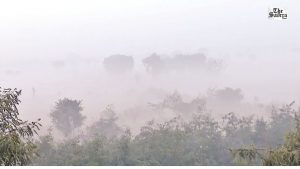
I n the mist-laden hills of Darjeeling, t h e m o r n i n g s have turned eerily quiet. For 70-yearold Dhanmaya Sarki, a resident of Kolbong Khasmahal, the silence carries a deep sense of loss. The once-familiar murmur of gurgling springs has faded, leaving behind the stillness of parched soil and empty channels.
The chirping of birds and the lowing of cows sound hollow without the rhythm of flowing water. Like her, hundreds of women in this remote village have grown accustomed to the absence of the mountain springs that once nourished their land and lives. The silence of these drying sources represents more than an environmental change— it signals abandoned f a r m s , d e c l i n i n g livelihoods, and the slow migration of the younger generation to towns and cities in search of work. Just a few years ago, Kolbong Khasmahal was known for its thriving vegetable and dairy production.
The region’s fresh produce was once in high demand in nearby markets. Today, the same households that once sold surplus vegetables now buy them from shops that depend on supply trucks from Dhupguri or Maynaguri in North Bengal. Shelves once lined with homemade cottage cheese, or churpi, are now stocked with packaged Amul milk and cheese.
This transition from selfsuffciency to dependence mirrors a broader rural transformation. The local economy, once rooted in traditional farming and livestock, has given way to external markets and industrial goods. The shift undercuts the national narrative of “Vocal for Local” and challenges the ideal of aatmanirbharta (selfreliance), as rural communities become increasingly dependent on distant sources for basic needs.For women like Dhanmaya, the crisis has also meant a heavier daily burden. With many natural springs either dry or reduced to trickles, women now spend long hours fetching water from distant sources.
On average, they walk up to two hours a day carrying heavy buckets along steep, rocky trails. Once, the sound of flowing water filled the mornings; now, the clinking of metal pails and the strained voices of women climbing uphill echo through the village.Their labour, though central to sustaining households, remains invisible. These women hold together families and communities in the face of water scarcity, continuing to hope that the education of their children will bring opportunities that the land can no longer provide. The situation in Kolbong Khasmahal is not an isolated case. It reflects a larger ecological and social crisis unfolding across the Indian Himalayan Region (IHR). Changing r a i n f a l l p a t t e r n s , d e fo re s t at i o n , a n d unregulated land-use practices have led to a steady decline in natural springs—the lifelines of mountain communities. As these water sources vanish, agricultural fields dry up, forcing families to abandon traditional occupations. Many migrate to urban areas, seeking alternative livelihoods.
T h e p r o b l e m i s particularly acute in the eastern and central H i m a l a y a s , w h e r e thousands of small villages rely almost entirely on spring water for drinking, farming, and livestock. During the COVID-19 pandemic, when migrant workers returned home, they found cracked earth and dry channels where once springs had flowed. The return to a parched homeland exposed the fragility of mountain ecosystems and the lack of sustainable alternatives.
A 2018 report by NITI Aayog sounded the alarm: nearly half of all springs in the Indian Himalayan Region are either drying up or have already disappeared. Nationwide, around 200 million people depend on spring water, especially in fragile ecosystems such as the Himalayas, the Western and Eastern Ghats, and the Aravalli ranges. Despite this vast dependence, India’s national water policies of 1987, 2002, and 2012 made no mention of springs. This institutional neglect began to change only in 2018, when NITI Aayog released its first report on the “Inventory and Revival of Springs in the Himalayas for Water Security.”
The report acknowledged that the loss of springs is not merely an environmental issue but one that endangers livelihoods, health, and cultural heritage. In the hills of Darjeeling and beyond, the drying of springs is reshaping not just landscapes but lives. It is a quiet crisis unfolding far from the noise of cities, yet its impact ripples across generations.
The silence that fills Dhanmaya Sarki’s mornings is a reminder that without urgent action to revive these springs, an entire way of life could vanish with them. The loss of Himalayan springs is not just about water— it is about the eroding relationship between people and their land, b e t w e e n t ra d i t i o n and survival. Unless addressed with focused policies and communitydriven restoration, the songs of the mountains may soon fall silent forever
Gaurav and Shaurya arrived in India as two brothers from Namibia in the first chapter of the country’s...

Himanshu Nitnaware Australian seabirds are being found with record amounts of plastic in their stomachs, with plastic ingestion...

Indian-born female cheetah KGP12 has given birth to four cubs in Kuno National Park, marking a new milestone...

South Asia bears the highest current economic burden from air pollution among world regions, equivalent to 10% of...
A scientific survey of the southern Gulf of Kachchh has recorded 64 dolphin sightings involving 193 individuals, highlighting...

Nepal has proven its resilience in coping with earlier disasters as the country stepped up search and rescue...
Aries: The day will be auspicious...