Last Updated: October 19, 2026
Last Updated: October 19, 2026





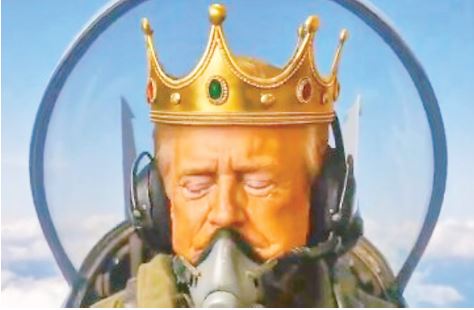
As the “No Kings” protests continue to sweep across the United States, President Donald Trump has stirred further outrage by sharing an artificial intelligence–generated video that mocks demonstrators challenging his administration. The protests, which have drawn millions to the streets across all 50 states, mark one of the largest coordinated movements in recent American history.
After spending the day golfing, the president took to his social media platform, TruthSocial, late in the evening to post a video depicting himself as a crowned ruler piloting a fighter jet emblazoned with the words “KING TRUMP.” The video, created with AI tools, shows the jet dropping brown liquid over a crowd of “No Kings” protesters while the 1986 Kenny Loggins hit “Danger Zone,” famously featured in the Top Gun films, plays in the background.
The imagery immediately drew criticism for its violent undertones and lack of sensitivity. Analysts and commentators condemned the video for appearing to trivialize citizens’ right to protest and for coming from both the president’s personal and official government accounts. Critics described the post as emblematic of the administration’s dismissive attitude toward widespread dissent.
The “No Kings” demonstrations began as a peaceful movement denouncing what protest organizers describe as the president’s authoritarian tendencies and the growing consolidation of power within the executive branch. Participants have carried banners reading “No Kings in America” and “Democracy, Not Dynasty,” arguing that the administration’s language and actions threaten the nation’s democratic institutions.
According to organizers, nearly seven million people joined the rallies nationwide, with major gatherings in Washington, D.C., New York, Los Angeles, and Chicago. Despite the largely peaceful nature of the marches, some Trump allies have characterized them as anti-American or even extremist.
House Speaker Mike Johnson labeled the demonstrations “Hate America rallies,” accusing participants of undermining national unity. Transportation Secretary Sean Duffy suggested that some protesters were being funded or organized by “radical left groups,” including Antifa, which the Trump administration has previously designated as a domestic terrorist organization.
Several prominent Republicans, including Vice President JD Vance, amplified Trump’s mocking tone online. Vance shared another AI-generated video showing the president donning a golden crown and cape as Democratic leaders, including Nancy Pelosi, kneel before him. Supporters of the administration circulated similar images, reinforcing the perception of Trump as a monarchic figure — the very idea protesters were rallying against.
Critics have accused the White House of deliberately fueling tensions to justify harsher measures against demonstrators. Some political analysts have speculated that the administration’s online provocations could be part of a broader effort to provoke unrest, potentially paving the way for Trump to invoke the Insurrection Act, a move that would allow federal troops to intervene domestically.
“No Kings” organizers have taken precautions to ensure that protests remain peaceful. Indivisible co-founder Ezra Levin, one of the movement’s key figures, told The Independent that the administration’s use of inflammatory imagery reveals “a deep fear of peaceful opposition.” Levin added that protesters are aware of attempts to link their movement to violence, but said they remain committed to nonviolent action and constitutional rights.
This is not the first time President Trump has used AI-generated content to promote a militarized or authoritarian image of himself. In September, as tensions flared over his administration’s threats to deploy the National Guard in Chicago, the president posted another AI-created image depicting himself in military fatigues, aviator sunglasses, and a cowboy hat, standing before helicopters hovering over a city engulfed in flames. The image was captioned with the phrase “Chipocalypse Now,” a play on the title of the 1979 Vietnam War film Apocalypse Now.
The accompanying post read, “I love the smell of deportations in the morning… Chicago is about to find out why it’s called the Department of WAR.” That message, which many interpreted as an endorsement of state violence, drew widespread condemnation at the time from civil rights organizations and lawmakers.
Now, as the “No Kings” protests grow and the administration continues to use provocative online imagery, political observers warn that the situation reflects a new and troubling intersection between technology, propaganda, and governance. The president’s latest AI video, they argue, symbolizes not just a clash over political power, but also a deeper struggle over how truth, technology, and democracy coexist in an era when even a digital image can carry real-world consequences.
Iran's Islamic Revolutionary Guard Corps (IRGC) Navy claimed early Monday that an oil tanker, violating regulations, had struck...
Amid ongoing protests and violence in Italy, the Indian Embassy on Monday issued an advisory for Indian citizens...
The number of Ebola virus cases in Kenya has risen to eight. Health officials have confirmed that a...
Houthi rebels fired several ballistic missiles at a government army training camp in Yemen's Shabwa province on Monday.
US Secretary of State Marco Rubio indicated on Monday that a trade agreement between the US and India...
Pakistan is among the 10 countries most affected by the global food crisis. According to a report, food...
Aries: The day will be auspicious...