Last Updated: October 12, 2026
Last Updated: October 12, 2026





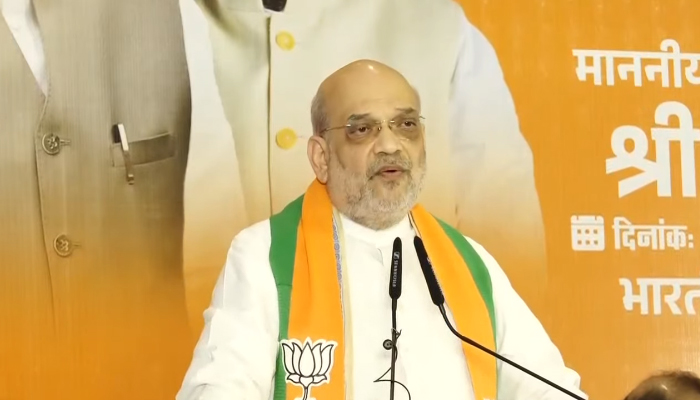
Amit Shah
(Union Minister of Home Affairs and Cooperation)
There have been many important moments in our country’s history when songs and arts, in various forms, played a crucial role in shaping movements by capturing public sentiments. Whether it was the war songs of Chhatrapati Shivaji Maharaj’s army, the songs of the freedom fighters, or the collective songs of the youth against the Emergency, these songs both inspired self respect and united Indian society. One such example is India’s national song, ‘Vande Mataram,’ whose history begins not on a battlefield, but with the quiet but unwavering resolve of a scholar, Bankim Chandra Chattopadhyay.
In 1875, on the day of Jagadhatri Puja (Kartik Shukla Navami or Akshaya Navami), he composed the hymn that became the eternal anthem of India’s independence. In writing these sacred words, he drew inspiration from India’s deepest civilizational roots. From the Atharva Veda’s clarion call “Mata B h u m i : P u t r o A h a m Prithviya:” to the invocation of the Universal Mother in the Devi Mahatmya.
This mantra of Bankim Babu was both a prayer and a prophecy. ‘Vande Mataram’ is not only India’s national song, not only the soul of the freedom movement, but also Bankim Chandra C h at t o p ad hyay ’s f i rs t proclamation of ‘cultural nationalism’. It reminded us that India is not just a piece of land, but a geo-cultural nation whose unity comes from its culture and civilization. It is not just a landmass, but a pilgrimage site, a sacred land bound by memory, sacrifice, bravery, and motherhood. As Maharishi Aurobindo described it, Bankim was a sage of modern India who revived the soul of the nation through his words.
His “Anandamath” was not just a novel, but a mantra in prose that awakened a nation that had forgotten its divine power. In a letter, Bankim Babu wrote: “I do not mind if all my works are washed away in the Ganges. This verse alone will live forever. It will be a great anthem and will conquer the hearts of the people.” These words were prophetic. Written during the darkest period of colonial India, “Vande Mataram” became the dawn song of awakening, a hymn that combined “cultural nationalism” with civilizational pride. Only someone whose very being was filled with devotion to the nation could have written such lines.
In 1896, Rabindranath Tagore set “Vande Mataram” to tune and sang it at the Kolkata Congress session, giving it voice and immortality. The song transcended the boundaries of language and region and resonated throughout the country. In Tamil Nadu, Subramania Bharati translated it into Tamil, and revolutionaries in Punjab sang it, openly challenging the British Raj. In 1905, during the Partition of Bengal movement, a rebellion broke out in Bengal. The British had banned the public recitation of Vande Mataram. However, on April 14, 1906, in Barisal, thousands of people defied this order. When police lathi-charged a peaceful gathering, men and women ran bloodied in the streets, chanting Vande Mataram.
From there, the chant of ‘Vande Mataram’ reached California with the Ghadar Party revolutionaries, echoed in the Azad Hind Fauj as Netaji’s soldiers marched from Singapore, and echoed in the 1946 Royal Indian Navy uprising, when Indian sailors hoisted the tricolour on British warships. From Khudiram Bose to Ashfaqulla Khan, from Chandrashekhar Azad to Tiruppur Kumaran, the slogan was the same. It was no longer just a song; it had become the voice of India’s collective soul.
Mahatma Gandhi himself acknowledged that ‘Vande Mataram’ had “the magical power to awaken even the dullest blood.” It united liberals and revolutionaries, scholars and sailors. Maharishi Aurobindo Ji, therefore, called it “the mantra of India’s rebirth.” On October 26th, during his “Mann Ki Baat” address, Prime Minister Narendra Modi once again reminded the nation of the history of the song “Vande Mataram” and announced that the Government of India will organize various programs starting November 7th for the next year to commemorate the 150th anniversary of the national song “Vande Mataram.”
These events will ensure that “Vande Mataram” will be sung in full across the country, enabling the young generation to imbibe the idea of “cultural nationalism.” Today, as we celebrate Bharat Parv and reverently remember Sardar Patel on his birth anniversary, we also recall how Sardar Patel embodied the spirit of “Vande Mataram” by creating “One India.” This song is not merely a reminder of the past, but also a call to action for the future. “Vande Mataram” continues to inspire our resolve for a developed India in 2047.
It symbolizes India’s civilizational self-confidence. Now, it is our responsibility to transform this spirit into a self-reliant and superior India. ‘Vande Mataram’ is the song of freedom, the spirit of unwavering resolve, and the first mantra of India’s awakening. Words born from the soul of the nation never die—they live forever, echoing through generations. This cry will continue to resonate across ages and generations for eternity. The time has come for us to view our history, our culture, our beliefs, and our traditions through the lens of Indianness. Vande Mataram
New Delhi: The Indian Navy’s guided missile stealth frigate INS Trishul has arrived at the United Kingdom’s Plymouth...

Chandigarh: The Aam Aadmi Party (AAP) Punjab on Sunday condemned the Delhi Police action against protesters in the...

Tehran: Iranian Foreign Minister Seyed Abbas Araghchi said on Sunday the US-Israeli attacks on Iran’s oil, refinery, and...
Bhopal: The CBI arrested an official of the CGST and Central Excise department in Bhopal for taking a...

New Delhi: Leader of the Opposition in the Lok Sabha, Rahul Gandhi, on Sunday released a video on...
Mumbai: Shweta Bachchan Nanda once opened up about how the entry of Aishwarya Rai changed the dynamics in...

Aries: The day will be auspicious...